

 45 minutes ago
6
45 minutes ago
6
ARTICLE AD BOX
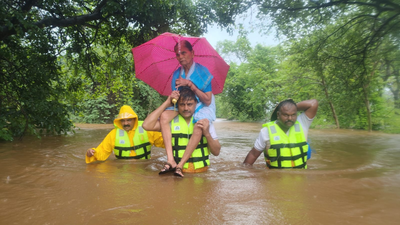
Image credit: x.com/RaigadPolice/
Every monsoon brings its own stories. Some are about flooded roads, submerged homes and disrupted lives. But once in a while, a story emerges that goes beyond rain and rescue operations.
It becomes a reminder of kindness.On a rain-soaked Sunday in Maharashtra's Raigad district, a police officer waded through waist-deep water carrying a 72-year-old woman on his shoulders. The image was simple, yet powerful. There were no dramatic speeches or heroic poses. Just an elderly woman who could not walk through dangerous floodwaters and a policeman who quietly decided that she would not have to.In a season often marked by destruction, that one moment became a symbol of humanity.The incident took place near Sarsai village along the Karjat-Pen Road after incessant rainfall caused the Patalganga River to cross its warning level. An MSRTC bus carrying eight passengers became stranded on a flooded stretch of road.According to Rasayani Police Senior Inspector Abhijit Bhujbal, an alert was received about the passengers trapped in the bus. The police immediately coordinated with members of the Help Foundation and launched a rescue operation.
All eight passengers were provided with life jackets and guided through nearly a kilometre of waterlogged road. But there was one challenge.A 72-year-old woman was unable to walk through the strong currents and waterlogged path.At that point, one police officer made a simple decision. He lifted the elderly woman onto his shoulders and carried her through the floodwaters until they reached safety.The photographs released later by Raigad Police showed the officer walking carefully through the muddy water, holding on to his responsibility in the most literal sense.
More than a rescue, it was an act of dignity
Disasters often expose people's vulnerabilities. For older adults, floods can be especially dangerous. In moments like these, dignity matters as much as safety.The image of a policeman carrying her did not become viral merely because it was dramatic. For that elderly woman and her family, the difference made on that rainy afternoon may never be forgotten.
Floods are becoming a growing threat for India's elderly
The incident also highlights a larger concern. Older adults are among the most vulnerable during natural disasters.According to the Government of India's National Disaster Management Authority (NDMA), senior citizens face greater risks during floods because of reduced mobility, chronic illnesses and difficulties in evacuation. The authority has repeatedly emphasised the need for special rescue measures for elderly and differently abled people during disasters.Police personnel are seen directing traffic, managing crowds or enforcing the law.
But during disasters, their roles change. They become rescuers, counsellors and sometimes the only source of hope for stranded families.The rescue in Raigad was not a large operation involving helicopters or sophisticated equipment. It was an example of something far simpler and perhaps more powerful: duty mixed with compassion.The Raigad Police, in a post on social media platform X, said the operation demonstrated the force's commitment to public service.
The photographs shared online quickly drew praise from people across the country.In difficult times, citizens remember these moments. They remember the officer who stood in the rain, the rescuer who arrived before help seemed possible, and the stranger who treated another person's life as precious.Disclaimer: This article is based on reports released by Raigad Police and media reports regarding the rescue operation in Raigad district, Maharashtra, on July 6, 2026. Information has been presented for public awareness and human-interest purposes. Readers are advised to follow official weather and disaster management advisories during flood situations.





 English (US) ·