

 4 days ago
6
4 days ago
6
ARTICLE AD BOX
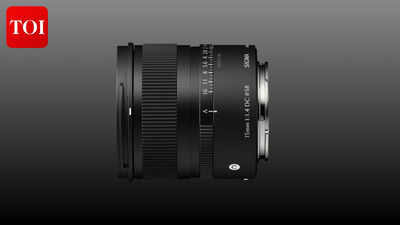
The Sigma 16mm always felt like too much lens. This one doesn't.
Some lenses you fight with. The old Sigma 16mm f/1.4 was one of them, not because it took bad pictures (it took lovely ones) but because it never quite believed in the camera it was bolted to.
You'd mount it on something small and it would sit there at 405 grams, nose-heavy, insisting you'd brought the wrong body. You learned to hold the rig by the lens. You learned to let the camera dangle.This one doesn't ask you to learn anything. It weighs 220 grams. We keep starting there because anyone who's held the old 16mm starts there too, and they're right to. The 15mm is a third shorter and roughly half the weight, takes a cheap 58mm filter, and on something like an X-M5 it stops being a lens with a camera attached and becomes a camera again.
You forget it's there. For a wide prime you're meant to carry all day and shoot from the hip, forgetting it's there is close to the entire point.The focal length is the quiet hero. Fifteen millimetres works out to about a 22. 5mm full-frame view on Fuji and Sony, a touch tighter at 24mm on Canon's crop. What that means in the hand is a lens that takes in a lot without bending it. Wide enough for a street with weather in it, an interior you can't back out of, a group of people who won't stand still—but it never does the thing ultra-wides do, where faces near the edge stretch and the verticals lean and every frame becomes a statement about being wide.
You point it, and the scene shows up looking roughly like you remember it. No drama. That's the lens.And then there's the f/1.4, which on a lens this wide isn't really about throwing backgrounds out of focus, whatever the marketing implies. It's about not needing light. Duck into a metro station, a bar going dim, a gallery lit for mood rather than photography, and you can keep your ISO somewhere sane and your shutter fast enough that a person walking through the frame stays a person rather than a smear.
You can get some separation up close, and the nine rounded blades keep the blur tidy, but the aperture's real job is the dark, and it's very good in the dark.
The flaws live in the blur
Stand close to a subject, open it up, and put something busy behind them (foliage is the classic trap) and the out-of-focus areas start to misbehave. A bluish-teal fringe creeps into the blur, a faint purple-green edge on the bright bits, and bokeh that should have melted instead gets a little anxious.
Fine, layered backgrounds like ferns or a hedge draw it out worst; a chrome detail caught close at f/1.4 will show it too.
It cleans up by f/2 and is largely gone by f/2.8, so it's a wide-open, close-up problem and nothing else. But if your thing is shooting people six inches from the glass with a tangle behind them, you'll meet it.There's a wrinkle here worth untangling, because the lens behaves like two different lenses depending on what you point it at.
Shoot a hard edge against a bright sky, a branch against cloud, a railing in sun, the place wide-angles usually smear red and cyan along every high-contrast line, and it stays clean. Genuinely clean. The colour creep that ruins so many wide lenses just isn't here. But the fringing does exist; it's simply moved.
It lives in the blur instead of the edges, close up, wide open, where you only find it once the background's gone soft.
So a lens that handles a sunlit skyline without a hint of colour can still leave a teal halo on a defocused twig a foot from the front element. The two aren't in conflict. They're different problems, and you meet them on different shots.The distortion is the other tax, and this one's pure software. The 15mm bends lines harder than the 16mm it replaces—over six percent of barrel if you measure it—and it leans on a correction profile to put them back straight.
Shoot JPEG or video and you'll never know; the fix happens before the image reaches you. Shoot raw and you'll see the bow, and early in a lens's life the profiles aren't always in the editing apps yet.
That's a temporary gap, not a permanent flaw, but if you live in raw it's worth knowing the lens isn't optically straight on its own. It's straight with help.
Contemporary stopped meaning compromise
What's strange, given the price, is how little it feels like a budget lens once it's in your hands.
The barrel's polycarbonate but solid, on a metal mount with a rubber gasket, sealed well enough for drizzle. Sigma's careful to say drizzle and not a downpour, the kind of warning that means someone drowned a prototype testing it. The front element sheds water and wipes clean in a pass. The aperture ring on the Sony and Fuji versions clicks in thirds with a real, considered resistance, and it doesn't drift when your coat catches it, which is the sort of thing you only notice when a lens gets it wrong.
Canon RF buyers get a control ring instead, programmable to whatever you like.The corners deserve a flag for the landscape crowd. Centre sharpness is excellent from f/1.4, no caveats, there the moment you open up. The edges are softer wide open and don't fully resolve until somewhere around f/4 to f/8, which sounds like a knock but isn't really, because f/8 is where you'd shoot a landscape anyway. And the field is flat, so when the centre snaps in, the corners come with it instead of curling away.
Stop past f/11 and diffraction starts smearing things back down, worse on the high-res Fuji sensors than the Sony ones, so treat f/16 as your sunstar setting rather than your sharp one.
The sunstars, for what they're worth, are lovely.Autofocus we have nothing to complain about, which is the highest praise autofocus gets. The stepping motor is quick and effectively silent, locks without hunting in dim rooms, and kept up with scooters and skateboarders well enough to bank keepers off erratic, turning-away movement.
Focus breathing is mild, present if you're pulling focus on a tripod and watching for it, invisible otherwise. There's no AF/MF switch on the barrel, no de-click for video, no custom button.
The lens is too small to wear them, and that's the trade you signed up for when you wanted something this size.
The one you leave on
The question is who needs it. Anyone with a small APS-C body and a Rs 50,000 budget who wants one wide, fast prime to leave mounted and stop thinking about. It focuses down to 17. 7cm, close enough to make a flower or a coffee cup the whole frame when you want, wide and bright enough to handle a city after dark, light enough to forget. It asks two things of you in return: run a profile when you shoot raw, and stop down a touch when the background gets fussy.
Do that, and it gets out of your way—which, for a lens you carry every day, is the most a lens can really do for you.






 English (US) ·