

 1 hour ago
5
1 hour ago
5
ARTICLE AD BOX
As Sikkim marks 50 years of statehood, Prime Minister Narendra Modi attended the closing ceremony and launched projects worth over Rs 4,000 crore. The milestone turns the spotlight on the covert intelligence operation by RAW under RN Kao that helped in the former kingdom's integration with India in 1975.
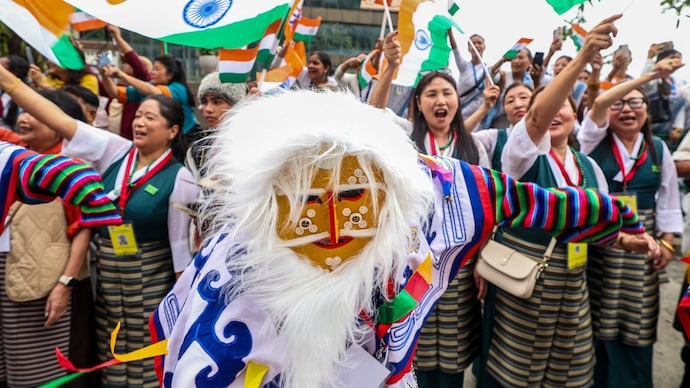
People in Gangtok on Tuesday take part in an event to mark Sikkim's 50th statehood celebrations. (Image: PTI)
It has been five decades since Sikkim joined the Indian Union, and the country is marking the closing ceremony of its golden jubilee celebrations on Tuesday. Sikkim officially became India's 22nd state on May 16, 1975. Prime Minister Narendra Modi is in the Himalayan state to attend the event and has unveiled developmental projects. But how Sikkim joined India and the 27-month-long covert operation that helped in its integration is a fascinating chapter in itself.
Even as celebrations continue and commemorations mark the milestone, there are many interesting facts about Sikkim that make it unique. The state underwent a carefully orchestrated political transition that changed its status from an Indian protectorate to full-fledged statehood.
Nestled in the eastern Himalayas between India, Nepal, Bhutan and China, Sikkim was once an independent kingdom ruled for over three centuries by the Namgyal dynasty's Chogyals, or God-Kings.
After India's Independence, Sikkim became a protectorate in 1950 under a treaty that gave New Delhi control over defence, foreign affairs and communications while allowing it self-rule.
The state lies in a strategic location, and before it became an Indian state, it was positioned as a buffer against China along the sensitive Sino-Indian border.
The erstwhile kingdom saw growing discontent among its ethnic Nepali majority, who resented the monarchy's feudal system and perceived favouritism toward the minority Bhutia-Lepcha communities. Modern India, which has never resorted to military conquests, relied on sophisticated intelligence-led diplomacy to integrate Sikkim peacefully.
Today, as PM Modi inaugurated and laid the foundation stone for multiple development projects worth over Rs 4,000 crore, the initiatives show India's focus on infrastructure, connectivity and economic growth in Sikkim.
HOW A RAW OPERATION MADE SIKKIM A PART OF INDIA
The story of Sikkim's integration was long shrouded in secrecy. The details came out for the first time when GBS Sidhu, a former special secretary in the Research and Analysis Wing (R&AW), wrote a book about it.
Sidhu was India's station chief in Sikkim's capital Gangtok during the early 1970s.
In his book, Sikkim Dawn of Democracy: The Truth Behind the Merger with India, GBS Sidhu, narrated how India's external intelligence agency ran a top-secret campaign for over two years to bring the Himalayan kingdom into the Union. Interestingly, not even top officials in India's Ministry of External Affairs (MEA) were aware of the RAW operation.
RAW led a meticulously planned covert operation that lasted for 27 months to secure Sikkim as India's 22nd state.
In April 1975, the mission reached its climax after a referendum. The referendum, held on April 14, 1975, asked Sikkimese voters whether they wanted to abolish the monarchy and merge fully with India. Official results showed an overwhelming 97.55% approval with a turnout of around 63%.
This outcome paved the way for the Sikkim assembly to pass a resolution for the kingdom's complete integration with India. China rejected the referendum outright, calling it a farce and an illegal "annexation", but India proceeded, viewing the popular mandate as decisive.
SIKKIM AND GEOPOLITICAL SITUATION IN THE 1970s
The early 1970s were a period of heightened regional tension for India. Though the victory in the Bangladesh Liberation War was fresh, India was still facing border issues with China. The wounds of the 1962 war were still unhealed.
Against this backdrop, ensuring stability on the northern Himalayan frontier was important.
The operation was launched in February 1973 by RAW founder and chief Rameshwar Nath Kao. This came after a request from then Prime Minister Indira Gandhi to bring Sikkim into India's fold.
Sidhu, who headed the secret three-member RAW team in Gangtok under the guidance of RN Kao and eastern regional director PN Banerjee, recalled in his book the extraordinary levels of secrecy involved.
"The operation was so secret that its ultimate objective of merging Sikkim with India was known only to three officials – Kao, Banerjee and myself," Sidhu wrote in his book.
"The two other R&AW officers in the special team in Gangtok – Padam Bahadur Pradhan and Myngma Tshering – were only briefed about the next phase of the operation when one phase was over," Sidhu had said in an interview to the South China Morning Post.
SIKKIM BEFORE IT BECAME A PART OF INDIA
Until 1975, Sikkim functioned as an Indian protectorate under the Chogyal Palden Thondup Namgyal, the 12th and last ruler of the Namgyal dynasty. The Chogyal's growing assertion of greater independence, reportedly influenced by his American second wife Hope Cooke, created friction with New Delhi.
Cooke, often described as encouraging the Chogyal to position Sikkim as the "Switzerland of the East", supported moves toward fuller sovereignty, including possible membership in international bodies like the United Nations. This stance alarmed India, which saw it as a potential opening for Chinese influence in a strategically vital buffer zone.
The kingdom's location near key passes such as Nathu La made it essential for India's border security. Granting "full sovereign rights" could have compromised India's control over defence and external relations, especially after China's occupation of Tibet and recurring border tensions.
India had long tolerated Sikkim's pro-democracy movements while maintaining a broadly pro-monarchy policy. This changed dramatically in late 1972.
According to Sidhu's book, Prime Minister Gandhi summoned Kao and her principal secretary PN Haksar to discuss the issue after the Chogyal proved uncooperative.
The Chogyal had been offered permanent association with India, with the possibility of India sponsoring Sikkim's entry into some UN organisations, but he insisted on full sovereign rights for his state. India could not accept this demand due to its strategic imperatives.
By September 1972, after one final unsuccessful offer to the Chogyal, India's policy underwent a "180-degree turnaround". When Sidhu assumed his post in Gangtok in February 1973, the secret plan to end monarchical rule and integrate Sikkim was already in action.
HOW RAW OPERATION GOT SIKKIM INTO INDIA'S FOLD
RAW's approach focussed on bolstering existing pro-democracy forces rather than direct intervention.
Sidhu described how the RAW provided discreet support and funding to political parties, particularly the Sikkim National Congress (SNC), to amplify their pro-reforms and anti-monarchy campaigns. These parties were advised secretly, though India's end goal was not revealed to most leaders.
"Only SNC chief Kazi Lhendup Dorji was taken into confidence because we trusted he would not spill the beans," wrote Sidhu in the book.
"The other politicians, many of whom were manipulated by the Chogyal, were slowly won over to the cause," Sidhu explained in his book.
"In July 1973, we had already launched the operation to lend support to anti-Chogyal and pro-democracy political parties and their leaders in Sikkim, especially Kazi Lhendup Dorji, to fulfil their long-cherished desire for political, economic and administrative reforms. The operation was to culminate in the merger of Sikkim with India. The last objective was to be achieved in stages and through constitutional means and as far as possible, through public support for elected leaders," Sidhu wrote.
INDIAN ARMY PLAYED A ROLE IN DISARMING SIKKIM GUARDS
The momentum built steadily. Pro-democracy agitation weakened the Chogyal's authority, leading to greater powers for the elected assembly and an eventual takeover of administration by Indian officials. Only once did the Indian Army play a direct role. In April 1975, just before the assembly moved the final resolution for merger, troops disarmed the pro-monarchy Sikkim Guards.
Sidhu noted this was necessary because intelligence indicated the guards might try to block the resolution or even harm pro-democracy leaders on the Chogyal's orders.
Throughout, the emphasis remained on political means and popular sentiment rather than force.
"So it would be unfair to call it annexation as some authors and foreign observers have. We just used popular feelings to achieve our objective. This was a political operation in which the military option was hardly exercised," Sidhu wrote.
After these records were declassified, former intelligence official Subir Dutta said, "Rarely has there been a more successful Indian intelligence operation than the merger of Sikkim."
Wedged between Nepal, Bhutan, China and India, Sikkim was of strategic importance for New Delhi. The integration has proved a win-win for both the people of the former kingdom and for India.
Half a century later, Sikkim stands as a thriving state within the Indian Union. PM Modi's visit, with its focus on celebrating this milestone and launching major development projects, highlights Sikkim's transformation from a protected kingdom to a fully integrated part of the world's largest democracy.
- Ends
Published By:
Anand Singh
Published On:
Apr 28, 2026 15:12 IST





 English (US) ·