

 1 hour ago
3
1 hour ago
3
ARTICLE AD BOX
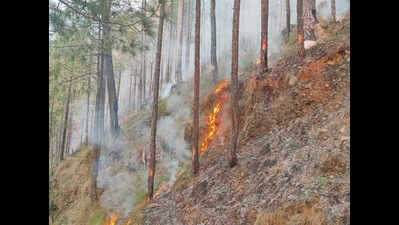
Researchers said rapid warming in Himalayan valley regions could intensify heat stress and contribute to forest fires, drying of water sources and ecological imbalance (TOI file image)
Dehradun: Srinagar in Pauri Garhwal recorded an AQI of 390 around 10am on May 20, pushing air quality into the “very poor” category, as forest fires, biomass burning and vehicular emissions added pollutants to stagnant air in the mountain valley, researchers at HNB Garhwal University said on Tuesday.
The reading was part of a scientific analysis of weather changes, AQI and black carbon levels between April 6 and May 20.The analysis was conducted by researchers at the Himalayan Atmospheric and Space Physics Research Laboratory (HASPRL) of the department of physics and shared in the fourth information bulletin on current weather changes and air quality. HNB Garhwal University’s website also listed the bulletin on the scientific analysis of weather, AQI and black carbon levels in Srinagar Garhwal during May 2026.Researchers said AQI, which reflected PM2.5 and PM10 levels, remained in the moderate category between May 6 and May 8, with values ranging from 83 to 116. It deteriorated from May 9, when AQI rose to 157, and reached 215 on May 10, entering the poor category. After a brief improvement on May 11 and May 12, the reading again climbed to 178 on May 13, 176 on May 14 and 230 on May 18.The sharpest deterioration was recorded on May 19, when AQI rose to 356.
By the morning of May 20, the index had touched nearly 390. Central Pollution Control Board classifies AQI between 301 and 400 as “very poor” and 401 to 500 as “severe”.“This is the first such instance when AQI has touched 390 in Srinagar. Forest fires, biomass burning and vehicular pollution can be directly linked to it. AQI generally hovered between 80 and 120, but this month it kept moving beyond 300,” said Alok Sagar Gautam, senior assistant professor, department of physics.Researchers said weak western disturbances had not helped disperse pollutants. Instead, they trapped stagnant and polluted air in the valley, worsening the impact of smoke and emissions. The Forest Survey of India’s fire portal recorded active fire details in Pauri Garhwal in May, including Diba range of Garhwal forest division on May 14, during the period covered by the university’s analysis.The bulletin also recorded a sharp rise in temperature during the observation period.
Maximum temperature rose from around 27.19°C on May 7 to nearly 38.95°C by May 19, an increase of almost 12°C in less than two weeks. Researchers said rapid warming in Himalayan valley regions could intensify heat stress and contribute to forest fires, drying of water sources and ecological imbalance.They said extremely hot conditions between May 15 and May 20 intensified atmospheric instability and environmental degradation.
The combination of high temperature, fluctuating humidity and declining atmospheric pressure created conditions in which pollutants accumulated closer to the surface. The max average black carbon concentration was observed between May 18- 20 of around 1928 ng/m3.Professor Trilok Chandra Upadhyay, head of the department of physics, said the bulletin was aimed at linking scientific research with public welfare. He said studies on air quality, climate change and Himalayan environmental systems were becoming increasingly important and could help improve public awareness and policy planning.









 English (US) ·