

 4 hours ago
4
4 hours ago
4
ARTICLE AD BOX
Residents pelted stones at officials and police personnel as over 200 houses in Mumbai's Garib Nagar slum cluster were razed on Wednesday in a Bombay High Court-backed demolition drive. The large-scale eviction drive is part of a major suburban rail expansion project aimed at easing congestion on Mumbai's overcrowded local train network.
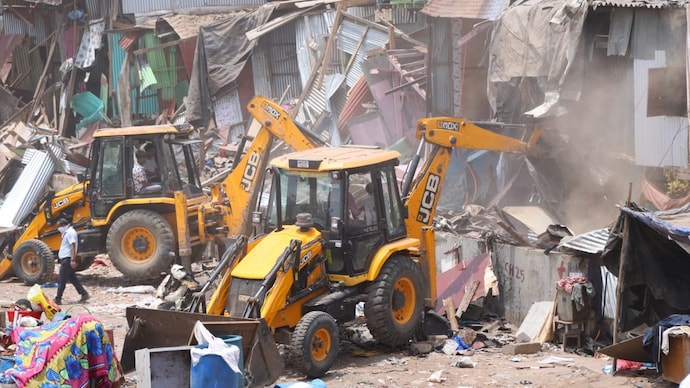
Stone-pelting was reported during the eviction drive at Mumbai's Bandra East slum cluster, Garib Nagar. (Image: Western Railway)
New Delhi,UPDATED: May 20, 2026 20:10 IST
A Bombay High Court-ordered demolition drive in Mumbai's Bandra East slum cluster, Garib Nagar, turned violent on Wednesday as residents pelted stones at officials and police personnel carrying out the anti-encroachment operation. Police resorted to a lathi charge to disperse the crowd, and several arrests were made.
The drive, being conducted by Western Railway, aims to remove over 400 unauthorised structures, including an illegal religious structure, built on railway land near Bandra East station. The operation follows a Bombay High Court order and is expected to continue for at least the next two days.
A source present at the Garib Nagar demolition site on both Tuesday and Wednesday told India Today Digital that emotional scenes unfolded throughout the day as bulldozers razed homes. Families watched helplessly while their houses were brought down, with many residents breaking down in tears. Women and children were seen pleading with officials amid the chaos and uncertainty about their future.
According to Western Railway, only about 100 residents identified as eligible in surveys conducted in August 2021 qualify for rehabilitation. These families will be provided alternative accommodation. The remaining structures are considered illegal encroachments on railway property.
A senior local journalist, who has covered Mumbai's transport beat for over a decade, said on condition of anonymity that the eviction was inevitable. "These slums were over 70 years old. It is the two-three storey structures that are being pulled down now. While it is very emotional to see people's houses being reduced to rubble, but they were built on Western Railway land. People lived here for generations, but the railway treats them as squatters. This is a sign of how Mumbai will change over the years," he said.
The journalist added that nearly half of Mumbai's population lives in slums. "This is not how [with slums] a city can work if it has to become a global city and compete with Dubai and Tokyo and New York, and that is unfortunately the truth. But at the same time, this is also how Mumbai works. If you remove Garib Nagar and Dharavi and the dozens of slum clusters, Mumbai won't be able to sustain itself. It doesn't rest, sleep, or stop because it's these pockets that keep working."
The cleared land, spread over roughly 500 metres hugging the tracks, will be used to expand the fifth and sixth railway lines on the Santacruz-Mumbai Central corridor. This will help run 50 new originating trains from Mumbai, ease severe congestion on suburban services, better connect Bandra suburban station with Bandra Terminus, and segregate local and long-distance trains.
The project also supports commercial redevelopment of nearby railway land. The demolition comes as Mumbai pushes ahead with major infrastructure upgrades, including the Mumbai-Ahmedabad Bullet Train station coming up in neighbouring Bandra Kurla Complex (BKC).
Authorities had pointed out that the drive is necessary for track safety, as encroachments and waste dumping pose risks to railway operations. The Bombay High Court had noted these safety concerns while allowing the action, but also directed protection for eligible slum dwellers.
The eviction drive in Garib Nagar shows how fate can deal a heavy blow to hundreds of lives in the City of Dreams.
But Mumbai's infrastructure is changing rapidly, and the upper middle class and the affluent have long called for the removal of slums because their apartments worth crores overlook the shanties. While infrastructural development is important, what is perhaps more important is rehabilitating those who lose everything overnight — the very people who make Mumbai the city it is.
- Ends
Published By:
Anand Singh
Published On:
May 20, 2026 20:10 IST








 English (US) ·