

 1 hour ago
6
1 hour ago
6
ARTICLE AD BOX
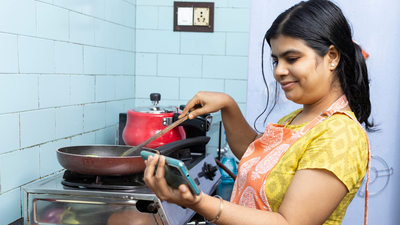
For generations, millions of Indian women have woken up before everyone else in the family and gone to bed after everyone else. They cook, clean, care for children, look after elderly parents, manage homes, provide emotional support, and keep households running smoothly.
Yet, when someone asks them what you do, they say "I'm just a housewife." That word "just" has carried the weight of an entire gender's invisible labour for a long time.Last week, the Supreme Court looked at that invisible mountain of work and put a number on it.
6 May 2026 | 16:56
What are the three things that make you instantly happy?
Rs 30,000 a month. In a landmark judgment that could change how India views unpaid household labour, the Supreme Court has given legal recognition to the work of homemakers, describing them as "nation builders" and fixing a notional monthly income of Rs 30,000 for their domestic care services in motor accident compensation cases.
While the number itself made headlines, it's what the judges said around it that's making women across the country sit up and take notice.
"Homemakers are nation builders"

Image: Canva
Hearing an appeal in a motor accident compensation case, a bench of Justices Sanjay Karol and N Kotiswar Singh made key statements. The court noted that homemakers play a significant role in shaping families and society. Justice Karol said homemakers contribute not only to households but to the development of individuals and the country itself.
“Housewives contribute to the household. They are nation builders.
They build the nation," the court observed.The judges said the term "homemaker" should now be understood in a much broader sense, one that recognises the immense social and economic value of unpaid care work.
Why the court fixed ₹30,000 a month
Here's the thing about accident compensation cases: when a working person dies or is disabled, courts calculate the family's loss based on their income.
Unlike salaried professionals, homemakers do not receive a monthly paycheck. But what happens when the homemaker dies? Because unlike salaried professionals, homemakers do not receive a monthly paycheck.For years, this created a legal blind spot. Families would lose a mother, a wife, a daughter and courts would struggle to put any meaningful value on what that family had actually lost. The Rs 30,000 figure is the court's attempt to close that gap.
The court clarified that this amount would act as a baseline for calculating compensation. If a homemaker was also engaged in paid employment, compensation for loss of domestic care would be calculated in addition to her proven income.
The invisible work that keeps families together

Image: Canva
Perhaps the most powerful aspect of the judgment is its recognition that a homemaker's contribution cannot be measured only through household chores. The court noted that homemakers provide care, emotional support, guidance, stability, and nurturing.
These services cannot simply be replaced by hiring domestic help. The judges also compared a homemaker to a potter shaping clay. Just as a potter carefully moulds raw clay into something useful and beautiful, homemakers help shape families, values, and future generations.The court also acknowledged that behind every successful professional, entrepreneur, politician, artist, or worker, there is often a homemaker whose contribution remains largely unseen.
A recognition women have long deserved
For decades, women's unpaid labour has remained absent from traditional measures of economic productivity. The Supreme Court referred to data showing that women spend significantly more time on unpaid domestic and caregiving work than men. Even women who work outside the home often continue to shoulder the majority of household responsibilities. Despite this, household work rarely finds a place in discussions around income, GDP, or economic contribution.
So what changes now?
Legally, the judgment will affect how compensation is calculated in motor accident cases. Socially, however, its impact may be much larger. For the woman who's spent years being a homemaker, there's something quietly powerful about the country's highest court saying, on the record: this is work. It has value. It builds nations.Is Rs 30,000 anywhere close to what that work is actually "worth"? Almost certainly not, ask any working parent what it costs to replace a cook, a nanny, a tutor, a counsellor, and a project manager, all rolled into one person, and the number would be far higher. But for the first time, the conversation has a starting point. And sometimes, that's exactly what's needed to shift how a whole society sees the women who've been holding it up all along.









 English (US) ·