

 1 week ago
9
1 week ago
9
ARTICLE AD BOX
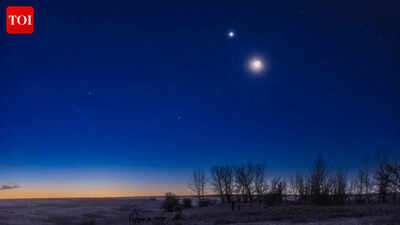
Skywatchers are in for a celestial treat tonight!Look up at the sky tonight, and you’ll get a glimpse of a real show. The crescent moon is linking up with three planets right after sunset.
The cosmic gathering, visible shortly after sunset, will transform the western sky into a dazzling planetary parade.
Unlike many astronomical events, no telescope is needed for this one — just a clear view and a few minutes outside.Picture it: a skinny crescent moon sitting close to bright Venus, mighty Jupiter, and the usually hard-to-find Mercury, all stacked low above the western horizon. If you’ve got a camera or even just your eyes, the whole thing will feel like some cosmic parade.In fact, per astronomers, this one’s a particularly special event because it brings together some of the brightest objects visible in the night sky.
What’s happening?
As Space underlined, over the past week, Venus and Jupiter have been putting on a show, hanging out really close together in the evening sky. Mercury, which usually keeps a low profile near the Sun, has joined the lineup.Now, the crescent moon is adding to the arrangement, tying the whole thing together — all four, bright and easy to spot after sunset.
Of course, they’re not actually clumped together; each one floats millions of kilometers apart. It’s just that, from our angle here on Earth, the orbits line up in a way that makes them all appear in the same slice of sky.Venus is impossible to miss, shining away as the “Evening Star.” Jupiter is nearby, king-sized and bright. Mercury is the trickster, as it’s usually a tough spot, close to the horizon, and fainter than the other two.
The thin moon ties it all up with a bow.
Who gets a glimpse of this planetary parade?
Per Space, the event is visible from much of the world, including North America, South America, Europe, Africa, Asia, and Australia. Just head outside right after sunset and look toward the west. Venus will be the brightest object, Jupiter will shine steadily nearby, Mercury will sit lowest to the horizon, and the Moon will be right beside them.The lower your view is to the horizon (think rooftop, beach, field), the better.
City lights can drown out dim objects, but Venus and Jupiter are so vivid that they still punch through. Mercury’s a little tougher, so if you’re in the countryside, you’ve got an edge.
What’s the best time for planet watching?
You’ll want to be looking between 30 and 60 minutes after sunset. That’s when the sky is dark enough for the planets, but before they duck below the horizon. Catching Mercury is especially time-sensitive. So if you wait too long, it’s gone.
Venus pops out first; Jupiter follows, and Mercury’s your last challenge. The moon will help your eyes find the bunch.Do you need a telescope to watch?Not really. Your eyes are enough!If you have binoculars, don’t use them until the Sun is completely down. Got a smartphone or camera? You’ll probably get a pretty cool shot.Cosmic alignments in the sky aren’t really rare. But seeing three planets and that perfect crescent packed so close together creates a scene you just don’t get every day. Plus, Mercury’s at its best right now. So, if you’re a skywatcher, this is your moment to cross it off your list finally.When you step outside tonight, you won’t just be stargazing — you’ll be catching a blink-and-you ’ll-miss-it dance choreographed by the solar system itself!









 English (US) ·