

 1 hour ago
3
1 hour ago
3
ARTICLE AD BOX
India's most significant port project is a geopolitical project of enormous ramifications.
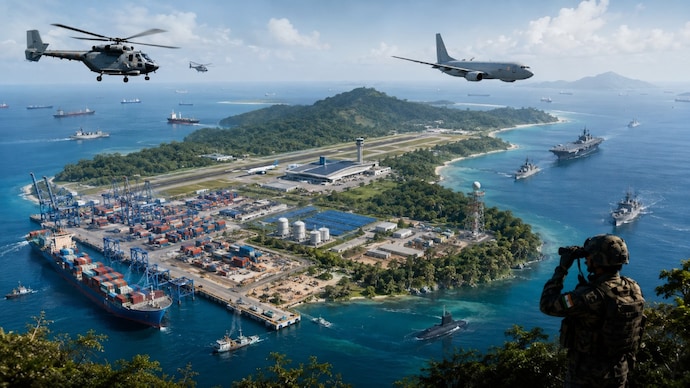
The Great Nicobar Project seeks to transform the island into a strategic maritime and economic hub. (AI-generated image)
India's mammoth project to build a transshipment port on the Great Nicobar Island has sparked controversy, with Leader of the opposition Rahul Gandhi calling it "destruction dressed in development language". Defence analysts have questioned the commercial utility of a project 1,400 kilometres away from the Indian mainland.
The Great Nicobar Project seeks to transform the island into a strategic maritime and economic hub by leveraging its proximity (about 40 nautical miles) to the East-West shipping route and reducing India's dependence on foreign transshipment ports.
The core of the project is a 14.2 million twenty-foot equivalent unit (MTEU) International Container Transshipment Terminal (ICTT) at Galathea Bay which will reduce India's reliance on foreign ports like Singapore and Colombo for transshipment. Other elements include a Greenfield International Airport (4,000 Peak Hour Passengers), a 450 MVA gas-solar power plant, and a planned township. The first phase of the project is due for completion by 2028.
The Rs 75,000 crore project is located just 40 nautical miles from one of the world's most critical maritime arteries, carrying 50 per cent of global container traffic and roughly 80 per cent of global seaborne oil trade. It transforms India from being a mere observer in the Association of South East Asian Nations (ASEAN), into a key participant in the influential economic grouping. This is only one of the reasons that makes the GNI one of the most significant geo-strategic projects ever attempted by India.
THE MALACCA DILEMMA
The 921-square kilometre Great Nicobar Island is India's southernmost territory. It is a third the size of the state of Goa, and is located near the Six Degree Channel — the primary trade route exiting from the narrow funnel of the Malacca Strait. Nearly 80 per cent of China's energy supplies pass through this critical maritime chokepoint, leading Chinese President Hu Jintao to coin the term "Malacca Dilemma" in 2003.
In this Chinese dilemma lies an Indian opportunity — India maintains seven small military bases on the Andaman and Nicobar Islands, including an airstrip, INS Baaz in Campbell Bay on the Great Nicobar Island. A tri-services theatre command established here in 2001 integrates land, air and naval assets. An Indian submarine based in the Andaman Islands would take just five days to arrive at the chokepoints of the Indonesian islands, roughly half the time it would take from Visakhapatnam.
Yet, even after 25 years, India has not based major warships, fighter aircraft, submarines or long-range Anti-Submarine Warfare (ASW) aircraft on these islands. Common reasons include a lack of fuel storage facilities, docking and repair facilities for warships and submarines. It is a chicken and egg conundrum.
Critics of the project prefer to see the GNI as a purely commercial venture delinked from the need to build up military infrastructure on the islands.
But what if GNI were a cleverly disguised dual-use project? A military project to dominate what is one of the world's seven choke points camouflaged as a benign civilian transhipment project. There are some clues that this is indeed the case. The civilian airfield on the project is clearly marked as a dual-use facility, meaning it is meant for use by military aircraft.
A dual-use strategic project should not surprise anyone. India has always hidden strategic programs under civilian cover. The nuclear weapons program was camouflaged by a civil nuclear program. The nuclear-powered ballistic missile submarine (SSBN) program, was disguised as a naval propulsion reactor program to power a nuclear-powered attack submarine (SSN), a tactical asset.
To western scholars, this dual policy might seem exasperating. India does not issue white papers on national security and has few well-defined national security doctrines. The few papers that are written, cause shock when they are revealed, decades later.
In the PN Haksar papers declassified a decade ago, for instance, we see an early articulation of the end state of India's nuclear weapons program. The papers authored by then Prime Minister Indira Gandhi's close aide in 1968, clearly articulated the need for nuclear-tipped inter-continental ballistic missiles (ICBMs) and SSBNs to target the population centres of Eastern China.
When the GNI project is seen through a straw, it appears to be a lonely, indefensible island outpost. The story of blind men feeling different parts of the elephant comes to mind. When the blindfolds are discarded, a bigger picture emerges — of an Indian strategy to create a "first Island chain" around the peninsula. A network of bases starting from the Andaman and Nicobar Islands extending in a sweep across the Indian Ocean — a base on Agalega Island in Mauritius, a proposed base on Assumption Island in the Seychelles, and a naval base on Minicoy Island in the Lakshadweep Islands.
It is a bold Indian project meant to challenge China’s naval dominance of the Indo-Pacific. This strategy is a modest version of the current US strategy to militarise its abandoned island fortresses in the Indo-Pacific like Titian, Guam and Palau or even China’s creation of 15-square kilometres of artificial islands to create a defensive perimeter in the South China Sea.
In a 2022 paper "Reorienting Indian Military Grand Strategy", Rear Admiral Raja Menon, one of India's foremost strategic thinkers, calls the GNI project the fulcrum of India’s response to the growing Chinese naval presence in the Indo-Pacific and a means to offset the pressure by the Chinese along the Line of Actual Control (LAC).
"If we have to establish superiority over the Malacca Straits, we need a place where we can establish information dominance, a kind of Indian Pearl Harbour (the giant US base in the Pacific). And that is where the GNI project comes in. We need to be there 24/7 over the Malacca Straits, not only establishing information dominance but also denying the enemy information dominance," Menon said.
The ongoing Hormuz crisis demonstrated the advantage of controlling key transport routes. Iran, with a non-existent navy and practically no Air Force, continues to control one of the world's most important energy arteries. This is not to suggest that a GNI project will turn India into a regional hegemon; rather, it is one that will enable New Delhi to exercise credible military options in a crisis.
Indian warships, submarines and anti-submarine aircraft based in GNI are closer to three other critical deep-water maritime passages — The Ombai-Wetar Straits, the Sunda and the Lombok Straits. These are critical, deep-water maritime passages in the Indonesian archipelago which serve as vital alternative shipping routes to Malacca and key linkages between the Pacific and the Indian Oceans. The Lombok Strait, for instance, is a deep passage preferred by supertankers and submarines as they transit to the waters of the Indian Ocean.
The GNI is also close to the "land bridge" project to link two ports on either side of the Kra Isthmus in southern Thailand, which will allow shipping vessels to bypass the congested Strait of Malacca by shaving approximately 1,200 km and several days off maritime journeys. Vessels from the land bridge project will pass through the 10 degree channel between the Andaman and Nicobar Islands.
EASTERN WALL OF INDIA'S BASTION
A robust Indian presence on the GNI could also be a key enabler of India's nuclear strategy that relies on a triad of land, air and sea-launched weapons. The sea leg relies on a small but growing fleet of Arihant class SSBNs. These submarines are built in Visakhapatnam and will eventually be based in underground pens carved into a granite mountain in Rambilli, over 60 kilometres south of Visakhapatnam. The base will allow submarines to stealthily enter the Bay of Bengal. It is difficult to spot submarines once they sail out into the open ocean. Hence, SSBNs form the most secure and survivable leg of the nuclear triad.
The current missile ranges of the K-4 missiles, around 3500 km, mean the Arihant class submarines will need to launch their missiles from the northern and eastern parts of the Bay of Bengal and the Andaman Sea. Newer submarines of the S-5 project that are under construction will fire longer-ranged missiles like the K-5 and K-6 from the centre of the Bay of Bengal. The Bay thus becomes crucial to India's sea-based nuclear deterrent, a bastion from whose safety Indian SSBNs can target both its nuclear-armed adversaries.
This fact has not been lost on the Chinese who have surged oceanographic vessels and spy ships into the Indian Ocean Region. Recently, Chinese Unmanned Underwater Vehicles (UUVs) or gliders have been recovered near Indonesian waters near the Lombok Strait.
It would not be unreasonable to expect that the Chinese have already planted such "listening devices" on the seabed near India. In times of conflict, these could be used to locate Indian submarines which could then be interdicted by roving Chinese submarines. It thus becomes vital for India to base ASW aircraft on the Andaman Islands from where they can detect and track Chinese submarines.
Currently, only the eastern shores of this "Indian lake" are defended. The dual-use GNI will anchor the southern end of a chain of island fortresses and airfields on the Andaman and Nicobar Islands. Indian ASW aircraft can detect and track Chinese warships and submarines entering the Bay of Bengal. A well-developed GNI island fortress thus becomes extremely vital for India’s great power ambitions well into the middle of the 21st century.
- Ends
Published By:
Sahil Sinha
Published On:
May 16, 2026 08:00 IST









 English (US) ·