

 1 hour ago
3
1 hour ago
3
ARTICLE AD BOX

For more than a century, global power has often flowed not just from armies or governments, but from tightly knit financial networks — from dynasties like the Rothschilds in Europe to the Rockefellers in the United States, whose influence helped shape modern capitalism, oil markets, and geopolitics.
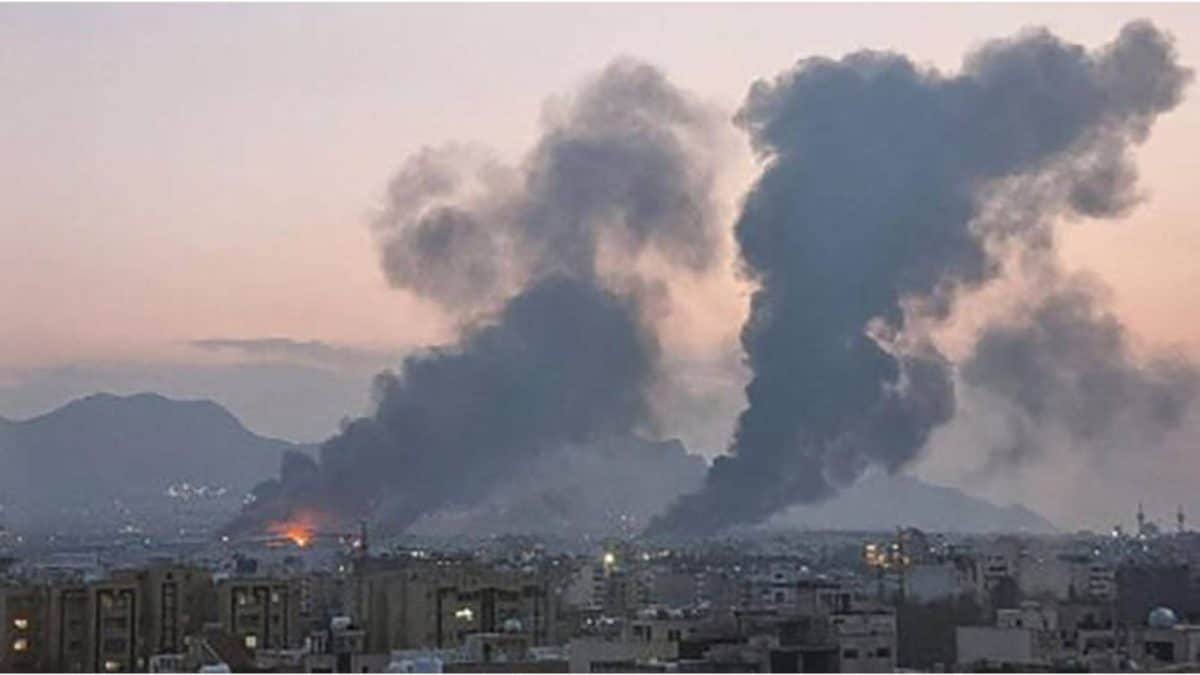
In 2012, when RIT Capital Partners linked with Rockefeller Financial Services, it symbolised how legacy power adapts, consolidates, and survives across generations.In today’s fractured geopolitical order, a similar model — though far more opaque and operating in the shadows — appears to be unfolding in Iran.The United States and Israel on February 28, 2026 launched an offensive against Iran, driven by concerns ranging from Tehran’s nuclear ambitions to pressure from the Benjamin Netanyahu-led government.
Yet after more than three weeks of sustained operations across the Gulf, despite deploying a substantial portion of their military capability, both countries have struggled to decisively weaken Iran’s strategic backbone.Part of the answer may lie far from the battlefield — in a glass tower office on the 38th floor of ICD Brookfield Place in Dubai. From here, a shadowy figure known only as “H” or “Hector” is believed to oversee a sprawling network that moves oil, money, weapons, and influence across continents.
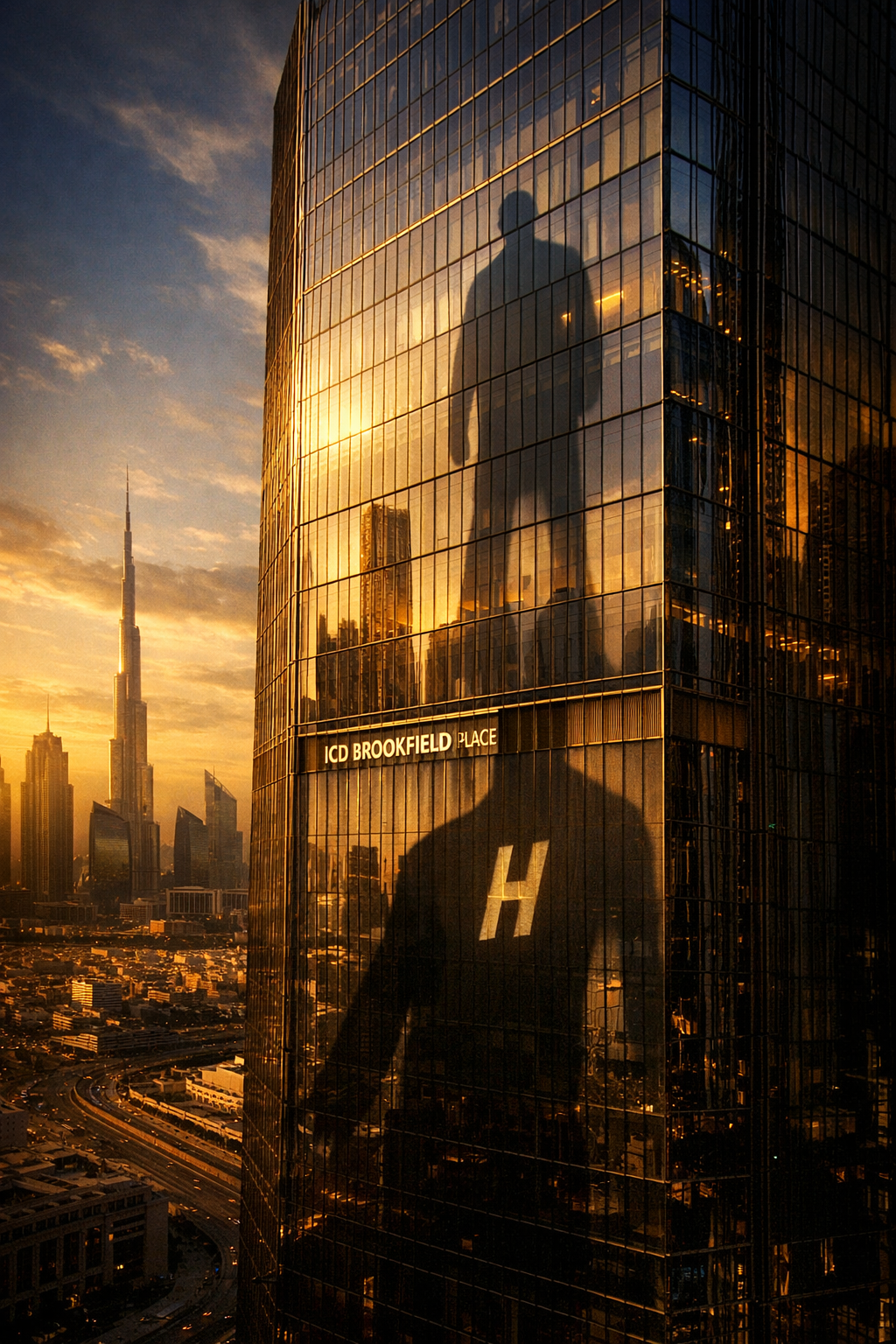
A Bloomberg investigation, based on testimonies from more than three dozen individuals and internal documents, identifies “H” as Hossein Shamkhani — the son of one of Iran’s most powerful insiders — and, according to US and European authorities, the architect of one of the largest sanctions-busting oil empires in the world.
Revolution, oil, and the birth of a system
The origins of Iran’s modern power structure — and by extension, the rise of figures like Hossein Shamkhani — are inseparable from the events of 1979.
The Iranian Revolution was not merely a political upheaval; it was an economic reset. It dismantled a monarchy accused of hoarding oil wealth among a narrow elite and promised a more equitable redistribution of resources. But over time, the system that replaced it evolved into something strikingly familiar — a concentration of power and wealth, albeit under a different ideological framework.“Iran has been a single product economy mainly, for much of its history, right after the discovery of oil in 1908,” said Mehrzad Boroujerdi, underlining how deeply hydrocarbons are embedded in the country’s political DNA.
Oil was never just an economic asset; it was the foundation of state authority, foreign policy leverage, and internal legitimacy.In the immediate aftermath of the revolution, control over oil became synonymous with control over the state. The newly formed Islamic Republic moved swiftly to nationalise assets, purge Western influence, and centralise decision-making. But the outbreak of the Iran-Iraq War in 1980 altered that trajectory.
The war forced Tehran to rely heavily on the Islamic Revolutionary Guard Corps (IRGC), transforming it from a revolutionary militia into a powerful military-economic institution.Over time, the IRGC expanded far beyond its original mandate. It entrenched itself in infrastructure, construction, telecommunications, and, crucially, the oil and shipping sectors. This militarisation of the economy created a hybrid system — part state-controlled, part informal — where official structures coexisted with opaque networks operating beyond public scrutiny.Sanctions, first imposed in waves after the revolution and later intensified over Iran’s nuclear programme, accelerated this transformation. Rather than crippling the system, they reshaped it. Cut off from formal global markets, Iran developed parallel channels to sustain its most vital revenue stream.“Because of sanctions, the Iranian regime is in dire need of middlemen,” Bloomberg’s reporting notes. “These folks have played a crucial role in bypassing sanctions against Iran and Russia.”This necessity gave rise to a new class of actors — intermediaries who could operate across borders, navigate legal grey zones, and maintain plausible deniability. They were not entirely outside the state, nor fully within it. Instead, they functioned in the space between — protected by political connections, yet structured as private entities.It is within this ecosystem that the concept of Aghazadeh took shape — the children of powerful officials who inherited not just influence, but access to opportunity.
As the Iranian state grew more insular, trust became a premium commodity. Entrusting critical economic operations to insiders and their families reduced risk, ensured loyalty, and maintained control.“The regime learned they need to rely on folks that they can actually trust, and who is better than family members of key regime officials?” said Miad Maleki, a former US Treasury official.The result was the emergence of a shadow economy layered atop the formal one — an intricate web of front companies, intermediaries, and logistics networks designed to keep oil flowing despite sanctions.
Over decades, this system matured, becoming more sophisticated, more global, and harder to trace.By the time Hossein Shamkhani entered the scene, the blueprint had already been laid. What he would go on to build was not entirely new — but it was масштабed, industrialised, and globalised in a way that reflected the next phase of Iran’s sanctions-era evolution.In many ways, the revolution did not eliminate the concentration of oil wealth.
It restructured it — embedding it within a system where political power, military influence, and economic control became inseparable.
The father: Ali Shamkhani and the architecture of power
To understand the scale and sophistication of Hossein Shamkhani’s network, one must first examine the career of his father, Ali Shamkhani — a figure who embodies the fusion of military authority, political influence, and economic access in post-revolution Iran.Born into modest circumstances, Ali Shamkhani rose rapidly during the revolution, joining the Mansouroun militant group that later aligned itself with Ayatollah Khomeini.
His early role as a revolutionary enforcer gave him proximity to the new leadership at a time when loyalty was rewarded with power. That trajectory continued with his integration into the Islamic Revolutionary Guard Corps (IRGC), where he would go on to command Iran’s navy during the Iran-Iraq War — a conflict that cemented the IRGC’s central role in both defence and economic activity.Over the next four decades, Shamkhani occupied some of the most critical positions in Iran’s establishment, including defence minister and secretary of the Supreme National Security Council.
In these roles, he was not only involved in military strategy but also in shaping Iran’s regional posture and managing sensitive diplomatic channels. Even after stepping down from formal office, he retained influence as a senior adviser to Supreme Leader Ayatollah Ali Khamenei.Crucially, his long tenure in maritime command and national security granted him intimate knowledge of Iran’s ports, shipping lanes, and covert logistics networks — the very infrastructure later used to bypass sanctions.
As analysts quoted by Bloomberg suggest, figures like Shamkhani “know where all the bodies are buried” when it comes to sanctions evasion.This combination of institutional authority and operational insight created a powerful legacy — one that extended beyond the state itself. It provided the foundation upon which the next generation, including his son Hossein, could build a far more global and financially sophisticated system.
The rise of the ‘Aghazadeh’ and The making of ‘Hector’
In Iran’s political lexicon, the term Aghazadeh — literally “children of the elite” — captures a defining feature of the Islamic Republic’s evolution: the quiet transfer of power from revolutionary figures to their offspring. These individuals inherit more than privilege. They inherit access, trust, and the ability to operate within a system where the boundaries between state authority and private enterprise are deliberately blurred.“The regime learned they need to rely on folks that they can actually trust, and who is better than family members of key regime officials?” said Miad Maleki, a former US Treasury official.Hossein Shamkhani’s trajectory fits squarely within this pattern. First introduced to the public in 2008 during a television appearance alongside his father, he appeared reserved, almost reluctant — a young man seemingly distant from the corridors of power he was born into.
Yet even then, observers sensed that his future would not be ordinary.“He looked very sharp and somehow shy,” recalled Mehrzad Boroujerdi. “It was very clear to me… being the son of Ali Shamkhani he's probably sitting on top of some huge economic enterprise somewhere.”That early perception would later crystallise into reality. Rather than entering formal politics, Shamkhani moved into the private sector — a space that, in Iran’s sanctions-era economy, offers both opportunity and deniability.
Over time, he began assembling a network of companies that operated across jurisdictions, quietly expanding in scale and complexity.By the early 2020s, this network had taken a more defined shape through entities like the Dubai-based Milavous Group. But even as the business grew, its leadership remained deliberately obscured.“What struck me the most was just the mystery around the owner,” said Bloomberg reporter Ben Bartenstein.
“The code names we started to hear were H or Hector.”Inside the organisation, secrecy was institutionalised. Employees either did not know who was in charge or were discouraged from asking. Internal systems referred to the top boss simply as “H/Hector”, reinforcing an aura of distance and control.“There was a bit of a concern about how powerful this individual was that they worked for,” Bartenstein noted.As Bloomberg pieced together testimonies, documents, and internal communications over months of reporting, a clearer picture emerged.
The elusive “H” — the figure directing strategy, approving financial decisions, and shaping the network’s expansion — could, in their assessment, be traced back to a single individual.“H could really only be one person, Hossein Shamkhani.”In that transformation lies the essence of Iran’s modern elite: a generation that has moved beyond ideological legitimacy to operational dominance — not through public office, but through control of networks that span continents, currencies, and conflicts.
Mapping the empire: A global network of oil, money and ships
What distinguishes Shamkhani’s operation is not just its scale, but its structure.According to US Treasury findings, intelligence mapping, and Bloomberg reporting, the “Shamkhani Network” spans more than 100 entities, vessels, and intermediaries across multiple jurisdictions.
.
The US described it as: “a vast fleet of vessels, ship management firms, and front companies — some posing as legitimate financial services firms — that launder billions in profits from global sales of Iranian and Russian crude oil.”At its core, the network functions through layered concealment:
- Front companies purchase Iranian and Russian oil
- Documents are falsified to obscure origin
- Ships frequently change ownership and flags
- Payments are routed through shell entities
- Profits are reinvested through hedge funds
Treasury officials say the network controls “a significant portion of Iran’s crude oil exports”.
.
Kharon, a risk intelligence firm, mapped the network into three key pillars:
1. The string-puller: Admiral Group and logistics web
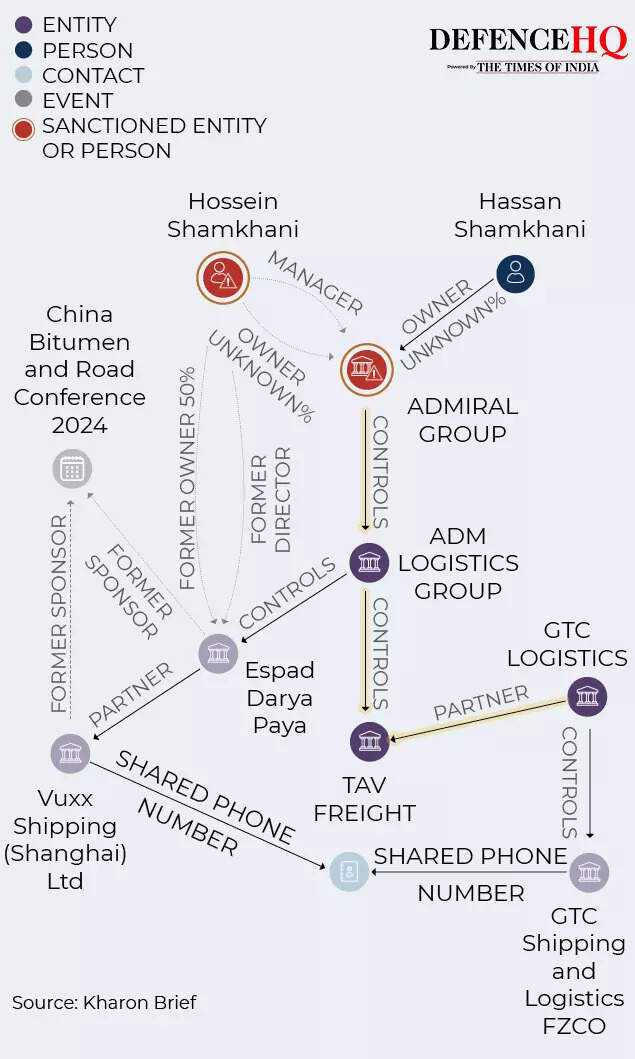
Admiral Group, founded by Hossein Shamkhani and his brother Hassan, serves as the logistical backbone.Named after their father’s naval rank, the company operates across the Persian Gulf and South Asia.
.
Through subsidiaries like ADM Logistics, the network extends into Iran, Russia, and China.
- Tav Freight partners with Russia’s GTC Logistics
- Joint exhibitions in Moscow highlight operational coordination
- Espad Darya Paya maintains ties with Chinese firms like Vuxx Shipping
This creates a tri-nation corridor linking Iran, Russia, and China — a key axis in the sanctions economy.
2. The shipping operator: Dark fleet and covert transport
At sea, the network relies on a “shadow fleet” of tankers.The US sanctioned 62 vessels linked to the network, many tied to Crios Shipping — a key maritime entity.
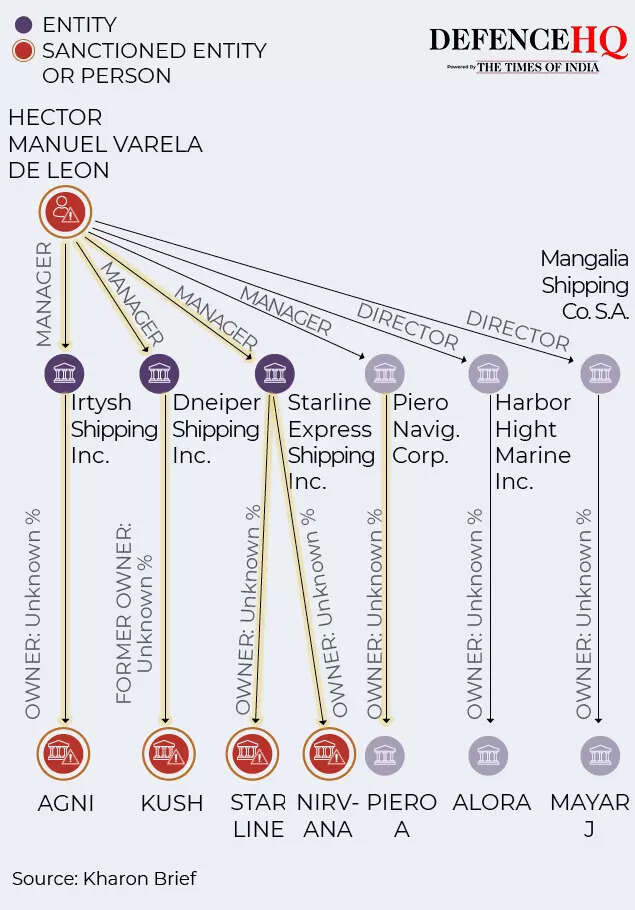
.
These vessels:
- Turn off tracking systems
- Conduct ship-to-ship transfers
- Reflag under different jurisdictions
- Blend oil to mask origin
Treasury also linked parts of this fleet to a weapons-for-oil scheme.Iran supplied missiles and drone components to Russia. In return, oil shipments were routed back through Shamkhani’s network and sold globally.
3. The hedge fund: Ocean Leonid and financial layering
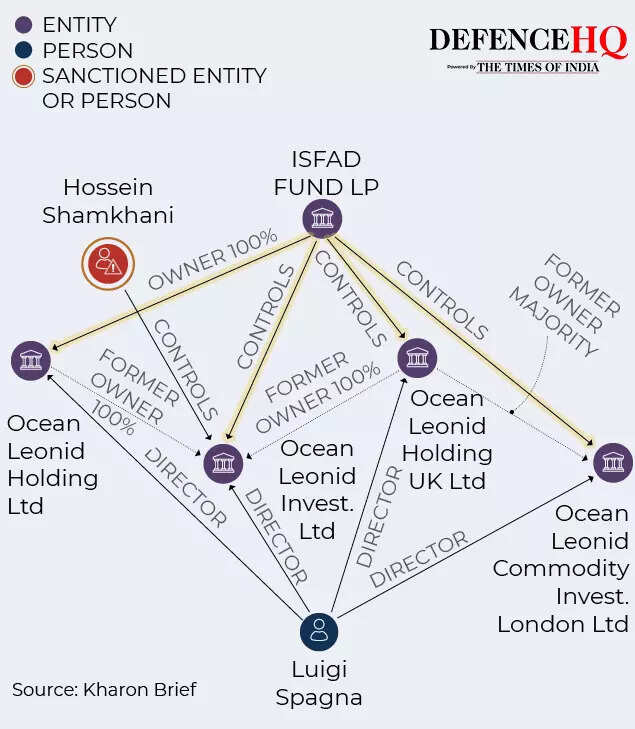
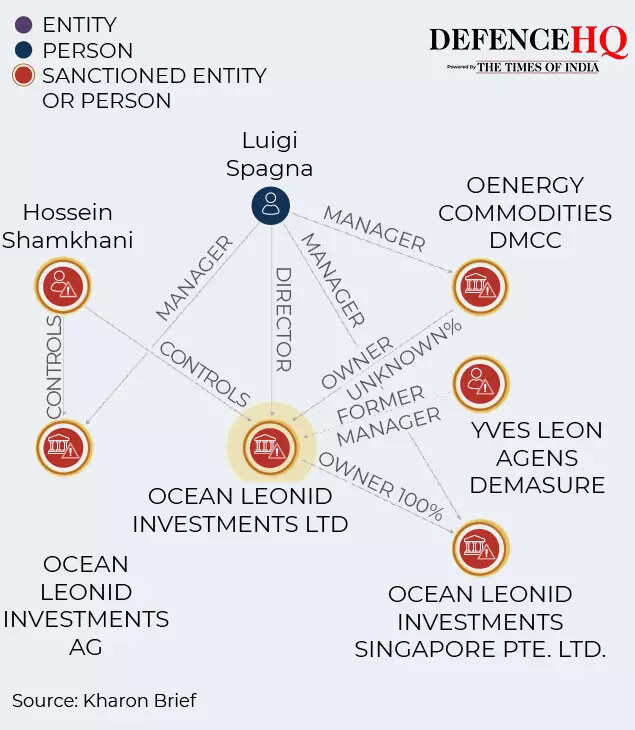
At the financial level, Ocean Leonid Investments acted as the network’s profit engine.
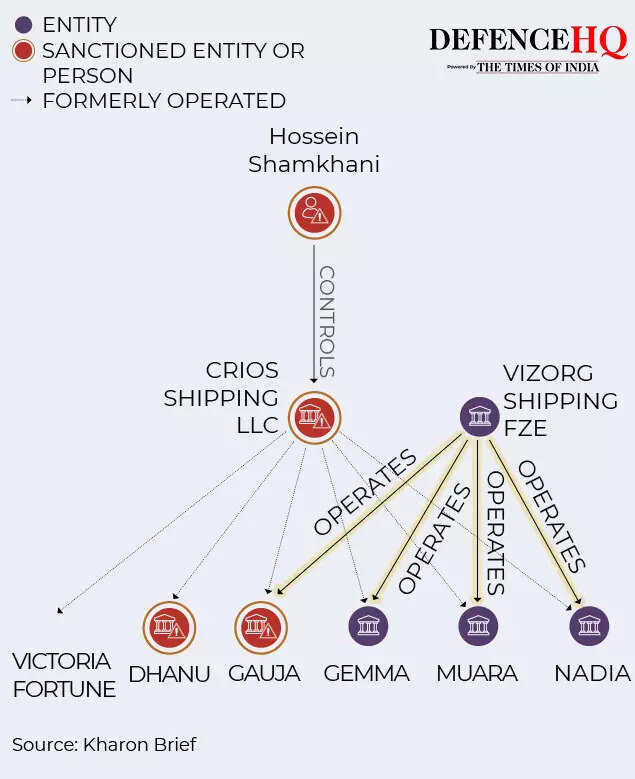
.
Operating across Dubai, Switzerland, and Singapore, the fund:
- Received capital from oil sales
- Invested in commodities, futures, and securities
- Generated “substantial profits” between 2021 and 2024
Shamkhani was “personally involved in investment decisions despite serving no official role”, according to US authorities.
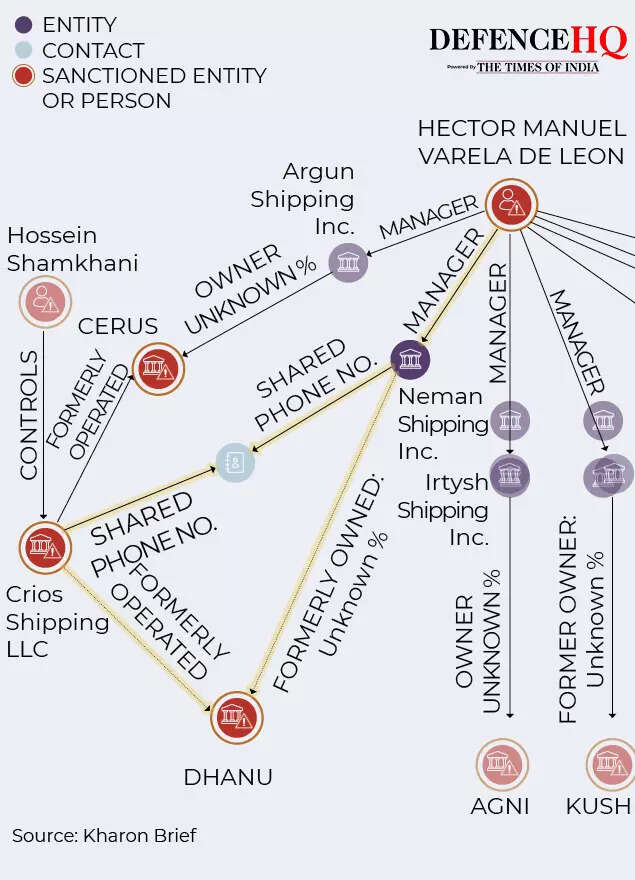
.
This structure allowed illicit proceeds to be converted into legitimate financial assets — a hallmark of sophisticated global networks.
Russia, China, and the sanctions economy
The transformation of Hossein Shamkhani’s network from a regional oil conduit into a global strategic instrument accelerated sharply after Russia’s invasion of Ukraine in 2022. What had once been a sanctions-evasion ecosystem centred on Iran evolved into a broader, interconnected economic bloc linking Tehran, Moscow, and Beijing — three actors increasingly aligned by necessity rather than ideology.Western sanctions on Russia’s energy exports created both disruption and opportunity. As traditional buyers stepped back, a parallel market began to take shape — one that relied on opaque logistics, alternative currencies, and intermediaries capable of navigating legal grey zones. Bloomberg’s investigation places Shamkhani’s network at the centre of this emerging system.“We realized the network was more than just oil. It was also part of the arms trade,” the report notes.At the core of this arrangement is a barter-like mechanism. Iran supplies weapons, drone components, and dual-use technologies to Russia — materials critical for sustaining its war effort. In return, Russia compensates not only in cash but also through oil shipments, which are then routed through Shamkhani-linked entities and resold in global markets.“When it came to the Russia relationship… that involved this network actually shipping weapons… and getting paid back in oil,” Bloomberg reports.China, meanwhile, plays the role of a stabilising buyer. As one of the world’s largest energy consumers and not a participant in Western sanctions, Beijing absorbs significant volumes of discounted Iranian and Russian crude. Transactions are often conducted in yuan or through non-dollar channels, insulating them from US financial oversight.This triangular flow — weapons and technology from Iran, oil and commodities from Russia, and demand anchored in China — has created what analysts describe as a “sanctions economy”.
It operates parallel to the formal global system, yet remains deeply intertwined with it.The implications are far-reaching. Not only does this network sustain sanctioned states, it also complicates enforcement. Any attempt to dismantle it risks disrupting global oil supply chains and triggering price volatility — a constraint that limits how aggressively Western powers can act.In effect, Shamkhani’s network does more than move oil. It connects two sanctioned economies to a willing buyer, creating a resilient circuit that allows all three to bypass pressure while reshaping the contours of global trade.
The US crackdown: Civil forfeiture and financial warfare
Washington’s response to the Shamkhani network has increasingly shifted from traditional sanctions to targeted financial warfare — focusing not just on ships and companies, but on the money flows that sustain the system.On March 6, 2026, the US Department of Justice filed two civil forfeiture complaints in a federal court in Washington, seeking to seize more than $15.3 million allegedly linked to the network. The move marked a strategic escalation: rather than only blacklisting entities, US authorities are now attempting to directly choke the financial arteries of sanctions evasion.According to the complaints, the funds were tied to a complex web of shell companies and distribution firms used to sell Iranian oil while concealing its origin and the involvement of sanctioned actors, including the Islamic Revolutionary Guard Corps (IRGC) and its Quds Force.The filings explicitly name Mohammad Hossein Shamkhani as the central operator of this network, alleging that he coordinated a system of front companies designed to “obfuscate the source of the oil and role of Iranian persons and entities in the transactions.”Officials described the operation as both sophisticated and deeply embedded within the global financial system.“Shamkhani runs a vast network of shell companies used to evade U.S. sanctions and launder funds for the Iranian regime and its terrorist proxies,” said Assistant Attorney General John A. Eisenberg.The case also sheds light on how the network attempted to penetrate legitimate markets. Entities such as Wellbred Capital and Sea Lead Shipping were allegedly structured to appear independent, masking their links to Shamkhani while facilitating payments, logistics, and trade.“Today’s civil forfeiture complaints illustrate the Criminal Division’s steadfast mission to prevent Iranian-backed shadow companies from using the US financial system,” said Assistant Attorney General Tysen A Duva.The enforcement push reflects a broader shift in US strategy: recognising that dismantling such networks requires more than sanctions lists. It requires tracking, freezing, and ultimately seizing assets as they move through banks, investment vehicles, and trade channels.Yet even this approach faces limitations. The very complexity that allows the network to function — layered ownership, shifting jurisdictions, and non-dollar transactions — also makes it difficult to fully dismantle.Still, by targeting the money rather than just the machinery, the US is attempting to do what military pressure alone cannot: erode the financial foundation of a system that has learned to survive under constant scrutiny.
Britain, Europe and the Western system: Sanctions meet infiltration
As Washington intensified its financial crackdown, Britain and the European Union moved in parallel — not only to sanction Hossein Shamkhani’s network but also to confront an uncomfortable reality: how deeply it had already penetrated the Western financial and trading system.In August 2025, the United Kingdom imposed sanctions on Hossein Shamkhani and a cluster of companies linked to his operations, including Milavous Group, Admiral Shipping Group, and Ocean Leonid Investments.
The Foreign, Commonwealth and Development Office stated that he had “facilitated and provided support to hostile activity by the Government of Iran,” freezing assets and prohibiting British entities from engaging with the network.The European Union followed with its own designation, describing Shamkhani as a “key player” in Russia’s shadow fleet — effectively linking his operations not just to Iranian sanctions evasion, but to Moscow’s wartime economy.These measures, however, also revealed the scale of the challenge. By the time sanctions were imposed, the network had already embedded itself within legitimate global systems. Bloomberg’s investigation found that oil routed through Shamkhani-linked entities had reached major international firms such as BP and Chevron, while associated financial structures maintained relationships with banks including JPMorgan and Standard Chartered.“That says quite something about… how this network was able to camouflage themselves,” said Bloomberg’s Ben Bartenstein.The methods were both simple and sophisticated. Oil was blended in transit to obscure its origin. Cargoes were rebranded through third jurisdictions such as Fujairah. Payments were routed through layered shell companies and, in some cases, through hedge funds operating out of financial centres like London and Geneva.This dual reality — sanctions on paper, integration in practice — highlights a central dilemma for Western governments. Cracking down too aggressively risks destabilising global oil markets and financial flows. Acting too slowly allows such networks to deepen their roots.In effect, Britain and Europe are not just confronting an external sanctions-busting operation, but a system that has already learned to operate from within — exploiting the openness, complexity, and interconnectedness of the very markets now trying to shut it out.
The denial
Hossein Shamkhani has denied all allegations. “I am not involved in the commodity industry as Bloomberg suggests,” he said. “As for my business, I operate in countries not under sanctions.”He also insisted: “My father never had nor does he have anything to do with my business activities.”His legal team accused media reports of being exaggerated and misleading.
Why the US cannot fully dismantle the ‘Hossein network’
Despite sweeping sanctions, asset seizures, and mounting legal pressure, the network attributed to Hossein Shamkhani continues to operate with resilience.
The challenge for Washington is not simply one of enforcement, but of structure — the system it is trying to dismantle is designed to survive disruption.At its core, the network is decentralised. Companies are layered across jurisdictions, ownership is obscured through proxies, and vessels frequently change names, flags, and operators. This fluid architecture ensures that even when one node is sanctioned or seized, others continue functioning with minimal interruption.Equally critical is the role of global demand. Countries such as China remain willing buyers of discounted Iranian and Russian crude, often transacting in non-dollar currencies. This reduces exposure to US financial controls and provides a steady outlet for oil flows, limiting the effectiveness of sanctions.The financial dimension further complicates enforcement. By routing transactions through shell companies, hedge funds, and alternative banking channels, the network avoids direct reliance on the US dollar system.
Even when funds pass through Western institutions, they are often disguised within legitimate trade, making detection difficult.There is also a geopolitical constraint. Aggressively targeting every element of such networks risks disrupting global oil supply chains and triggering price spikes — a scenario that carries domestic political costs for Western governments. This creates a balancing act between enforcement and market stability.Finally, the network benefits from political insulation. Its alleged links to Iran’s elite circles provide both protection and continuity, allowing it to adapt quickly to new restrictions.As a result, what Washington faces is not a single entity, but an evolving ecosystem — one that learns, reconfigures, and persists. In that sense, dismantling it entirely is not just difficult; it may be structurally improbable without reshaping the global conditions that allow it to exist.
Wealth, power, and inequality
While billions of dollars flow through networks like the one attributed to Hossein Shamkhani, the benefits remain concentrated within a narrow circle of politically connected elites, leaving ordinary Iranians largely excluded from the country’s most valuable resource. “If you think of a ideal scenario… it would be one in which the oil industry can really support the average Iranian,” a Bloomberg source said. “Instead… just a few families really profit.” This growing disparity has deepened public frustration, particularly against a system that was born out of promises of justice and equality. Over time, the concentration of wealth among elite families — many with direct links to the state and security establishment — has reinforced perceptions of a parallel economy operating beyond public accountability. Mehrzad Boroujerdi captured this irony, noting how the revolution’s original ideals appear to have come full circle. “It is ironic… we have ended up at this point… when the new revolutionary elites have become even more despised than the regime that they overthrew,” Boroujerdi told Bloomberg. The result is a widening gap between state-linked prosperity and public hardship — a tension that continues to surface in protests and political discontent, even as the shadow economy sustaining the system grows more entrenched.
The deep state within a state
Hossein Shamkhani’s rise reflects a broader transformation in Iran’s power structure — from ideological revolution to networked capitalism under sanctions.Like historic financial dynasties, his influence lies not in visibility, but in control over flows — of oil, money, and information.“This network… was one of the three biggest oil trading networks for Iran,” Bloomberg reports. Its reach spans from Tehran to Dubai, Moscow to Beijing, and into the heart of Western financial systems.And as long as that network remains intact, military pressure alone may not be enough. In the modern geopolitical battlefield, power is no longer just about missiles and armies.It is about networks. And in that shadow world, the most powerful figure may not be a general or a president — but a man known only as H.




 English (US) ·