

 1 week ago
7
1 week ago
7
ARTICLE AD BOX
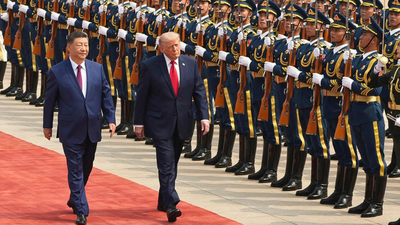
Chinese President Xi Jinping and US President Donald Trump (AP photo)
“Military is obvious.”The remark from US President Donald Trump came almost casually as he stood amid the grand ceremonial spectacle arranged by his Chinese counterpart and host Xi Jinping in Beijing. Rows of Chinse soldiers stood in perfect formation.
Red carpets stretched across the vast expanse of the Great Hall of the People. Children waved flags. Precision, discipline and power were on full display, not subtly, but deliberately, leaving Trump a bit toned down than his usual approach.For a president who has oftentimes boasted that the American military is the “greatest and best,” Trump’s tone carried something different this time: admiration mixed with recognition that the global military balance is no longer as one-sided as it used to be.For decades after the Soviet Union collapsed in 1990, Washington stood alone at the peak of global power. America’s military dominance became the defining feature of the post-Cold War world. But in Beijing on Thursday, China appeared eager to send a message to Trump and the world alike, that era may be changing.Trump repeatedly praised Xi during the visit, calling him a “great leader.” Yet behind the warm words and diplomatic smiles was a deeper undercurrent: this was not merely a state visit.
It was a showcase of China’s confidence, military, technological and geopolitical.And Beijing did not stop at symbolism.Even as Trump received military honours, China’s messaging on Taiwan turned strikingly blunt. Chinese officials warned that US involvement in Taiwan-related matters could “lead to US-China conflict.”The warning came as tensions around Taiwan continue to sharpen. The self-ruled island, claimed by Beijing but backed militarily and politically by Washington, has increasingly become the most dangerous fault line in US-China relations.Taiwan hit back strongly.“The Beijing authorities are currently the sole risk to regional peace and stability,” Taiwan’s defence ministry said, accusing China of “military harassment” and grey-zone operations around the island. It added that “Beijing has no right to make any claims on behalf of Taiwan internationally.”But beyond Taiwan, another conflict has quietly revealed how modern geopolitical battles are evolving, and how China’s influence may already be extending into the future of warfare itself.Trump’s military offensive against Tehran under “Operation Epic Fury” thrust the Iran conflict into global focus. Reports surrounding the war repeatedly pointed toward Chinese technology playing a behind-the-scenes role in strengthening Iran’s military capabilities.The battlefield of the 21st century is no longer decided only by fighter jets, aircraft carriers or the size of defence budgets. Increasingly, power is being measured through drones, AI systems, cyber capabilities, satellite navigation and precision technology.And in many of those areas, Beijing is rapidly emerging as a serious challenger to Washington.One symbol of that shift is the BeiDou Navigation Satellite System, China’s answer to America’s GPS network. Iran has reportedly been using the BeiDou system since 2021 to improve drone accuracy and deploy decoy systems capable of complicating enemy targeting.That detail may seem technical. But strategically, it is enormous.
A quieter Trump in Xi’s staged show
Trump, in China and in Xi Jinping’s presence, appeared notably more restrained compared to his usual approach with other world leaders, where he is often more confrontational.From calling Shehbaz Sharif to the mic mid-presser for praise, to publicly grilling Volodymyr Zelenskyy over gratitude and even his outfit, Donald Trump has often turned diplomatic meetings into headline-grabbing moments marked by sharp exchanges.
But with Xi Jinping, the tone has shifted. Trump has repeatedly praised Xi as a “great leader,” replacing pointed remarks with warmer language and diplomatic smiles.
Yet beneath the cordial optics, the visit has doubled as a carefully choreographed showcase of China’s military strength, technological ambition and growing geopolitical confidence.
China reshaping conflicts beyond its borders
It suggests that China is no longer only building weapons for itself.
Its technology is beginning to shape conflicts far beyond its borders, testing itself indirectly against American military systems in real-world combat situations.The contrast is striking.The United States still spends more on defence than any other country in the world. China, meanwhile, possesses the world’s largest standing army. But modern warfare is increasingly becoming less about size and more about systems, who controls the algorithms, the satellites, the drones, the data and the artificial intelligence behind the battlefield.That is the real contest unfolding beneath the carefully choreographed handshakes in Beijing.Not simply a rivalry between two nations. But a struggle over who will define the next era of global power.Empty missile bins behind superpower image
Advanced systems like Tomahawk cruise missiles, JASSMs, Patriot interceptors and THAAD air defence systems performed effectively.But the scale of the operation also triggered alarm bells inside strategic circles.According to the CSIS assessment, America’s stockpile of long-range precision munitions was already under pressure well before the Iran conflict began. The war only accelerated the depletion.The concern is particularly serious because modern warfare against China would rely heavily on exactly those weapons.Unlike conflicts in the Middle East, a Pacific war would involve massive distances, heavily defended airspace and enormous missile exchanges. In such a scenario, long-range strike systems become the backbone of military operations.
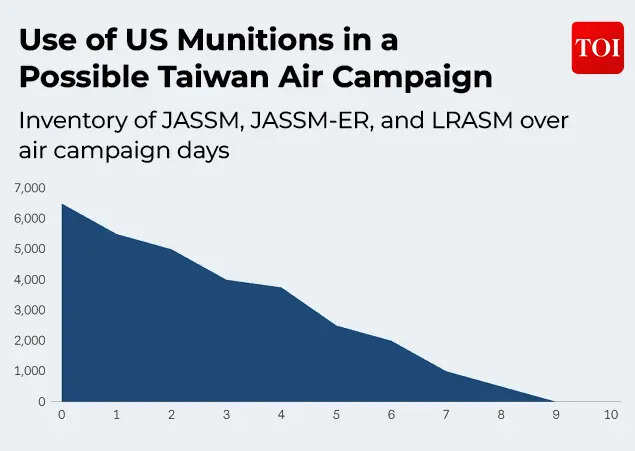
The problem? America may not have enough of them.The report noted that production timelines for critical weapons remain painfully slow.
Some systems take between three and four years to manufacture. Refilling depleted arms and ammunition inventories is not a quick process.And while US officials publicly insist America still possesses overwhelming military strength and stands at the top in defence expenditure, strategic analysts increasingly fear that prolonged conflict could rapidly expose shortages.China’s war machine already on wartime footing
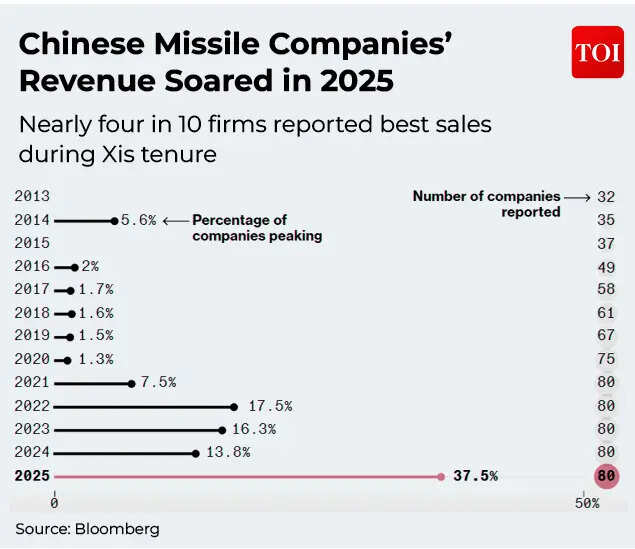
And unlike the United States, which still faces procurement delays and political bottlenecks, China’s centralised system allows faster scaling of military production.The concern is no longer just about numbers of tanks or fighter jets.Modern warfare has shifted toward drones, AI-enabled targeting, cyber systems, electronic warfare, satellite navigation and autonomous platforms. In many of these sectors, China is moving aggressively.The Iran conflict became a glimpse into that future.Reports surrounding Tehran’s drone and missile operations repeatedly pointed toward Chinese-linked technology. Iran’s use of the BeiDou Navigation Satellite System improved drone accuracy and enabled more sophisticated battlefield deception systems.What once sounded futuristic is now becoming operational reality.Wars are increasingly being fought not only with bombs and bullets — but with algorithms, autonomous systems and satellite networks.Taiwan becomes centre of the storm
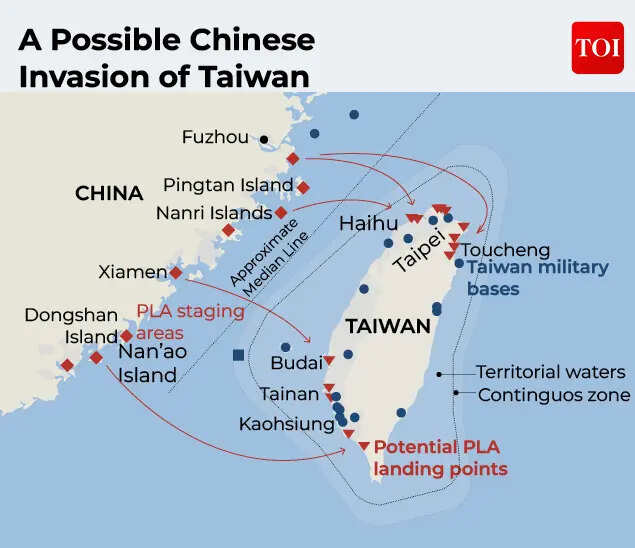
For military planners, Taiwan is no longer simply a diplomatic flashpoint. It is the scenario around which future Pacific warfare is increasingly being modelled.The CSIS report highlights repeated war-game simulations in which US forces exhausted critical long-range missiles within just the first week of a Taiwan conflict.Taiwan itself reportedly ran out of anti-ship missiles almost immediately in several simulations.That finding has deeply alarmed strategists because China’s missile systems now threaten large parts of the Indo-Pacific, including American bases in Japan, Guam and the Philippines.US aircraft carriers and destroyers, once symbols of unmatched American power, are now considered increasingly vulnerable inside China’s missile range.The age of 'Hellscape' warfare







 English (US) ·