

 1 hour ago
4
1 hour ago
4
ARTICLE AD BOX
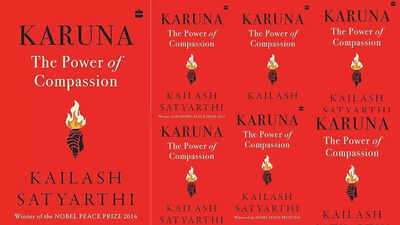
“But we must also be talking about those who no one is thinking about,” his office called me up in the thick of the Covid19 pandemic. Nobel Peace Laurate Kailash Satyarthi had initiated a COVID-19 Support Center for rural India and urban slums to support orphaned children, medical care, missing child complaints, reporting child sexual abuse cases to the authorities.
The challenge to distribute food, protective gear and medical kits was multi-fold amidst restrictions of a lockdown and social distancing. On my part, I made sure a special feature on this concern and effort was run on prime time at the news channel I was working at. It was a lesson about never losing your ‘karuna’ (compassion) in the face of extreme difficulty.Now, six years after that incident I am reminded of that lesson again, with anew concept coined by Satyarthi, called CQ = Compassion Quotient.
In his latest book titled, ‘Karuna – The Power of Compassion’, he explains that compassion has been his perennial source of power to fight for freedom, justice and equality. He says that this needs to be the common denominator for any dialogue process. His book has several examples about how every human being is born with compassion as an inherent quality but unfortunately, we gradually lose it while growing up in a world of societal pressures governed by discrimination, work deadlines and lack of time.
In his experience of rescuing different children for so many past decades, where he has observed how the compassion of different people involved with his work - his colleagues, police officers and other members of law enforcement, have helped in improving the life of abused children.Since compassionate intelligence is based on morality and righteousness, it rejects short term thinking and looks at the larger responsibility towards people.
Basis this argument, he brilliantly broaches the subject of embracing AI provided it’s core can be integrated with compassionate intelligence. Algorithms and data should be designed in a way that promotes ethical and mindful problem solving. Only then can AI be used as a tool for extended justice.
For example, when Satyarthi rescued 11 years old Mithun from the begging mafia, he could not recall which village or city he belonged to.
That’s when his colleague, Chirag, at the rehabilitation centre decided to use Google Earth with satellite imagery to help identify Mithun’s home. After many months of Chirag’s compassionate use of technology, he finally relocated Mithun’s family and the young boy managed to reunite with them.
While reading the book, I wondered how can CQ, something which sounds abstract to most of us, be calculated in numbers? But he believes that this can be measured with available tools and you can also improve your CQ score with established methods. His organisation, the Satyarthi Movement for Global Compassion (SMGC) explains the calculation method on the basis of four parameters – awareness of suffering, connectedness with suffering, feeling of responding to the suffering and action to remove the suffering. Unlike IQ and EQ which is an internal measure of an individual, CQ extends to family and society at large. The SMGC is collaborating with the best of psychologists, psychiatrists, sociologists, neuroscientists and technologists from across the world in order to scientifically establish the CQ. He says, “I see a world where compassion is the only solution”. Whenever CQ becomes an acceptable global standard of measurability, it will be yet another proud moment for India. By Sahar Zaman ( Sahar Zaman is an award-winning author, multimedia journalist, cultural curator and an advocate of the Orange Economy. She has Founded Asia’s first web-channel dedicated to the Arts, called Hunar TV.)









 English (US) ·