

 1 week ago
9
1 week ago
9
ARTICLE AD BOX
For a long time, the Neanderthals were regarded as functional, survival-minded humans who possessed the capabilities of hunting and tool production. Still, they had only primitive skills for abstract thinking and symbolic expression.
Modern humans, on the other hand, were regarded as the first to create art, to communicate complex messages, and to demonstrate cultural refinement. But a new find in central France is soon to upset all this. In a limestone cave overlooking the Loire River, archaeologists have found carvings on soft chalk surfaces buried under sediment for more than 57,000 years.The symbols, in the form of lines, arcs, dots, and intersecting grids, show a marked sense of spatial organisation and repetition, which can be seen as the result of symbolic thinking.
And the evidence suggests that the artists were not Homo sapiens but Neanderthals, which would mark a very significant extension of the known history of abstract thinking in our human cousins.
What 30 feet La Roche-Cotard Cave tells us about Neanderthals
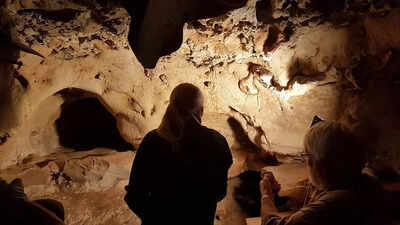
La Roche-Cotard cave is located in a limestone formation along the Loire River. Unlike most archaeological sites, it has remained untouched by humans or animals for tens of thousands of years. Natural sedimentation sealed the cave completely under roughly 30 feet (9.14 metres) of material, preserving its contents in pristine condition.
Inside, researchers discovered markings pressed into soft chalk, known locally as tuffeau.
These engravings include carefully drawn lines, arcs, and grids, created with fingers. The cave’s long-term isolation means that the only plausible authors of these markings are Neanderthals, as modern humans had not yet arrived in this part of Europe.The La Roche-Cotard engravings provide strong evidence that Neanderthals were capable of abstract thought.
Previously, Neanderthals were viewed primarily as practical tool users, focused on hunting and survival. These markings, however, indicate purposeful and structured behaviour. They are not random scratches or the result of natural processes; replication experiments and 3D photogrammetry confirm that they were made deliberately by human fingers.
The abstract patterns suggest symbolic intent, an ability to plan, and a form of expression, characteristics that were once thought to belong solely to modern humans.
La Roche-Cotard cave shows ancient Neanderthal engravings and tools
Researchers used optically stimulated luminescence (OSL) to estimate when mineral grains in the cave were last exposed to light. The results show that La Roche-Cotard was sealed between 57,000 and 75,000 years ago. This predates the arrival of Homo sapiens in Europe by tens of thousands of years. Alongside the engravings, Mousterian stone tools were discovered, further linking the site to Neanderthals. No evidence of later human activity exists, confirming that the engravings are exclusively the work of Neanderthals.Unlike Upper Paleolithic cave art, which often depicts animals or human figures, the La Roche-Cotard markings are abstract. They include lines, arcs, dots, and intersecting grids distributed across four panels in the “Pillar Chamber.” The patterns show repetition and careful spatial organisation, suggesting that the marks were created intentionally rather than accidentally. While they may not qualify as figurative art, they demonstrate a form of symbolic behaviour, highlighting the cognitive complexity of Neanderthals.
La Roche-Cotard cave and other sites show Neanderthal symbolic behaviour
The discovery at La Roche-Cotard aligns with other evidence for Neanderthal symbolism. In Spanish caves, red hand stencils and geometric pigment marks, dating to around 65,000 years ago, have been attributed to Neanderthals. In Bruniquel Cave, France, circular stone constructions dated to 176,000 years ago indicate planning and social organisation. Collectively, these findings suggest that Neanderthals engaged in behaviours once thought unique to modern humans, including symbolic representation and abstract thinking.








 English (US) ·