

 1 hour ago
6
1 hour ago
6
ARTICLE AD BOX
Last Updated:June 26, 2026, 18:44 IST
A 7.8 magnitude earthquake killed at least 45, injured over 600 and displaced thousands, underscoring the Philippines high seismic risk on the Pacific Ring of Fire.


A worker walks near a collapsed building following the magnitude 7.8 quake in General Santos, southern Philippines. (Reuters)
A powerful 7.8-magnitude earthquake that struck off the coast of Mindanao earlier this month and one hitting it on Friday, killing dozens and injuring hundreds, has once again highlighted why the Philippines is among the most seismically active countries in the world. The answer lies in its location on the Pacific “Ring of Fire" — a vast belt of volcanoes and fault lines that circles the Pacific Ocean.
What Is The Ring Of Fire?
The Ring of Fire is a horseshoe-shaped zone stretching roughly 40,000 kilometres around the Pacific Ocean, from South America to North America, across Russia, Japan, the Philippines, Indonesia and New Zealand.
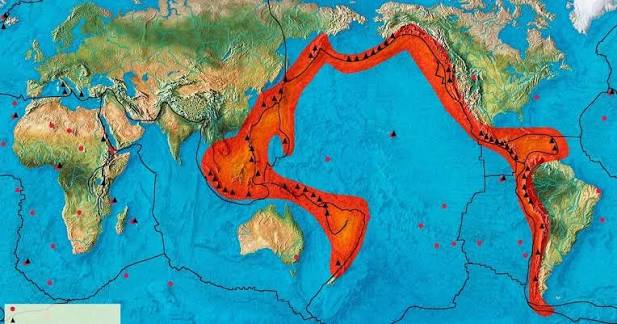
It is home to nearly 75% of the world’s active volcanoes and experiences around 90% of all earthquakes globally because several major tectonic plates constantly collide, slide past or dive beneath one another.
Why Is The Philippines So Vulnerable?
The Philippines sits at the junction of multiple tectonic plates, including the Philippine Sea Plate and the Eurasian Plate. Their constant movement creates numerous active faults and deep ocean trenches around the archipelago, making the country highly susceptible to powerful earthquakes and tsunamis.
The June 8 earthquake originated off the coast of Sarangani in southern Mindanao, where movement along an offshore subduction zone triggered violent shaking and tsunami warnings across parts of Southeast Asia.
What Happened In The Recent Earthquake?
The magnitude-7.8 quake struck off southern Mindanao, killing at least 45 people, injuring more than 600 and displacing thousands. Buildings collapsed, roads cracked, hospitals were damaged and more than 2,000 aftershocks were recorded in the days that followed, complicating rescue efforts.
The earthquake also dramatically altered parts of the coastline, with sections of the seabed rising by nearly two metres, exposing coral reefs and reshaping beaches in affected coastal communities.
How Often Do Earthquakes Strike?
The Philippines experiences hundreds of earthquakes every year, although most are too weak to be felt. However, its position on the Ring of Fire means damaging earthquakes are a recurring reality.
In recent years, the country has been hit by several major quakes, including the devastating 7.8-magnitude Mindanao earthquake this month, twin powerful earthquakes off Davao in 2025, and multiple destructive tremors in 2023 and 2022.
Can Earthquakes Be Predicted?
Scientists can identify high-risk seismic zones and monitor tectonic activity, but they cannot accurately predict when an earthquake will occur. Instead, authorities focus on earthquake-resistant construction, early-warning systems for tsunamis, emergency preparedness and rapid disaster response to reduce the impact of future disasters.
Handpicked stories, in your inbox
A newsletter with the best of our journalism
News world Three Quakes, One Month: How The Pacific 'Ring Of Fire' Shapes Philippines' Seismic Risk
Disclaimer: Comments reflect users’ views, not News18’s. Please keep discussions respectful and constructive. Abusive, defamatory, or illegal comments will be removed. News18 may disable any comment at its discretion. By posting, you agree to our Terms of Use and Privacy Policy.
Read More









 English (US) ·