

 1 hour ago
4
1 hour ago
4
ARTICLE AD BOX

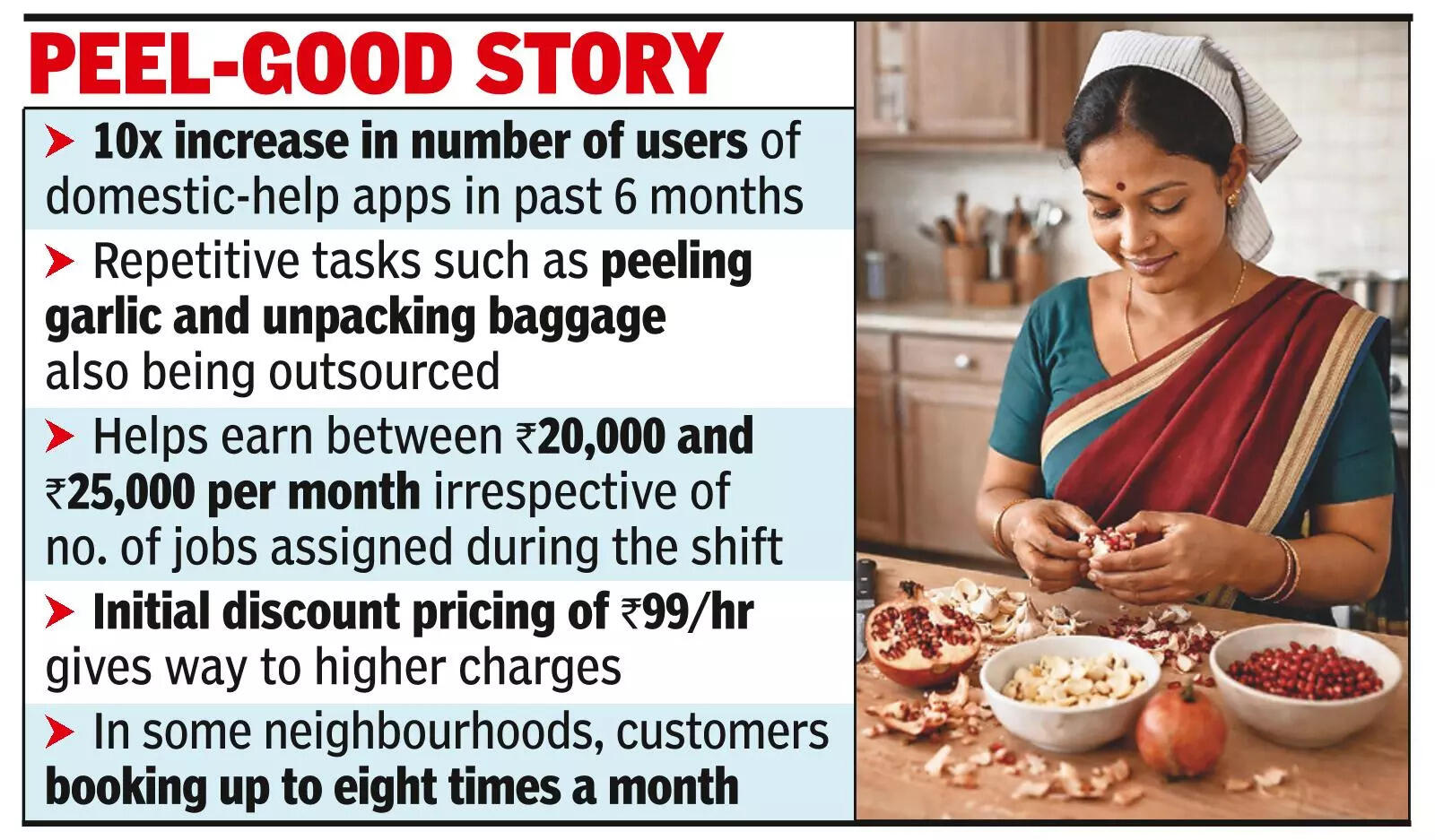
BENGALURU: Unpacking suitcases, arranging wardrobes, handling time-consuming tasks such as peeling pomegranates and garlic, or prepping for weekend gatherings - these are among the chores urban households are increasingly getting done through domestic help apps, alongside routine chores such as dishes and laundry.What began as a convenience experiment is now scaling rapidly across parts of Bengaluru, Mumbai and Delhi NCR, driven by repeat usage and aggressive supply build-out. Bengaluru-based Snabbit has gone from roughly 100,000 monthly jobs in Aug 2025 to a run rate of 10 lakh monthly jobs currently, founder and chief executive Aayush Agarwal told TOI, a tenfold increase in under six months. "We are a very reliable backup for all households.
Whether it is absenteeism, ad hoc support or getting extra work done, Snabbit provides the comfort of having someone just a tap away," Agarwal said.
Peel-good story
A Bellandur resident said she uses the app about twice a month, mainly when her regular help is absent or when guests are visiting.Urban Company's InstaHelp, launched last year, shows a similar trajectory. The vertical reached 468,000 orders in Oct 2025 within eight months of launch, according to an earlier shareholder letter.
By the Oct to Dec quarter, InstaHelp reported 1.6 million orders, implying average monthly volumes of over 500,000."The micro markets where we are present, we are penetrating very fast. And the level of customer usage and retention that we are seeing is very encouraging," Urban Company founder and chief executive Abhiraj Singh Bhal said in the company's latest analyst conference. However, the company also disclosed that InstaHelp reported an adjusted EBITDA loss of Rs 44 crore in the quarter, driven by investments in supply onboarding, training and early earnings support.
EBITDA is a financial metric used to evaluate a company's operating performance and profitability.On the supply side, the model departs from traditional gig structures. Snabbit's service professionals sign up for fixed shifts and earn between Rs 20,000 and Rs 25,000 per month depending on shift duration, Agarwal told TOI, adding that this pay is assured irrespective of the number of jobs assigned during the shift.
Similar pay bands exist across rival platforms.Investors argue that durability will depend less on gross order growth and more on how often customers return."Order growth is an outcome metric. Frequency and retention matter the most," Rahul Taneja, partner at Lightspeed, said. In certain high-frequency neighbourhoods, customers are already booking up to eight times a month, and in those segments, repeat usage is stronger than what early food delivery or quick commerce platforms saw in their formative months, he said.Consultants tracking the space point out that usage remains largely supplemental rather than substitutive. "Currently, the service acts primarily as a supplementary layer, stepping in when regular domestic help is unavailable rather than replacing full-time help," said Artham Khetan, engagement manager at Redseer Strategy Consultants.









 English (US) ·