

 1 hour ago
6
1 hour ago
6
ARTICLE AD BOX
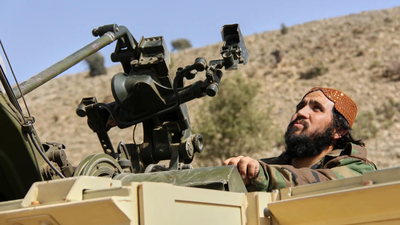
The recent hostility between Afghanistan and Pakistan has again brought the region to the brink of war. On 27 February, Pakistan’s defence minister announced that his country is in “open war” with Afghanistan.
This cross-border conflict between the two countries, although not new, escalated on 26 February, with both sides accusing the other of starting the latest flare-up.
The Afghan Taliban has stated that their military launched attacks on Pakistani positions along some sections of their porous and disputed Durand line, with the districts of Bajaur and Kurram bordering Afghanistan being the worst affected. A Pakistani military officer reportedly confirmed that Afghan Taliban drones targeted three locations - the army's artillery school in Nowshehra, one near a military academy in Abbottabad, and one that fell near a primary school in Swabi - but all were intercepted.
However, the Taliban claimed to capture more than 15 Pakistani check posts and kill several Pakistani soldiers in retaliation for Pakistan’s airstrikes on the border area on 21 February, which resulted in the killing of innocent civilians, including women and children. Pakistan’s information ministry denied this charge and said that its military had conducted an “intelligence-based, selective operation” against seven camps belonging to militants, including TTP and ISKP, in the eastern Afghan provinces of Nangarhar, Khost, and Paktika last Sunday.
The airstrikes followed a month of deadly attacks inside Pakistan, which Islamabad alleged were being orchestrated from the Afghan soil. Pakistan finally declared “open war/direct confrontation” with Afghanistan with the launch of its Operation Ghazib Lil-haq or “Operation Righteous Fury”, targeting 22 locations, including several military installations in major cities/provinces like Laghman, Kabul, Kandahar, and Paktia.
This dramatic escalation is a major development in the region. Mosharraf Zaidi, Pakistan’s prime minister’s spokesperson for foreign media, claimed that as a result, 297 Afghan fighters have been killed, 89 Afghan posts have been destroyed, 18 soldiers were captured, and more than 450 were injured.
`Although both sides claimed to have inflicted considerable damage, the exact scale of casualties remains unclear.However, there are multiple dimensions to the conflict. Firstly, the latest round of violence represents a continuation of tensions that had already driven Afghanistan–Pakistan relations to their lowest point in years in 2025—particularly in October, described as “the worst fighting since the Taliban’s 2021 takeover of Kabul”— marked by deadly border clashes, disrupted trade, and a breakdown in diplomacy between the two countries.
Islamabad accuses Kabul of harbouring sanctuaries for TTP and other insurgent groups, while the Taliban-led government rejects the allegation, characterising the TTP issue as Pakistan’s “internal problem,” and, in turn, accuses Islamabad of violating Afghanistan’s sovereignty through cross-border airstrikes. According to a report released by the Pak Institute for Peace Studies (PIPS), Pakistan saw a sharp escalation in militant violence in 2025, with terrorist attacks rising by 34 per cent and terrorism-related fatalities increasing by 21 per cent, which has persisted since the Taliban’s takeover of Afghanistan in August 2021.
Initially, Pakistan publicly welcomed the Taliban’s return to power and claimed it as a strategic victory.
It viewed the Taliban through the long-standing prism of strategic depth— the expectation that a pliant or puppet regime in Kabul would provide Islamabad with security buffers against its arch-rival India, limit Indian influence in Afghanistan, and align closely with Pakistani regional interests. However, this anticipated strategic depth failed to materialise in practice.
Most notably, militant sanctuaries in Afghanistan fuelled a resurgence of the Pakistan Taliban and the Baloch insurgent groups following the Taliban’s regaining of power in Kabul, even as India–Afghanistan relations witnessed renewed momentum, especially after the Afghan foreign minister visited New Delhi in October last year. These shifting alliances are generating strategic uncertainty for Pakistan.Secondly, the roots of the Afghanistan-Pakistan conflict extend back to 1893, when the Durand Line was drawn by the British colonial authorities, cutting through Pashtun tribal lands. No Afghan regimes including the Taliban, has ever willingly recognised the boundary. Aimal Faizi, spokesman of the former Afghan President Hamid Karzai, had once said, “The Durand Line is an issue of historical importance for Afghanistan and any decision on the status of the Durand Line, the de facto border between Afghanistan and Pakistan, should be taken by the people, and not by the government.
” Islamabad, on the other hand, has always treated the Durand Line as an international frontier and fortified it with barbed wire—moves that have periodically triggered fatal border skirmishes.Thirdly, it is widely believed that Pakistan may be leveraging the conflict to divert both domestic and international attention from its ongoing political and economic instability in the country. Commentators note that the issue has generated an unusual degree of political consensus at home in support of the military’s response—an alignment reminiscent of the unity that underpinned the effectiveness of Operation Zarb-e-Azb a decade ago.
Such consensus, largely absent in Pakistan’s counterterrorism posture in recent years, appears to be the very ingredient Islamabad seeks to revive through the present operation. Pakistan’s state establishment, particularly its military, has successfully promoted a narrative that the country is strategically encircled by the so-called hostile forces of India in the east and Afghanistan to the west to rally domestic support and justify its actions, such as airstrikes across the Afghan border.In addition, humanitarian and migration dynamics have become closely intertwined with this volatile security landscape. Since 2023, and more forcefully in 2024 and 2025, Pakistan has increasingly instrumentalised Afghan refugee repatriation as a means of exerting pressure on the Taliban administration in Kabul to take actions against militant groups reportedly operating from Afghanistan. Although Pakistan has hosted millions of Afghan refugees for decades, Islamabad has increasingly reframed their continued presence as a security, economic, and administrative burden, thereby seeking to influence Taliban behaviour with the forceful deportation of the Afghan refugees at a time when Afghanistan remains mired in a severe humanitarian and economic crisis.Responses from the Regional Countries & International CommunityIn response to media queries about Pakistan's airstrikes on Afghanistan, MEA’s Official Spokesperson Shri Randhir Jaiswal said: India strongly condemns Pakistan's airstrikes on Afghan territory that have resulted in civilian casualties, including women and children, during the holy month of Ramadan. MEA is reportedly closely monitoring the situation. Other regional countries and international organizations are also urging both sides to exercise restraint and prioritize dialogue and diplomacy. Iran offered to facilitate talks between Afghanistan and Pakistan, while the Turkish foreign minister engaged counterparts from Pakistan, Afghanistan, Qatar, and Saudi Arabia in separate discussions, urging de-escalation.
China, expressing concern over the escalation, called for a ceasefire, and Russia— the only country to have recognised the current Taliban government—urged an immediate halt to cross-border attacks and to opt for a diplomatic resolution.
In contrast, the United States extended support to Pakistan in the ongoing standoff with the Afghan Taliban.With Zabihullah Mujahid, the Taliban’s spokesperson, announcing that the group’s leadership is prepared to engage in negotiations with Pakistan to end the violence, a window for dialogue may emerge, though it is likely to remain temporary and fragile. Without a fundamental recalibration of security approaches— one that prioritises cooperative counterterrorism mechanisms, sustained diplomatic engagement, and confidence-building measures—Afghanistan–Pakistan relations are likely to remain a source of instability for the region in the coming days.






 English (US) ·