

 1 hour ago
6
1 hour ago
6
ARTICLE AD BOX
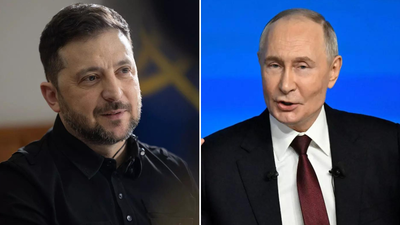
The war in Ukraine has not only reshaped Europe’s security landscape but is also dramatically altering the global arms trade. New data from the Stockholm International Peace Research Institute (SIPRI) shows that the conflict has produced two starkly different outcomes: Russia’s arms exports have collapsed, while Ukraine has become the world’s largest importer of weapons.According to SIPRI’s latest trends in international arms transfers for 2021–25, the volume of global arms transfers increased by 9.2 per cent compared with the previous five-year period. The rise is largely driven by the war in Ukraine and the rapid military build-up across Europe following Russia’s full-scale invasion in 2022.The data reveals that Ukraine now accounts for 9.7 per cent of total global arms imports — a dramatic jump from just 0.1 per cent in 2016–20.
At the same time, Russia, once the world’s second-largest arms exporter, has seen its global share shrink sharply as sanctions, battlefield pressures and shifting geopolitical alliances reshape the defence market.
Russia’s arms exports plunge amid war pressures
SIPRI’s report shows that Russia was the world’s third-largest arms supplier during 2021–25, but its exports dropped dramatically. Moscow’s share of global arms exports fell from 21 per cent in 2016–20 to just 6.8 per cent in 2021–25 — a decline of 64 per cent.
Among the world’s top ten arms exporters, Russia was the only one to record such a sharp fall.
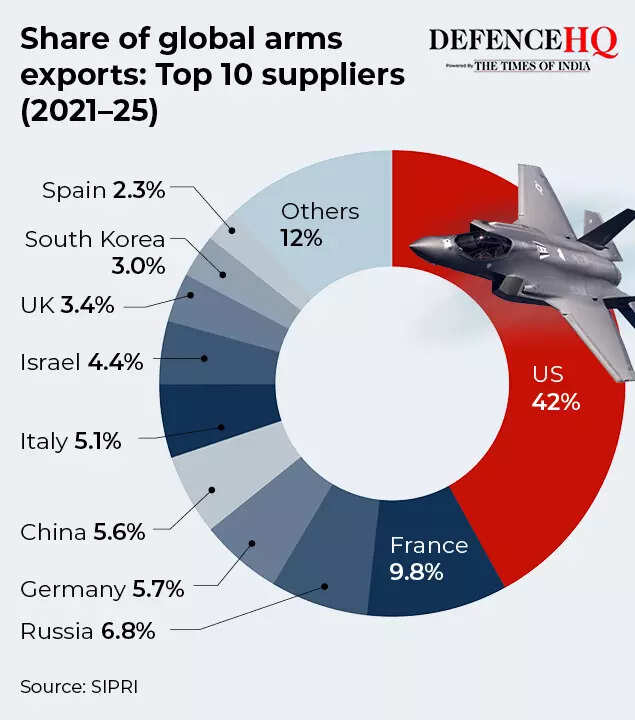
The steep drop was largely driven by reduced arms sales to key clients such as Algeria, China and Egypt. The war in Ukraine has strained Russia’s defence production and diverted equipment to its own military needs, while Western sanctions and political pressure have also complicated exports.In 2021–25 Russia supplied major arms to 30 states and one non-state armed group.
Most of its exports — around 76 per cent — went to countries in Asia and Oceania. Three countries accounted for nearly three-quarters of Russian arms exports during this period: India received 48 per cent, while China and Belarus each accounted for 13 per cent.However, Russia’s future export pipeline appears weak compared with its main competitors. SIPRI noted that the number of pending Russian arms export orders is far lower than those of the United States and France — currently the world’s two largest arms suppliers — and also lower than several other countries in the top ten.
Ukraine becomes the world’s largest arms importer
While Russia’s export position has weakened, Ukraine has become the single largest recipient of major arms globally.SIPRI’s data shows that Ukraine was the largest arms importer in Europe — and the world — during 2021–25. Since Russia launched its full-scale invasion in 2022, at least 36 countries have supplied major weapons systems to Kyiv.
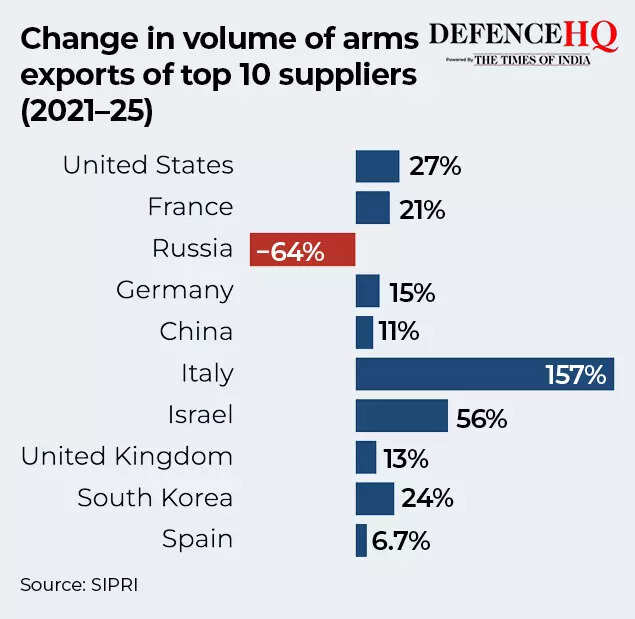
The United States has been the dominant supplier, accounting for 41 per cent of Ukraine’s arms imports.
Germany followed with 14 per cent, while Poland supplied about 9.4 per cent.Western military assistance has fundamentally transformed the flow of global arms. Large quantities of advanced weapons — including air-defence systems, missiles, armoured vehicles and artillery — have been transferred to Ukraine in an effort to strengthen its ability to resist Russian forces.However, the volume of arms transfers to Ukraine declined in 2025 compared with the previous two years.
SIPRI attributes this largely to a reduction in US military aid during that year. Even so, many European countries, along with Australia and Canada, continued to deliver significant military support and pledged further assistance in the coming years.In addition, at least 25 countries agreed in 2025 to purchase weapons from the United States specifically for transfer to Ukraine. These weapons — including guided bombs and air-defence missiles — are recorded in SIPRI’s database as US arms exports to Ukraine.Meanwhile, Russia itself imported a small share of global arms during the same period, accounting for just 0.4 per cent. These imports included one-way attack drones and other missiles from Iran as well as artillery and missiles from North Korea.
Europe’s arms build-up accelerates
The war has also triggered a wider military build-up across Europe. SIPRI reports that arms imports by European NATO member states surged by 143 per cent between 2016–20 and 2021–25 as governments rushed to strengthen their defences.More than half of these imports — about 58 per cent — came from the United States. The volume of US arms transfers to European NATO countries more than doubled during this period.Poland emerged as the largest importer among European NATO states, accounting for 17 per cent of their combined arms imports. Polish imports were more than nine times higher than in the previous five-year period, driven largely by purchases from South Korea and the United States.







 English (US) ·