

 1 hour ago
5
1 hour ago
5
ARTICLE AD BOX
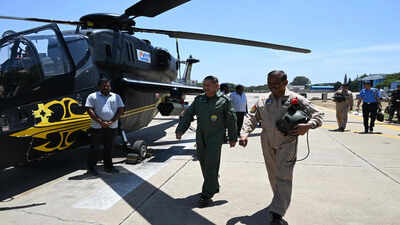
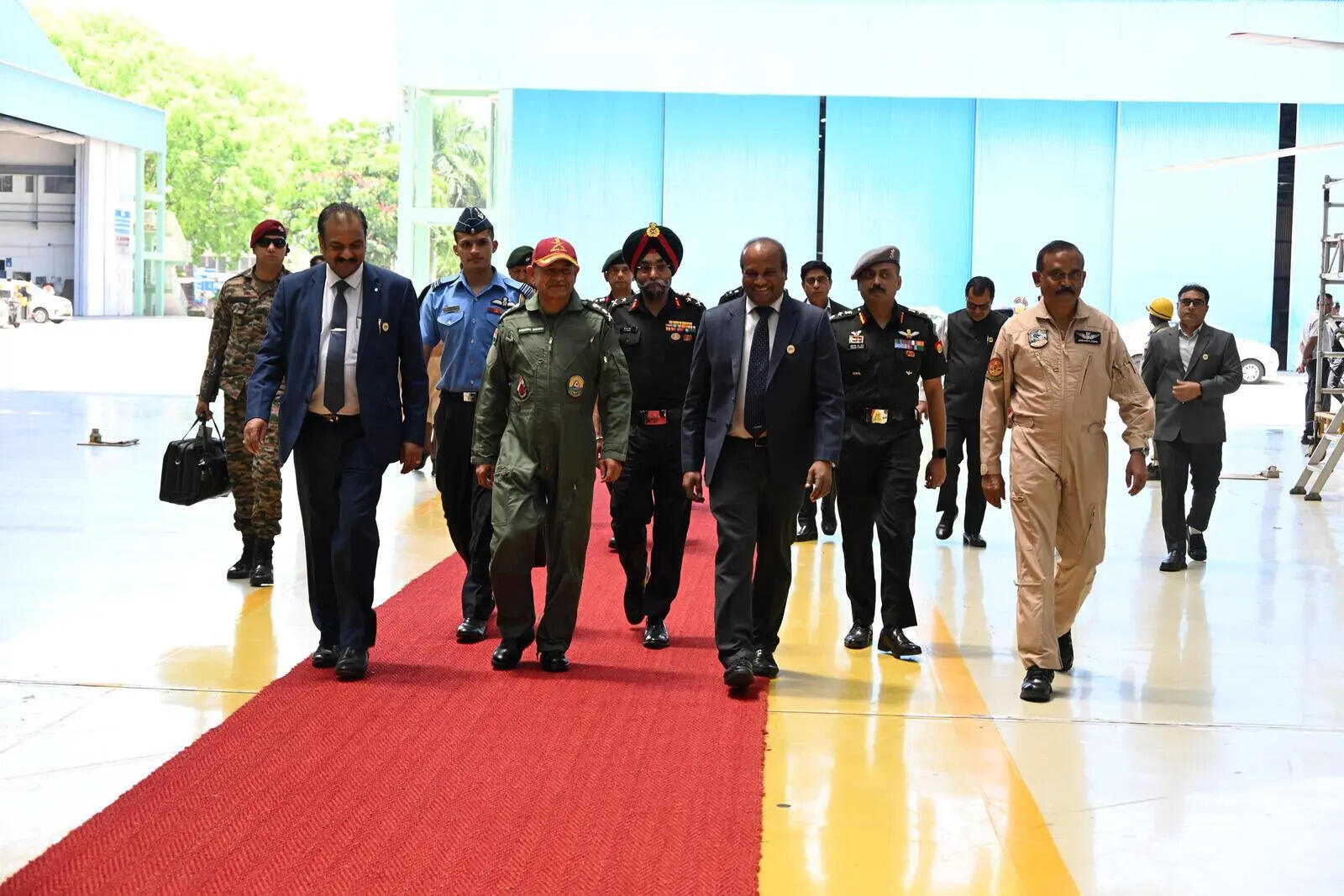
NEW DELHI: In a clear signal of India’s push towards indigenous defence capability and evolving battlefield doctrine, General Upendra Dwivedi, Chief of the Army Staff (COAS), recently visited Hindustan Aeronautics Limited (HAL) in Bengaluru to review the Indian Army’s aviation capabilities and indigenous platforms.The visit included a sortie aboard the Light Combat Helicopter (LCH) Prachand and covered key areas such as production, maintenance, upgrades and operational readiness. It also highlighted the growing role of Army Aviation in modern warfare, especially in low-altitude airspace.
Dwivedi’s sortie provided a direct assessment of Prachand’s capabilities and reaffirmed confidence in India’s ability to deploy indigenous combat platforms suited for complex terrains, including high-altitude areas.
Aatmanirbharta push and Army Aviation
The visit comes at a time when India’s defence doctrine is evolving, driven by technological changes and lessons from recent conflicts. The Indian Army is focusing on self-reliance under the Aatmanirbhar Bharat initiative, with HAL playing a key role in developing indigenous systems.At HAL’s Bengaluru facility, the Army Chief reviewed platforms such as the Advanced Light Helicopter (ALH) Dhruv and the LCH Prachand. Both have been developed domestically and are now part of India’s operational strategy.
The review also included maintenance, repair and overhaul (MRO) systems, which are essential to ensure platforms remain operational across terrains such as deserts and high-altitude regions.
Prachand and air littoral operations
Modern warfare is increasingly expanding into low-altitude airspace, often referred to as the “air littoral”. This space is now dominated by drones, loitering munitions and unmanned systems.Control of this zone plays a key role in determining the outcome of ground battles.
In this context, Prachand provides the Army with a dedicated platform to operate effectively in this layer.Prachand is India’s first indigenously designed attack helicopter and is built for high-altitude operations, including areas above 6,000 metres. It is suited for deployment along the Line of Actual Control (LAC).The helicopter is equipped for missions such as close air support, anti-armour operations and armed reconnaissance.
Its design allows it to operate in varied terrain and combat conditions.
HELINA and Dhruvastra
HELINA (Helicopter-launched Nag) and Dhruvastra are third-generation, fire-and-forget anti-tank guided missiles (ATGMs) developed by the Defence Research and Development Organisation (DRDO).HELINA is the Army version, while Dhruvastra is used by the Indian Air Force. Both missiles are deployed from platforms such as ALH Rudra and LCH Prachand.They have a strike range from about 500 metres to over 7 kilometres and use an Imaging Infrared (IIR) seeker for target tracking. This allows them to operate in day and night conditions.The missiles are capable of direct hit as well as top-attack modes, making them effective against modern tanks, including those fitted with explosive reactive armour.In terms of numbers, HELINA has entered induction into the Indian Army, with limited initial production orders placed for frontline units.
Exact numbers are not publicly disclosed.Dhruvastra has also been cleared for induction into the Indian Air Force after successful trials. Initial orders have been placed, with further procurement expected as more platforms are inducted.
Dhruvastra: Details, numbers and orders
Dhruvastra is the air-launched version of the Nag missile system and is designed for use on helicopters like ALH and LCH.It operates on a fire-and-forget system and uses an Imaging Infrared seeker to lock onto targets.
It can engage armoured targets in both direct and top-attack modes.The missile has been tested in high-altitude regions such as Ladakh and in desert conditions in Rajasthan. These trials confirmed its performance in different operational environments.Dhruvastra has been cleared for induction into the Indian Air Force. While exact numbers are not available in the public domain, initial orders have been placed for operational deployment.Future orders are expected to increase in phases according to a March 2025 notification, depending on the induction of additional LCH Prachand helicopters and other platforms.
Anti-armour capability boost
The integration of HELINA and Dhruvastra with indigenous helicopters strengthens India’s anti-armour capability.India has traditionally relied on imported systems, but these developments mark a shift towards domestic production of both platforms and weapons.The combination of attack helicopters and advanced ATGMs allows the armed forces to carry out precision strikes against armoured targets. It also enables operations in varied conditions, including day and night and across terrains.








 English (US) ·