

 1 hour ago
2
1 hour ago
2
ARTICLE AD BOX
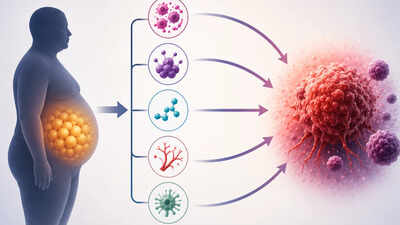
Representative image created using AI
Excess weight is more than a cosmetic concern; it is increasingly recognised as a major driver of cancer. The latest research has found that people who gain the most weight during adulthood face significantly elevated cancer risks.The research, conducted by scientists at Lund University, Malmö, Sweden, was presented at this year’s European Congress on Obesity (ECO 2026) in Istanbul, Turkey. The study showed that people who gain the most weight across adulthood are at more thandouble the risk of certain cancers.
Obesity and cancer
Obesity is a rising health concern. One in eight individuals across the globe is obese. Obesity is recognised as a leading cause of cancer. Substantial evidence has linked excess body weight to cancers of the oesophagus (adenocarcinoma), gastric cardia (top part of the stomach), colorectum, liver, gallbladder, pancreas, postmenopausal breast, endometrium, ovaries, kidneys, meninges, thyroid gland, and multiple myeloma, the International Agency for Research on Cancer (IARC) notes.
There is also evidence of potential links to other cancer forms, including blood cancers.Previous studies have focused on body weight and cancer at a single point in time—typically in mid- to late adulthood. However, the associations between how weight changes across a person’s entire life have been less explored. In the new study, the researchers looked at weight patterns from ages 17 to 60 and studied their link to cancer incidence.
They used data from the Swedish ODDS study, which includes records from 1911 to 2020, and cancer follow-up through 2023.
They collected data from 251,041 men and 378,981 women, with each person having, on average, four weight measurements between the ages of 17 and 60.
Cancer linked to a dramatic rise in cancer cases
The researchers found that faster weight gain is linked to a higher incidence of any cancer. The risk increases the more a person gains weight. When comparing people who gained the most weight (top 20%) with those who gained the least (bottom 20%), the risk of all cancers combined was slightly higher—7% in men and 17% in women.
However, for cancers linked to obesity, the risk was much higher, rising by 46% in men and 43% in women.
For specific obesity-related cancers, the top 20% of weight gain had much higher risks than those in the bottom 20%. The risk was 2.67 times higher for liver cancer and 2.25 times higher for oesophageal cancer in men. In women, the risk of endometrial cancer was 3.78 times higher. There were also smaller increases in gastric cardia (61%) and rectal (16%) cancers among men, and postmenopausal breast cancer (42%) and meningioma (32%) among women, as well as colon cancer and renal cell carcinoma among both men (52% and 81%) and women (31% and 91%).For cancers not linked to obesity, there was still an association. People in the top 20% of weight gain had higher risks compared with those in the lowest 20%. This included pituitary tumours among men (HR 3.13; a 3.13 times higher risk) and women (2.13 times), with significant associations also for malignant melanoma (27% increased risk) and diffuse large B-cell lymphoma (48%) among men, and tumours of the parathyroid gland (33%) among women.The researchers also noticed that weight gain at age 17 was linked to several cancers. They found that weight changes in early, middle, and later adulthood were associated with overall cancer incidence and established obesity-related cancers among both men and women.Men who were obese before age 30 years were at a fivefold risk of liver cancer, a doubled risk of pancreatic cancer and renal cell cancer, and a 58% increased risk of colon cancer compared with non-obese men.
Similarly, women with obesity before age 30 years had a 4.5 times higher risk of endometrial cancer, a 67% higher risk of pancreatic cancer, a doubled risk of renal cell cancer, and a 76% increased risk of meningioma.
What does this mean?
Obesity is one of the key drivers of several types of cancer. “Steeper increases in body weight between ages 17 and 60 were associated with a higher incidence of several established obesity-related cancers, as well as some for which previous evidence linking obesity to cancer is more limited.
Associations were particularly pronounced for liver cancer and oesophageal adenocarcinoma among men, endometrial cancer among women, and renal cell carcinoma and pituitary tumours in both sexes,” the author said.They also found that weight gain in women aged 30 years or older was strongly associated with endometrial cancer, postmenopausal breast cancer, and meningioma—cancers for which sex hormones are considered a primary aetiological factor.
In such women, the incidence of colon cancer was also higher. In men, obesity-related cancers were stronger for weight gains below age 45, most clearly for oesophageal and liver cancer—cancers for which factors such as chronic inflammation, insulin resistance, and (in the case of oesophageal cancer) gastro-oesophageal reflux disease (GERD) may play prominent roles.In general, the main biological mechanisms linking obesity to cancer are believed to include altered sex hormone metabolism, insulin signalling, adipokine secretion, and inflammation.“Both early adult body weight and weight gain across adulthood were associated with the risk of most established and some potentially obesity-related cancers, with differences by cancer site, sex, and timing of weight gain. In the context of the rising prevalence of obesity and cancer in Western countries and globally, the findings highlight the importance of a life-course perspective on weight management for cancer prevention,” the researchers concluded.









 English (US) ·