

 5 days ago
6
5 days ago
6
ARTICLE AD BOX
3 min readRaipurFeb 16, 2026 07:05 AM IST
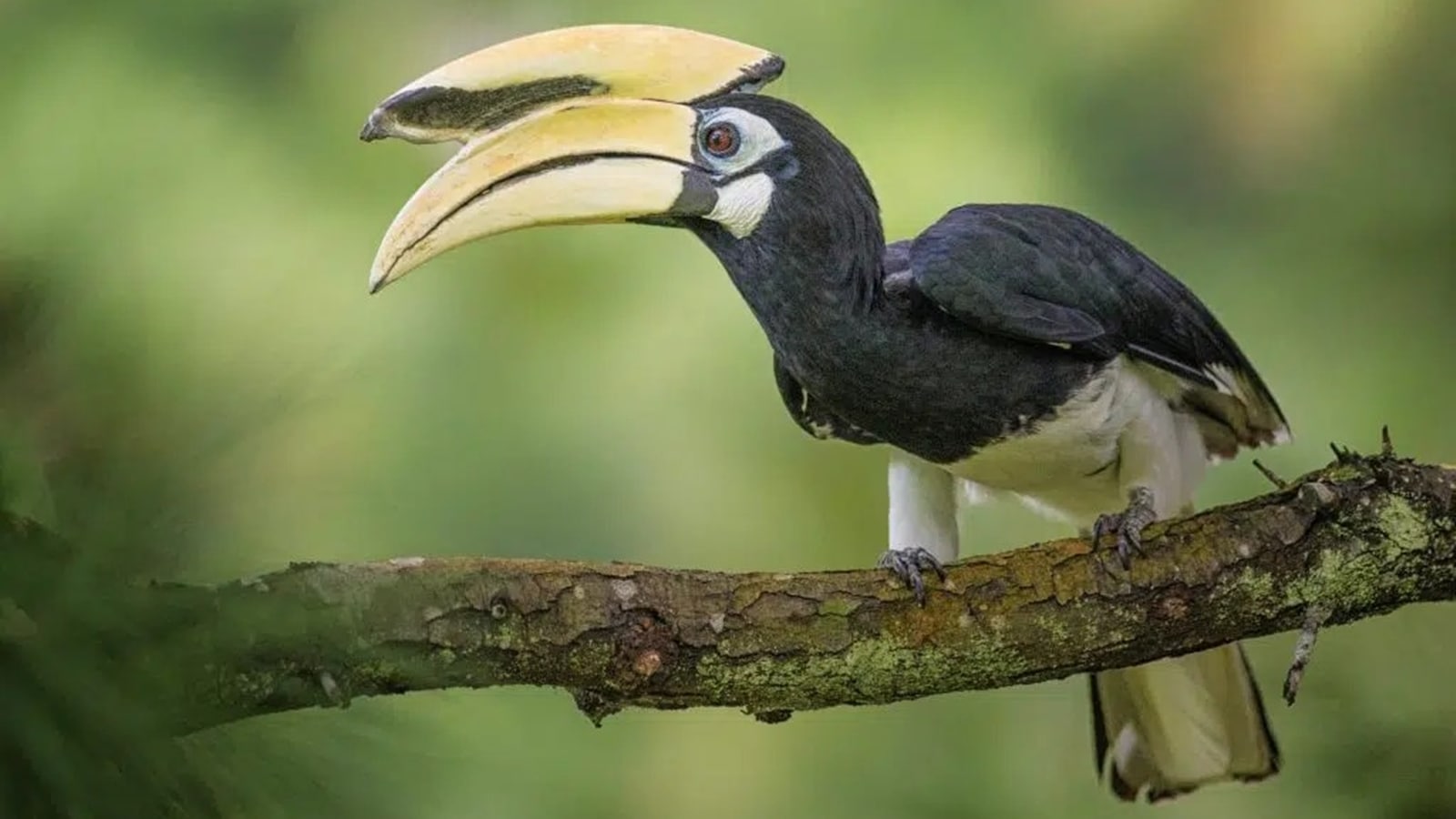 Since 2023, five dedicated teams of hornbill trackers have been trained in operating point-and-shoot cameras, leveraging their traditional ecological knowledge to identify hornbill habitats and monitor nests.
In an effort to provide a permanent haven for the rare Malabar Pied Hornbill and to promote natural forest expansion, the Chhattisgarh Forest Department has started the process of establishing six of what it calls “hornbill restaurants” in the Udanti Sitanadi Tiger Reserve (USTR) in Gariaband district.
The Malabar Pied Hornbill (Anthracoceros coronatus), primarily found in the Western Ghats, was first documented in USTR in 2017. By 2023, sightings increased to one or two per month, and now, one or two are seen every week. The bird stands 2 to 2.5 feet tall, has a large beak and vibrant plumage.
Traditionally associated with the moist forests of the Western Ghats, their population has been increasing in USTR — a reserve where 60% of the area is mountainous with elevations as high as 1,000 metres and a climate similar to the Ghats. The hornbill’s natural predators include leopards, snakes, and the Indian Shaheen Falcon, which has recently seen an increase in population at the Udanti Sitanadi Tiger Reserve.
“Hornbill restaurants” are areas where the bird can find an abundance of its primary diet, fruit. Principal Chief Conservator of Forests (Wildlife), Arun Kumar Pandey, said, “Hornbill restaurant is not an artificial construction. We are developing natural clusters of fruit-bearing trees like peepal, banyan, and other ficus species that constitute the primary diet of the hornbill.”
“The objective of this initiative is to ensure the availability of natural food throughout the year and to promote a secure habitat. Efforts are also being made to plant and monitor the specific trees required by hornbills for nesting,” Pandey said.
On the bird’s ecological importance, USTR Deputy Director Varun Jain said, “They are recognised as keystone seed dispersers in tropical forests. By consuming large quantities of figs and other fruits and dispersing seeds over wide areas, they facilitate forest regeneration, maintain plant diversity, and support the persistence of large-seeded tree species.”
Trees will also be planted in empty patches around villages, which will help people see the hornbills from a comfortable distance and attract eco-tourists to the area. “We will be planting 100 fig trees in two hectares of land at Ondh village… near Baniyadhas waterfall,” Jain said.
Story continues below this ad
One “restaurant” for hornbills was already established in the Sornammal area last year, where 40 hectares of land was planted with peepal and banyan trees.
There are currently about 400-500 hornbills across the reserve’s three ranges — Kulhadighat, Indagaon, and South Udanti. In the most recent assessment by the International Union for Conservation of Nature (IUCN), the Malabar Pied Hornbill was listed in the ‘Red List of Threatened Species’ in 2024, under the ‘Near Threatened’ criteria. As per the IUCN, there are 3,000–32,000 mature individuals of the species in existence. They are found only in the Indian subcontinent.
People have been known to hunt hornbills, as well as the Indian Giant Squirrel, for meat. To prevent this, forest authorities have carried out a crackdown, arresting over 500 poachers, smugglers and encroachers in the last three years. Drones are being deployed to monitor any poaching activity and potential forest fires.
Since 2023, five dedicated teams of hornbill trackers have been trained in operating point-and-shoot cameras, leveraging their traditional ecological knowledge to identify hornbill habitats and monitor nests.

Jayprakash S Naidu is a Principal Correspondent for The Indian Express, currently serving as the state correspondent for Chhattisgarh. With an extensive career in frontline journalism, he reports on the political, security, and humanitarian landscape of Central India. Expertise and Experience Specialized Conflict Reporting: Jayprakash is a leading voice on the Maoist/Naxalite conflict in the Bastar region. His reporting provides a critical, ground-level view of: Internal Security: Tracking high-stakes encounters, surrender programs for senior Maoist leaders, and the establishment of security camps in formerly inaccessible "heartland" villages. Tribal Rights & Displacement: Investigative reporting on the identity and land struggles of thousands of displaced tribals fleeing conflict zones for neighboring states. Governance & Bureaucratic Analysis: He consistently monitors the evolution of Chhattisgarh as it marks 25 years of statehood, covering: Electoral Politics: Analyzing the shift in power between the BJP and Congress and the impact of regional tribal movements. Public Policy: Reporting on landmark infrastructure projects (e.g., mobile connectivity in remote zones) and judicial interventions, such as High Court rulings on civil and family law. Diverse Investigative Background: Prior to his current focus on Chhattisgarh, Jayprakash held reported from Maharashtra, where he specialized in: Crisis & Disaster Management: Notable for his extensive coverage of the Cyclone Tauktae barge tragedy (P-305) and the COVID-19 pandemic’s impact on frontline personnel. Legal & Human Rights: Investigative pieces for platforms like Article-14, focusing on police accountability and custodial deaths across India. Environmental & Social Justice: Authoritative reporting on the Hasdeo Aranya forest protests and the approval of major tiger reserves, highlighting the tension between industrial mining and environmental preservation. ... Read More
Stay updated with the latest - Click here to follow us on Instagram
© The Indian Express Pvt Ltd








 English (US) ·