

 1 hour ago
8
1 hour ago
8
ARTICLE AD BOX
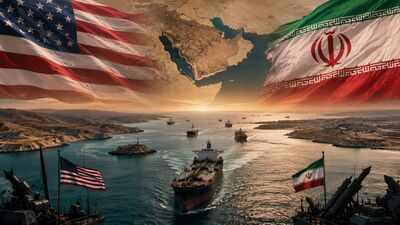
NEW DELHI: The United States and Iran have agreed to halt recent hostilities in the Gulf and resume technical talks over their dispute surrounding the Strait of Hormuz, offering fresh hope for the survival of the June 17 memorandum of understanding (MoU) after days of military exchanges threatened to derail it.
A US official said both sides had agreed to stand down for now and allow commercial vessels to move freely through the strategic waterway while negotiations continue.The renewed diplomatic push comes after both countries accused each other of violating the 14-point interim peace agreement, with the dispute centring on Article 5, the provision governing the reopening of the Strait of Hormuz and the safe passage of commercial shipping.Washington says Iran breached the agreement by attacking commercial vessels transiting the strait, while Tehran argues that US military action and attempts to alter shipping arrangements violate the MoU, which recognises Iran's authority over the strategic waterway.According to Reuters, technical talks on all aspects of the memorandum are expected to continue, while Axios reported that negotiations are likely to resume in Qatar on Tuesday.
The latest breakthrough follows several days of strikes and counterstrikes that pushed the fragile ceasefire to the brink.Also read - 'It's signed': US-Iran MoU officially finalized after both sides digitally sign agreement
Why Article 5 matters
Article 5 is one of the most important provisions of the agreement because it seeks to restore commercial traffic through the Strait of Hormuz, a chokepoint that carries roughly one-fifth of global oil supplies.Following the US-Israeli military campaign against Iran that began on February 28, Tehran imposed a de facto blockade of the strait, disrupting shipping and triggering a global energy crisis.Under the MoU, Iran agreed to reopen the waterway and facilitate commercial navigation while maintaining oversight of the strategic passage.The agreement states: "Iran will make arrangements using its best efforts for the safe passage of commercial vessels with no charge for 60 days only from the Persian Gulf to the Sea of Oman and vice versa."It also requires Iran to remove technical and military obstacles and complete demining operations within 30 days.Another clause provides that: "Iran will conduct dialogue with the Sultanate of Oman to define the future administration and maritime services in the Strait of Hormuz in discussion with other Persian Gulf littoral states in line with the applicable international law and the sovereign rights of coastal states of the Strait of Hormuz."
Competing interpretations
While both countries signed the same agreement, they appear to differ sharply over what Article 5 allows.Iran maintains that the MoU recognises its authority over the Strait of Hormuz and gives it the responsibility to regulate maritime traffic."The Strait of Hormuz remains under the total oversight and management of Iran through the 30 coming days, and after all obstacles are removed, the total capacity of the waterway will be restored. This is what we are working on," Iranian Foreign Minister Abbas Araghchi said during a visit to Baghdad."This responsibility rests on the Islamic Republic of Iran. There is no other party or state in this respect. This is totally clear under the memorandum of understanding, and any intervention or any unilateral action will result in exacerbating the situation and also delay the reopening of the strait."The United States, however, has supported greater international coordination involving Oman and the International Maritime Organization (IMO) to facilitate shipping through the strait, a move Tehran opposes.Iran has repeatedly warned against the creation of alternative shipping corridors that bypass its control.
How the latest crisis unfolded
The latest escalation began after commercial vessels came under attack while transiting the Strait of Hormuz.On Friday, the Singapore-flagged Ever Lovely was struck by a drone. A day later, the Panama-flagged Kiku was hit, prompting fresh US military strikes.Although Iran did not publicly claim responsibility for the attacks, the United States responded by targeting Iranian missile and drone storage sites as well as coastal radar installations.The US military's Central Command (CENTCOM) said: "CENTCOM forces launched strikes today in direct response to continued Iranian aggression against commercial shipping."Iran rejected the accusation and instead accused Washington of breaching the memorandum.Iran's foreign ministry described the US attacks as "a blatant violation" of the UN Charter and a "clear breach of Paragraph 1 of the memorandum of understanding."It added: "These brutal attacks … show that the US does not place the slightest value and credibility on its commitments."The Islamic Revolutionary Guard Corps (IRGC) later announced missile and drone attacks on US military installations in Bahrain and Kuwait, saying they were retaliation for American strikes on Iranian coastal sites.
Shipping traffic declines
Tensions have also affected commercial shipping. Last week, Iran's Revolutionary Guards warned that the northern corridor through Iranian territorial waters was the only authorised route for vessels crossing the Strait of Hormuz.According to maritime intelligence firm Windward AI, four tankers travelling through the southern route in Omani waters were forced to turn back, while three others altered course before completing their transit.The uncertainty has sharply reduced shipping activity. Windward AI reported that daily transits fell from 70 vessels on Wednesday to 54 on Thursday, before dropping further to 40 on Saturday.
Trump warns of further action
Following the latest US strikes, President Donald Trump defended the military response and accused Iran of violating the ceasefire.In a post on Truth Social, Trump said US forces had targeted "Iranian missile and drone storage locations, and coastal radar sites, for violating the Cease Fire Agreement, AGAIN!""There may come a point when we are no longer able to be reasonable, and will be forced to militarily complete the job that we very successfully started," he wrote."If that happens, the Islamic Republic of Iran will no longer exist."US Vice President JD Vance also defended Washington's response."Iran signed a ceasefire agreement. We have honoured it. … But violence will be met with violence."As both sides continue to invoke Article 5 to justify their actions, the clause intended to restore safe navigation through one of the world's most strategic waterways has instead become the central point of dispute threatening the survival of the US-Iran peace agreement.









 English (US) ·