

 5 days ago
6
5 days ago
6
ARTICLE AD BOX
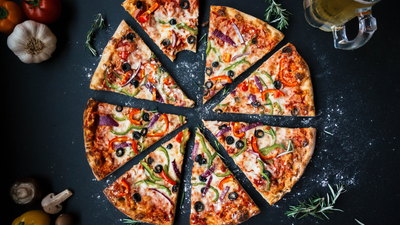
What is the pizza theorem? (image: canva)
If two people pick alternate slices from a pizza that has been cut unevenly from an off-centre point, common sense suggests one of them will walk away with more. But geometry says otherwise.In the field of elementary mathematics, the “pizza theorem” defines the notion that with particular circumstances, the cutting of a circular pizza will sum up to a certain total area, regardless of the location of the cutting point. It is evident that many of the pizza cuts are unbalanced, yet the sum is equal.The theorem has become a popular example in classrooms because it connects intuition, symmetry and rigorous proof in a way students can visualise immediately.
The mathematical setup
Let us consider a circular disk. We define any point inside this disk and draw lines from this point at equal intervals on this disk such that this disk is divided into n segments. Here, n should be a multiple of four but at least eight. The lines are created by rotating an initial line through p repeatedly by an angle of 2π/n radians until the full circle is partitioned.Number the sectors consecutively around the circle. The pizza theorem states that the total area of the odd-numbered sectors equals the total area of the even-numbered sectors.
This means that if two diners take alternate slices, both receive exactly the same amount of pizza, regardless of how far the cutting point is from the centre.The condition that n must be divisible by four is essential. If the disk is divided into four sectors only, or into a number not divisible by four, the alternating areas do not generally balance.
How the idea developed
The problem was first posed in 1967 by Upton as a challenge question.
A solution was published the following year by Michael Goldberg, who approached it through algebraic manipulation of the formulas for sector areas.Later mathematicians explored geometric approaches. Carter and Wagon presented a proof based on dissection, dividing each sector into smaller pieces that can be paired congruently between odd and even slices. Frederickson expanded this method into a broader family of dissection proofs that work for 8, 12, 16 and higher numbers of sectors.Subsequent research refined the theorem further. Don Coppersmith demonstrated that divisibility by four is not merely convenient but necessary. Mabry and Deiermann later clarified what happens when the number of sectors leaves a remainder of 2 or 6 when divided by 8. In such cases, if no slice passes through the centre, the two alternating groups no longer have equal areas, and one can determine precisely which group is larger.Interestingly, when the alternating areas are equal, so is the crust. Researchers have observed that the outer boundary of the pizza is divided evenly under the same conditions. In uneven cases, the diner who receives more total area actually receives less crust.The theorem even extends to toppings. If each topping occupies a disk-shaped region that contains the cutting point, alternating slices will divide the toppings equally as well.
Beyond two diners
This principle can also be extended to multiple people. When a pizza has n sectors of equal angles, with n divisible by four, then it can be divided equally between n/4 people. A pizza with 12 sectors, hence divisible by four, can be divided between three people.Further, researchers have looked at similar issues arising in game theory, where the diner selects the pieces strategically, as opposed to a pre-specified cyclic choice.
Here, the issue of fairness will not be guaranteed, with the mathematical strategies determining the minimum a player will attain.More recently, various mathematicians have modified the concept of alternating sums to incorporate several dimensions. Indeed, it has been noted that with certain configurations of several hyperplanes, the alternating sum of those volumes equates to zero; as such, there exists a prominent multidimensional variant of the pizza theorem that relates to the well-known ham sandwich theorem.
Why this matters for students
The pizza theorem demonstrates that mathematical structure can exist even when visual symmetry disappears. The slices may look uneven, but the underlying geometry of the circle preserves balance under precise conditions.To the students reading this, the theorem offers more than just a good anecdote. It also serves to remind readers of the necessity of well-stated assumptions, demonstrates a strong relationship between a geometric and an algebraic concept, and reveals how a simple setup can result in a century-long mathematical journey.A question about slicing a pizza eventually leads to a discussion of higher-order concepts related to something called symmetry, partitioning, and higher-dimensional geometry.







 English (US) ·