

 1 week ago
18
1 week ago
18
ARTICLE AD BOX
The world may be feeling the pinch of Iran's blockade of Strait of Hormuz, the key oil supply lifeline, amid its war with the US. But Pakistan got a taste of it decades ago when India exerted a covert blockade during the 1971 war. Here's how it unfolded.
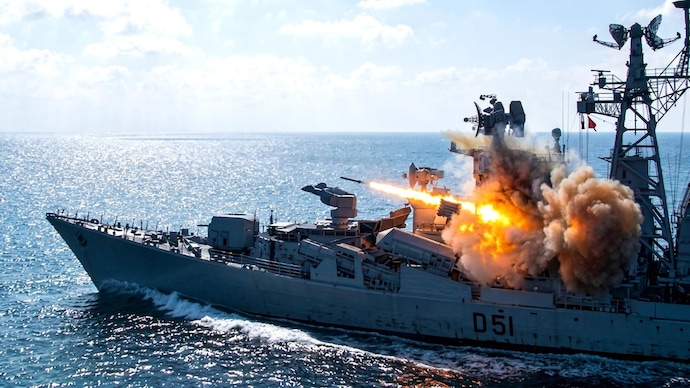
INS Rajput in action in the Bay of Bengal (AP)
"In the 1960s, a misperception had gained ground among the political and military planners that the navy had only a marginal role to play in the armed conflicts India was forced into," former Navy chief SM Nanda wrote in his memoir 'The Man Who Bombed Karachi'. However, it was the same navy that emerged as a pivotal force in the 1971 India-Pakistan war, exerting a covert blockade to break the link between West and East Pakistan (now Bangladesh). The world may be feeling the pinch of Iran's naval blockade in the Strait of Hormuz, the key oil supply lifeline, but Pakistan got a taste of it decades ago.
In 1971, the sea quietly helped decide the war, even though much of the action happened on land. The Iran war too has spilt onto the sea, with Washington and Tehran jostling to take control of Hormuz, which accounts for the supply of a fifth of the world's oil needs. It will prove to be decisive whether the US or Iran gets the bragging rights. The template, however, was set in 1971 by India. 
THE COVERT BLOCKADE IN BAY OF BENGAL
While the navy's bombing of the Karachi port and the Kemari oil refinery, which burned for days, is the stuff of folklore, the story that unfolded in the eastern theatre is lesser known. It might not have had the same spectacle or chutzpah, but it was no less decisive.
During the 1971 war, Pakistan's biggest weakness was its geography. Its major ports (Karachi, Gwadar, Port Qasim) lie on a relatively short coastline facing the Arabian Sea. This made it challenging for Islamabad to defend East Pakistan, which was cut off by over 1,600 km of the Indian landmass. Thus, during the war, this became a liability.
The air route over the Indian subcontinent was also closed after the hijacking of an Air India plane in January 1971. It meant Pakistani aircraft had to go via Sri Lanka around Cape Comorin.
Thus, the only lifeline for East Pakistan was the Bay of Bengal. During peacetime, fuel, arms, and ammunition flowed from Pakistan to its key ports, Chittagong and Cox's Bazar.
Indian military planners were already aware of this vulnerability. Cut the sea route between Pakistan and East Pakistan, and the war was half won. When the war broke out on December 3, 1971, India moved the pieces on the chessboard in the Bay of Bengal quickly.
Then the Eastern Command, which is headquartered in Andhra Pradesh's Visakhapatnam, was led by Vice Admiral N Krishnan. Krishnan understood it was important to cut off Karachi from Chittagong.
The instructions from the then Navy chief, SM Nanda, were clear - destroy Pakistan's lines of communication.
"India did not formally declare a naval blockade, likely to avoid diplomatic complications. But in practice, its actions amounted to precisely that," defence expert Sandeep Unnithan told IndiaToday.in.
If a formal blockade order had been issued, India would have risked taking on big powers like the US or Great Britain. Delhi wanted to avoid that. 
HOW INS VIKRANT BECAME INDIA'S VITAL COG
At the heart of the naval operation was India's first aircraft carrier, INS Vikrant, which was bought from the UK and commissioned a decade ago. Call it fate or sheer luck, but the INS Vikrant wasn't supposed to be in the eastern theatre. The ageing but formidable aircraft carrier was moved a few months ago due to a technical glitch.
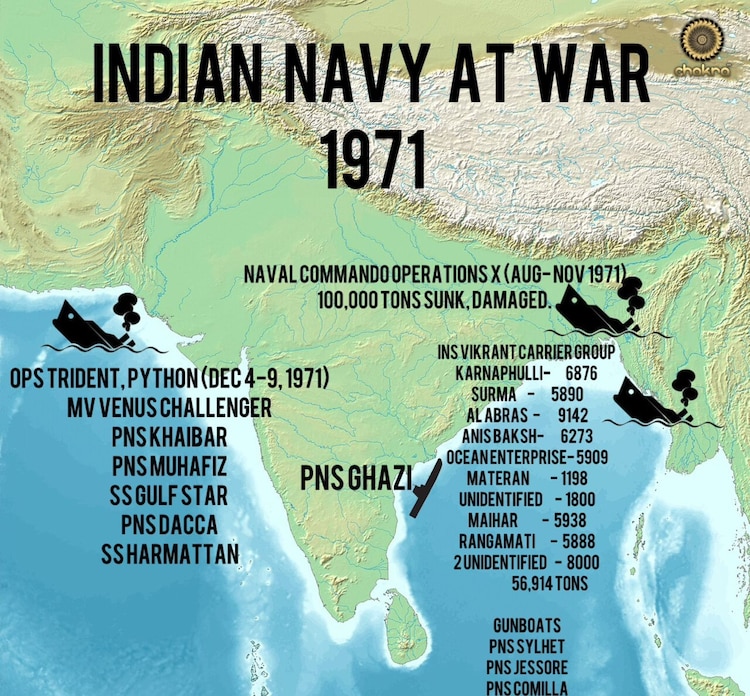
India was aware INS Vikrant would be among Pakistan's top targets. It deployed submarine PNS Ghazi to pursue the carrier. However, India was up to the task. To mislead PNS Ghazi, the Navy deployed the ageing destroyer INS Rajput as a decoy.
Heavy wireless signals were sent out to make Pakistan believe that INS Vikrant was in the vicinity. In fact, the carrier was moved secretly to the Andaman and Nicobar Islands.
Pakistan took the bait. On the night of December 3, 1971, INS Rajput detected suspicious underwater movement near the Vizag coast. It released an anti-submarine warfare (ASW) weapon in the area. Soon, a powerful explosion was recorded. The next morning, debris believed to be from the PNS Ghazi was found near the harbour.
Till this day, Pakistan claims the submarine was destroyed due to an internal accident. Nevertheless, the sinking of PNS Ghazi eliminated a significant danger at the outset of the war.
INS Vikrant and its carrier group, consisting of frigates, corvettes and support ships, were ready for action. 
HOW BLOCKADE FORCED PAKISTAN TO SURRENDER
The first strikes on East Pakistan's coastal facilities came from the air, launched by Sea Hawk fighter jets that took off from Vikrant.
Ports, fuel depots and logistical infrastructure were struck with impunity in Chittagong, Cox's Bazar, Khulna and Mongla. Harbours that once bustled with activity fell silent under repeated bombardments.
Then came the real shift. The warships now started patrolling the sea lanes leading into East Pakistan. More than the strikes, the presence of Vikrant and the warships signalled control.
While there was no formal declaration of any blockade like Trump did of Iranian ports, its effect was undeniable. Merchant vessels automatically avoided the area amid repeated sorties by Indian jets and ships. Several were trapped either in East or West Pakistan, like we are seeing in the Persian Gulf. War risk insurance premiums skyrocketed.
The blockade crippled maritime movement.
It meant Pakistani forces in East Pakistan had no escape route via the sea. Supplies and reinforcements also could not be sent from Pakistan. Its eastern forces were isolated. East Pakistan essentially became a landlocked country.
What compounded the problem for Pakistan was that it had limited naval assets in East Pakistan - mostly small gunboats and patrol vessels. These were no match for a coordinated fleet supported by an aircraft carrier. All its advanced ships were deployed near Karachi in the Arabian Sea.
This meant there was no real challenge to the Indian Navy in the Bay of Bengal.
The naval blockade proved significant for the army's ground campaign. With reinforcements not coming via the sea, the Indian Army and the Mukti Bahini advanced rapidly towards Dhaka. At the same time, the Air Force established complete dominance over the skies.
THE ENDGAME
In such conflicts, when forces smell defeat, they try to retreat through the sea. During World War II, British and Allied troops managed to escape from Dunkirk in northern France as Germany could not control the sea. In 1971, a similar large-scale evacuation was not possible due to India's naval blockade.
Only one of Pakistan's gunboats, PNS Rajshahi, managed to evade the India Navy and escape into Myanmar.
By mid-December, Pakistani forces in Dhaka were surrounded on land and cut off at sea. Only one option was left. On December 16, 1971, Lieutenant General AAK Niazi surrendered with 93,000 troops to Indian forces. It remains one of the largest military surrenders since World War II.
The missile strikes on the port of Karachi would make front-page headlines. The daring ground offensive made history. But the silent naval blockade by the Indian Navy ensured that forces in East Pakistan could not receive arms or additional support. The outcome of the 1971 war was, in fact, sealed at sea due to the naval blockade in the Bay of Bengal. 
NAVY ROLE IN OPERATION SINDOOR
A similar pattern was seen decades later, during Operation Sindoor in May 2025. The mere threat of the Indian Navy's presence in the Arabian Sea, with Karachi being in the line of fire, created enough pressure on Pakistan to move towards a ceasefire.
This showed how a powerful navy can be a tool of coercion. By threatening a blockade, an adversary, whose economy is heavily dependent on the sea, can be forced to negotiate, as was seen during the 1971 war or Operation Sindoor.
Pakistan, like India, depends heavily on the sea for its energy supplies. The effect was seen during the Iran war and the subsequent closure of the Strait of Hormuz.
However, while India has strategic fuel reserves that can last for several weeks, Pakistan has a very limited stockpile. This makes it particularly vulnerable during any conflict. This vulnerability can be exploited by India in case of any future conflict.
- Ends
Published By:
Abhishek De
Published On:
Apr 18, 2026 12:01 IST
Tune In








 English (US) ·