

 1 hour ago
7
1 hour ago
7
ARTICLE AD BOX
When police don’t shoot to kill: UP’s growing ‘half encounter’ list
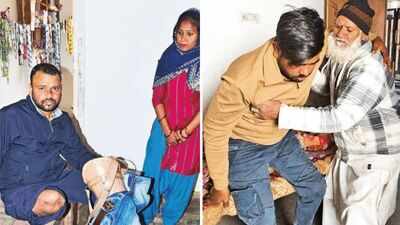
NEW DELHI: Sushil Kumar, a 22-year-old Shamli resident, was picked up by UP Police from his home on Dec 16 last year. The next day, his family was told that he had been shot in the leg. Police said they were forced to fire while arresting him in connection with a loot case.
His mother Munesh Devi, however, claims Sushil was taken away over his alleged ties with a girl.“ Apna achha kaam dikhaane ke liye wo kisi ko bhi uthaakar goli maar dete hain (to show that they are doing a good job, they pick up anybody and shoot them),” she says of the police. Her son —whose wife is six months pregnant — ran a small confectionery shop and was the family’s sole breadwinner, Munesh Devi said, adding that her two other sons are incapacitated.Thousands like Sushil are now left facing a punishing — in some cases, lifelong — ordeal for being named a crime accused in UP. And that’s even before courts have had a chance of pronouncing them guilty.Encounter deaths have been common, but away from the headlines, the count of those ending up maimed keeps creeping up every time police aim below the waist — to avoid fatalities — in their hunt for an alleged criminal.Accused & condemnedIn the nine years till mid-May this year — after the Yogi Adityanath-led BJP govt came to office in 2017 promising ‘zero-tolerance’ against crime — 289 criminals had been killed in 17,043 police encounters. Over 34,000 accused were arrested and 11,834 of them — nearly a third — were injured, creating a growing list of survivors of what are termed “half encounters”. Data released by UP DGP HQ and accessed by TOI shows 3,153 such injuries recorded in 2025, compared with 1,823 in 2024.
Many of those who are shot survive with life-changing injuries while their cases continue in court. But getting away with their lives does not mean they have got away lightly, especially when their family members, too, have to suffer the consequences.Take the case of Semaan Khan, 25. He was returning from a relative’s place in Muzaffarnagar on Oct 17, 2020, when he was intercepted by UP Police personnel. Shots were fired and one bullet pierced his spine.
That left the resident of Teherki village in Sardhana tehsil of Meerut paralysed waist-down.“My family’s savings have been exhausted by medical bills. My father died of stress two years ago. My brothers are married and have lives of their own. I am losing hope of justice, too,” said Seeman.His shooting led to a departmental probe against the policemen involved. Transfers followed, but his uncle Irshad Khan says the family’s hopes of compensation diminished after Semaan was booked in a separate case of motorcycle theft, a charge they deny.Then there’s Shera Singh, 35, who was shot in the leg in March last year in an encounter in Bareilly Cantonment. The injury later required amputation. He now uses a prosthetic limb. Police records describe him as a history-sheeter with multiple cases. Shera does not deny that cases were registered against him, but disputes the circumstances leading to the firing. “My biggest concern is providing for my five children.
How long can I remain dependent on my father?” he says.His father, Arjun Singh, says Shera Singh did not get necessary medical treatment after being shot. “His leg got badly infected. He was taken to court bleeding. The judge reprimanded the police for their insensitivity and sent him back for medical care. He was later made to sign a consent form for amputation,” he says.What HC has saidAllahabad HC said on Jan 31 that presenting shootings in non-vital parts of the body as encounters had become routine.
The bench headed by Justice Arun Kumar Singh Deshwal said only courts are empowered to punish offenders and that firing with intent to injure cannot be justified as standard policing. Police shootings reflect a pattern that risks undermining judicial authority, observing that firing at suspects and presenting the incidents as encounters cannot replace due process.UP Police, for its part, put down such actions to the exigencies of fighting crime.
“Police resort to firing only in self-defence or when the situation becomes extremely necessary. Even in such situations, we are trained to shoot in the leg to avoid fatality. There have been hundreds of incidents in the last eight years in which policemen have lost their lives while over a thousand sustained injuries. But we still try to avoid full encounters.
But if any police personnel is found involved in excesses, we do take action,” DIG (Bareilly range) Ajay Sahani told TOI .But the family of Zeeshan Haider say they’ve had a different experience. Police took Zeeshan, 45, from his home in Deoband in UP’s Saharanpur district for questioning in connection with an alleged cow-slaughter case. It was Sept 2021. The next morning, they were informed that he had been shot and admitted to the district hospital. “We rushed there, only to find Zeeshan’s body lying in the mortuary. He had succumbed to excessive bleeding,” says his cousin, Isa Raza.Zeeshan’s widow, Afroz Alam, 47, sought to register an FIR against 12 policemen. It was registered two years after the incident and only after the intervention of a local court. Five years later, the trial is yet to begin. The accused officers remain posted in Saharanpur district. The family alleges continued pressure to agree to a compromise.Senior lawyer and human rights activist Vrinda Grover pointed out how courts have expressed concern over the “the pervasive culture of impunity for trigger-happy cops” and the challenge of bringing them to justice.“Despite the Supreme Court’s clear direction since 2014, it still takes years of determined efforts by victim families to even get the complaint registered against the fake encounter police team,” she said, adding that can be followed by an investigation that “drags on for years”.“Allahabad HC has delivered a very significant ruling by unambiguously declaring ‘half encounters’ by police as illegal and a gross criminal abuse of power.
The guidelines laid down the HC supplement the directions prescribed by Supreme Court in 2014. For these guidelines to become effective deterrents, it is necessary that investigation and trial of all cases of fake police encounters are monitored by the court.
Only then can there be any hope of accountability,” said Grover.Rihana Adeeb, a Muzaffarnagarbased human rights activist and director of the NGO Astitva, said: “Rule of law has become a myth here.
The state is witnessing unchecked police raj. The fact that despite high court’s reprimand, police encounters continue unabated speaks volumes about the judicial process being bypassed.” She underlined that “the suffering does not end there” for police shooting survivors. “They are forced to deal with FIRs, medical treatment, prolonged legal battles, and crippling financial distress. Even those of us who speak up for their rights are made to face repercussions.”



 English (US) ·