

 12 minutes ago
2
12 minutes ago
2
ARTICLE AD BOX
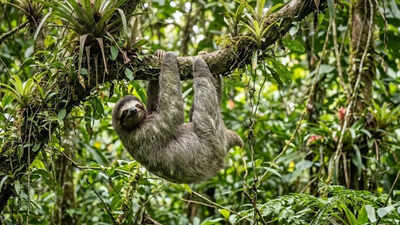
Sloths spend most of their lives avoiding the forest floor. They sleep in trees, feed in trees, mate in trees, and move with such caution that some species can remain almost invisible in the canopy for hours at a time.
Coming down to the ground exposes them to many of the predators they are otherwise built to avoid. Yet despite that risk, several sloth species still make a slow descent every few days simply to defecate. The behaviour has puzzled biologists for decades because it appears inefficient and dangerous. A sloth on the ground cannot move with the same control it has among branches, and the trip itself uses energy that these animals conserve carefully.
Even so, the pattern continues across generations. Explanations now tend to centre on a mix of digestion, camouflage, nutrient exchange, and the strange ecosystem that lives directly on a sloth’s body. None of the ideas fully settles the question on its own, which is partly why the behaviour continues to attract attention from researchers studying rainforest mammals.
Why pooping on the ground remains dangerous for sloths
Tree-dwelling mammals usually avoid unnecessary movement, especially species with extremely slow metabolisms.
Sloths are among the clearest examples of that strategy. Their bodies process food gradually, and their low-energy lifestyle depends on avoiding wasteful activity whenever possible.Even with that limitation, many sloths descend roughly once a week to defecate near the base of a tree. According to the report of the Sloth Institute, the animal often digs a small depression with its tail before relieving itself and then covers the area lightly with leaf litter or soil.
The trip may last only a short time, though it still places the sloth in a far more vulnerable position than it would occupy in the canopy.Researchers have long questioned why evolution would preserve a habit that seems to increase danger without obvious benefit. Jaguars, ocelots and large birds of prey are all more threatening when a sloth is exposed at ground level. In forests where survival often depends on remaining unnoticed, repeated descents appear counterintuitive.
How moths and algae may explain sloths’ risky poop behaviour
Part of the explanation may involve an unusual relationship between sloths, moths and algae. Sloth fur supports entire miniature ecosystems. Certain moth species live within the animal’s coat, and scientists have proposed that their life cycle may partly depend on sloth dung deposited on the forest floor. The study published in ResearchGate, titled “Why Do Sloths Poop on the Ground”, examined whether this behaviour could help maintain the biological community living in sloth fur.
According to the study, moths leave the sloth after defecation to lay eggs in the dung. Once mature, the new moths return to the animal’s coat, where they continue living among the fur and moisture trapped there.That connection may also influence algae growth. Sloth fur often carries a greenish tint caused by algae that thrive in the damp outer hairs. Some researchers suspect nutrients linked to the moth population help sustain that growth.
The algae may provide camouflage by helping the sloth blend into moss-covered branches and wet tropical vegetation, particularly during the rainy season when forests appear densely green.The relationship is unusual because it is not entirely clear whether the sloth benefits directly or simply tolerates the organisms living on its body. The balance may involve small advantages rather than a single major evolutionary gain.
How slow digestion may shape sloth’s unusual poop behaviour
Sloths process leaves slowly, sometimes taking days to digest a meal fully. Their stomachs function through fermentation, and the digestive system occupies a large portion of the body cavity. Because digestion is so gradual, waste builds up over several days before elimination takes place.Some researchers have suggested that defecating from a tree could create hygiene problems around feeding and resting areas.
Depositing waste at ground level may reduce lingering scent near branches the sloth uses regularly. That theory has circulated for years, although evidence remains incomplete. As per the study by The Sloth Institute also discusses energy trade-offs. Climbing down requires effort, but the amount of energy lost may remain relatively small because sloths descend infrequently.
Their extremely slow lifestyle changes how movement costs are measured compared with faster mammals.
There is still disagreement over which explanation matters most. The behaviour may not stem from one single cause at all. Biological habits sometimes persist because several smaller functions overlap rather than because of one decisive advantage.
Why sloths continue one of the forest’s strangest survival habits
Modern wildlife tracking has answered many questions about rainforest mammals, though sloths remain difficult to study in detail because of their quiet behaviour and inaccessible habitat.
Much of their daily life happens high above the ground in dense canopy cover, where direct observation is limited.What appears odd to humans may fit into a larger ecological system that evolved gradually over millions of years. The descent to defecate, risky as it seems, may support relationships between the sloth, its fur ecosystem, rainforest soil organisms and even surrounding vegetation.Scientists still debate the balance between those factors. Theories continue to shift as more field observations emerge. For now, the behaviour remains one of the stranger examples of how survival in tropical forests does not always follow the most obvious logic.









 English (US) ·