

 1 hour ago
5
1 hour ago
5
ARTICLE AD BOX
One of the season's first intense spells of monsoon rain has inundated Mumbai's roads and subways. But, the reservoirs and lakes supplying drinking water to Mumbai are at seven percent of their capacity. We explain what's behind this paradox.
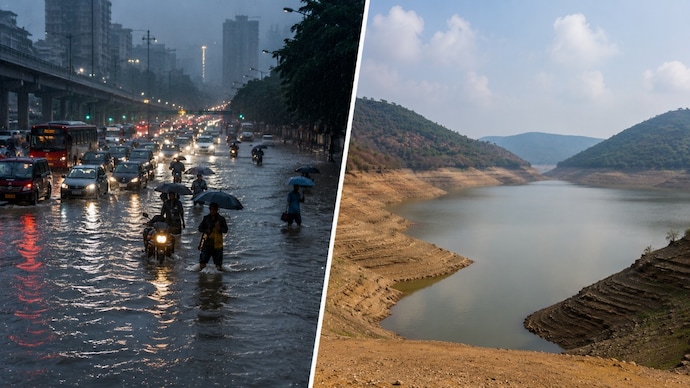
While Mumbai roads are submerged, the lakes feeding the city are dry. (Image for representation: Generative AI)

New Delhi,UPDATED: Jul 1, 2026 17:29 IST
If irony could fill reservoirs, India's financial capital Mumbai would have enough water for the next three summers. But that's not the case.
On one hand, motorists in Mumbaikars spent Wednesday morning wading through waterlogged roads to get to their workplaces. The crucial Andheri subway is inundated. Vehicular traffic crawled along the Western Express Highway as several neighbourhoods in Mumbai received over 100 mm of rain in just 24 hours, said officials of the Indian Meterological Department (IMD).
But officials in another government department are tracking a more worrying number. The reservoirs and lakes that supply water to Mumbai and keep it hydrated, are holding less than 7% of their live storage (as of June 29).
It is perhaps Mumbai's greatest monsoon irony. Mumbai appears to be drowning while simultaneously having to worry about running out of drinking water. These reports are baffling. The explanation of the paradox is in understanding the fact that the rain flooding Mumbai's roads and subways and the water filling the reservoirs that feed the city do not always travel the same path.
Mumbai received one of its first intense spells of monsoon rain on Wednesday, with several areas recording more than 100 mm in a day and low-lying stretches going underwater. But, just two days earlier, the Brihanmumbai Municipal Corporation (BMC) reported that the city's seven reservoirs had just 6.93% of their live storage left, compared to 39.5% at the same time in 2025.
So, what's behind it? Why are Mumbai's roads full of water? Lakes aren't.
WATER FLOODING MUMBAI IS NOT THE ONE THAT FLOWS IN TAPS
Come monsoon, Mumbai reminds the country that flooding and water scarcity can co-exist. The Mumbai roads that are underwater this week are a result of heavy rainfall in the city.
But, the reservoirs that store and supply drinking water depend on a different process to replenish themselves. The seven lakes — Bhatsa, Upper Vaitarna, Modak Sagar, Tansa, Middle Vaitarna, Tulsi and Vihar — collect water over time. Rain feeds their catchments and eventually flows into the reservoirs, according to a PTI report.
This process is far slower than the one that floods roads, streets and subways. The filling of these freshwater reservoirs is a gradual process that unfolds over the four-month monsoon. It's not after a single spell of heavy rain that fill up these water bodies.
In cities like Mumbai, cloudbursts or prolonged spells of rain can overwhelm storm-water drains, especially if they haven't been desilted, within hours. Reservoirs, on the other hand, require a sustained inflow of water over days and weeks before storage begins to rise substantially.
That is why just a day of heavy rain brings up the striking visuals from Mumbai's streets even as the city stares at a potential drinking water scarcity.
WHAT'S BEHIND MUMBAI'S DRINKING WATER CRISIS?
The shortage of drinking water gripping Mumbai today is the result of what happened (or rather, what did not happen) through most of June. Yes, it's the monsoon rains.
The southwest monsoon usually reaches Mumbai around June 10 after hitting the Kerala coast a week (or weeks) earlier. This year, however, it arrived later than usual. During those weeks, the reservoirs on the outskirts of Mumbai continued supplying nearly 4,000 million litres of water every day. Meanwhile, they received far less replenishment than expected.
The BMC's data show the bigger picture. On June 17, the seven reservoirs supplying water to Mumbai held 10.01% of their useful storage. By June 29, the number dropped to just 6.93%.
The seven lakes are located across the Mumbai Metropolitan Region and neighbouring districts like Thane, Palghar and Nashik. Together, they form a system that supplies around 4,000 million litres of drinking water to Mumbai every day.
This year the situation is worse than last year. Around the same time in 2025, Mumbai's reservoir storage stood at 39.5%. One important reason was that the monsoon had arrived unusually early, allowing the lakes to begin filling weeks in advance. This year, Mumbai entered the monsoon with its reservoirs already depleted.

SO, WHY MUMBAI FLOODS FASTER THAN RESERVOIRS FILL
For anyone watching flooded streets and reading this piece, there must be a question that, where does all the rainwater falling on Mumbai go? Frankly, much of it is never used, let alone be turned into drinking water.
When intense rain falls over a city built largely of concrete, asphalt and buildings, water runs across roads into storm-water drains. If the rainfall is heavier than what the drainage network can carry (or if drains are clogged or high tides slow the outflow), water accumulates in the urban pockets almost instantly.
That is precisely what happened in places like the Andheri subway and Wadala on Wednesday. Commuters found themselves trapped and navigating knee-deep water. But reservoirs, as usual, were following a different clock. They do not respond to a few hours of heavy rain but to the prolonged and cumulative effect of repeated rainfall across the monsoon season. That's how the lakes and reservoirs get filled.
Also, these lakes are outside the city limits, spread across Thane, Palghar and Nashik districts. Their water levels don't depend on a single spell of heavy rain in Mumbai. So, this scenario gives birth to another situation where not all the seven reservoirs are at the same level. This is also equally important in explaining why one day's rainfall in Mumbai would not replenish its lakes.
Even rainfall is naturally uneven. During the 24 hours before the June 29 assessment, two of the seven lakes in northern Mumbai — Tulsi and Vihar received 179 mm and 110 mm of rain, respectively. Meanwhile, Modak Sagar in Thane district recorded only 38 mm of rain.
This data shows why one rainy day cannot transform Mumbai's overall fresh water availability position.
Even though monsoon has arrived, nothing will change overnight for the reservoirs feeding Mumbai. The seven-lake system supplies around 4,000 million litres of potable water every day to the city and its metropolitan region. Until the inflow exceeds the volume of water supplied from them, storage is expected to remain under pressure.
That explains why the BMC imposed a 10% water cut in May and later increased restrictions for industrial and commercial users. So, to sum up the piece, monsoon, though delayed, might have finally arrived in Mumbai, but for its reservoirs and civic authorities, the test has only begun. Until weeks of sustained precipitation can replenish the seven-lake system, Mumbai could continue to face a drinking water shortage even as its roads and subways remain submerged.
- Ends
Published By:
Sushim Mukul
Published On:
Jul 1, 2026 17:29 IST






 English (US) ·