

 1 hour ago
6
1 hour ago
6
ARTICLE AD BOX

Indian cities face dangerously warmer nights, harming health (AI image used for representational purpose only)
Nights are warming faster than days because our cities are using more and more concrete, which retains heat, making a 45 degrees Celsius summer feel like 50 and stealing precious hours of sleep from the urban population. It’s time to treat night warming as a public health emergency.Known to “sleep like a log”, the joke in Shantanu’s family is that an earthquake wouldn’t wake him up. Ten years into his new life in Delhi, the family’s most famous sleeper is spending half the night just trying to sleep, waking up at odd hours, and to the faintest of sounds.
“Some nights in these last few weeks have felt like a series of short naps. It was the same during the heatwave last summer,” says the communications executive in his mid-40s, who lives in a housing society in NCR, coping with “real feel” temperatures nudging 50 degrees Celsius.Sound sleepers like Shantanu have turned into fitful sleepers, early sleepers are struggling to wind down, and late sleepers are seeing bouts of insomnia. And this is in urban houses with good air conditioning. In homes of the less privileged, a recent Climate Trends study, based in Chennai, found indoor night temperatures frequently crossed 32 degrees Celsius. Coupled with high humidity, the feeling would be similar to being in a sauna, except this by force.
Heating up of nights is accelerating across Indian cities, affecting the resting phase of people working through the day, stealing hours of deserved sleep from the urban population and exposing it to, or worsening, health problems like hypertension and diabetes. In a study, researchers from IIT-Delhi’s Centre for Atmospheric Sciences have found nighttime temperatures in densely built NCR areas to be 2-4°C higher because of urban heat island effects.
Another Delhi-focused study found nighttime urban heat island intensity reaching 4-6°C during some months.Little recovery time for bodyBecause of dangerously warming nights, doctors say the body is under almost continuous heat stress for 24 hours, making rising nighttime temperatures one of the most serious but least understood public health threats that is linked both to climate change and side-effects of urbanisation such as reduction of greenery and the concrete wrapping of gentrification.“Hot nights don’t let the body recover. Under normal conditions, body temperature naturally drops during sleep, allowing the heart, brain and other organs to rest. But when nights remain excessively hot, this cooling process fails,” explains Dr Amlendu Yadav, head of emergency medicine at Dr Ram Manohar Lohia Hospital in Delhi.“During heat waves, the body depends on cooler nights to recover from the day’s heat.
However, when nights remain unusually hot, heat from the previous day remains stored in the body and additional heat gets added the next day,” he adds.A 2025 report by Council on Energy, Environment and Water (CEEW) found very warm nights have risen faster in the last decade than very warm days, exacerbating the harshness of summer for millions of Indians.Compared with the 1982-2011 period that it took as baseline, it found 70% of districts saw at least five additional very warm nights per summer (March-June) in the decade ending 2021-22, while 28% saw five or more additional very hot days.
Mumbai tops concrete impactIt found Mumbai bearing the worst of India’s night warming with 15 extra very warm nights per summer, followed by Bengaluru (11), Bhopal and Jaipur with seven each, Delhi six and Chennai four. Delhi’s increasingly grimy summers, with a soaring discomfort index, is explained by an almost 9% rise in relative humidity over the last decade.The resultant impact on the body’s cooling system, says Dr Yadav, directly affects cardiac health.
“People sweat through the night, losing fluids even during sleep and wake up already dehydrated before the day begins. The heart also has to work harder to maintain body temperature. Over days, this continuous strain can overwhelm the body’s naturalcooling mechanisms. When these systems fail, the body temperature can rise dangerously, leading to heatstroke,” Yadav says, emphasising heatstroke is not simply “high fever” but could evolve into a life-threatening multi-organ emergency.“Heatstroke can affect the brain, kidneys, liver, muscles and lungs simultaneously. It can cause confusion, unconsciousness, seizures, kidney injury andsevere cardiac stress,” he says.Dr KK Talwar, chairman, PSRI heart institute, former chairman of Medical Council of India, former head of cardiology at AIIMS Delhi, says when nights are very warm, the pulse rate goes up. “Since the body cannot cool itself properly, this puts extra burden on the heart,” he explains, adding the elderly are more vulnerable.
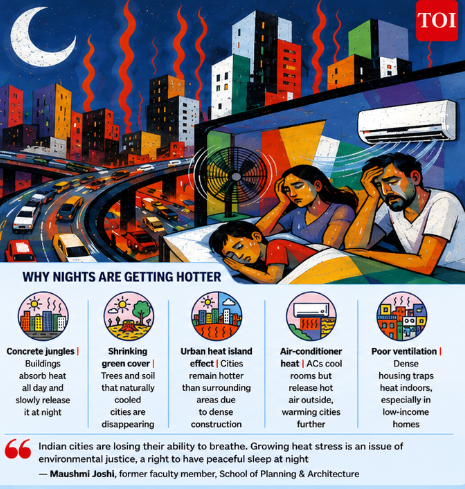
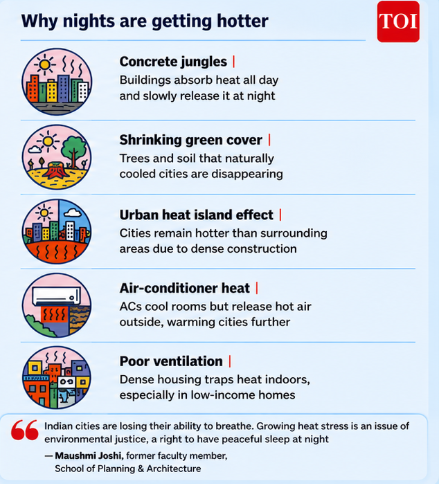
“Physiological protective mechanisms are compromised at an advanced age. Those with underlying cardiac problems are also at risk,” he adds.Why cities stay hot after sunsetScientists say the primary reason behind rising nighttime temperatures is the rapid transformation of Indian cities into giant “heat-retaining” landscapes.IMD director Mrutyunjay Mohapatra says cities are increasingly experiencing the “urban heat island effect”, where densely built urban regions remain significantly hotter than surrounding areas because concrete structures trap and slowly release heat.So, if you are walking at ITO in Delhi or Lower Parel in Mumbai on a midsummer afternoon, you are probably experiencing an effective temperature of 45 degrees C when the atmospheric temperature is 40 degrees C because of the heat generated by your glass and chrome surroundings.Mohapatra blames expanding concrete infrastructure for the urban heating problem. “Concrete structures absorb heat during the day and release it slowly at night, preventing proper cooling after sunset,” he says.Mohapatra says since heatwaves in India are becoming more frequent, prolonged and intense because of climate change, urban heating and nighttime heat stress now needed greater policy attention.Concrete change in local climateEnvironmentalist, ecologist and Delhi University Professor Emeritus CR Babu says Indian cities have steadily replaced natural ecosystems with “concrete jungles”, fundamentally altering local climate systems. Fallow land, for example, has given way for concrete walkways and paved road shoulders in most cities. “In natural ecosystems, soil, moisture and vegetation regulate temperature through evaporation and cooling. But cities have replaced these systems with concrete surfaces that absorb and retain heat,” Babu says.“Concrete does not behave like soil. Soil retains moisture and supports evaporation-based cooling, but concrete absorbs heat during the day and slowly releases it through the night. That is why cities are no longer cooling after sunset,” he explains.According to him, shrinking green cover has worsened the problem because vegetation has what scientists call a “microclimatic regulation” effect. “This means trees, soil moisture and vegetation regulating local temperatures, a system that is collapsing in Indian cities,” Prof Babu says. “Even residential areas are increasingly replacing soil and open spaces with tiles and cemented surfaces. This is further reducing cooling capacity”.Babu criticises current compensatory afforestation practices where trees cut in cities are replaced wherever land is available, which could be in another part of the country. “If you cut trees in densely populated urban areas and plant elsewhere, it has no meaning for the city’s local climate,” Babu says.
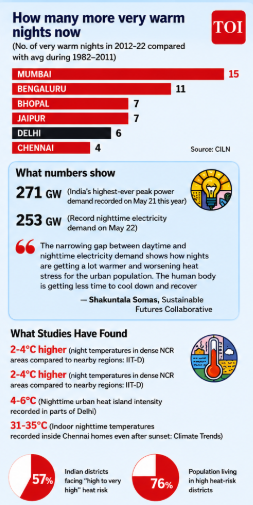
Homes becoming heat trapsThe Climate Trends study conducted in 50 low- and middle-income households in Chennai found while indoor nighttime temperatures frequently remained above 31-32°C, some homes recorded nearly 35°C even after sunset.
Researchers blamed dense housing, poor ventilation, shrinking green spaces and concrete-heavy construction for trapping heat indoors.Prof Monika Arora, vice-president at Public Health Foundation of India and founding governing board member of Healthy India Alliance, says while the urban heat island effect is worsening because of excessive concretisation and shrinking green cover, low-income families who cannot afford air conditioners are the most affected by heat stress.“Besides, ACs extract heat from indoor environments and exhaust it directly outdoors. This creates a thermal feedback loop where cities become hotter and cooling demand rises further,” she explains.Architect and former SPA Delhi faculty member Moulshri Joshi says all this has collectively led to Indian cities losing their ability to “breathe”. She describes growing heat stress as “an issue of environmental justice, a right to have peaceful sleep at night”.
“The way we build houses has not changed much over the decades. What has changed drastically is the surrounding environment — trees have been cut, open spaces reduced and land heavily concretised,” she says. According to her, buildings absorb heat all day but fail to release it because there is little shade and poor airflow around them. “As a result, homes are turning into heat traps, especially in dense urban neighbourhoods,” Joshi said.A public health emergencyThe impact of hotter nights is becoming visible in India’s electricity consumption patterns as well. India’s peak power demand touched a record 271 GW on May 21 this year, while nighttime demand also reached a historic high of 253 GW on May 22.Shubhranshu Suman of Sustainable Futures Collaborative says the narrowing gap between daytime and nighttime electricity demand shows how nights are getting a lot warmer and worsening heat stress for the urban population.
“The human body is getting less time to cool down and recover,” he says, adding rising nighttime cooling demand also increases risks of power shortages, load-shedding and financial stress because of high consumption of electricity.Experts say India’s heat action plans focus too heavily on daytime heatstroke while ignoring indoor nighttime heat exposure. Prof Arora says heatwaves can no longer be treated merely as weather events. “This is now a rapidly escalating public health emergency driven by climate change,” she says, adding that future urban planning must prioritise cool roofs, shaded public spaces, ventilation corridors, open green areas, climatesensitive housing and equitable cooling access for vulnerable populations.









 English (US) ·