

 1 hour ago
3
1 hour ago
3
ARTICLE AD BOX
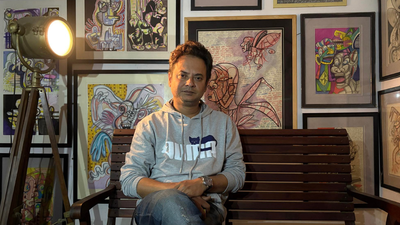
KOLKATA: Following his demise on location for his latest project, ‘Bhole Baba Paar Karega’, Rahul Arunoday Banerjee left behind a legacy that is both diverse and deeply rooted in the soil of Bengal.
While veterans like Soumitra Chatterjee had compared his instinctive acting to that of the legendary Kali Banerjee, his peers remember him as an underrated actor par excellence whose acting journey began at the age of three with his father’s theatre troupe, Bijoygarh Atmaprakash. The stage-bred discipline remained the backbone of his craft and found an expression of his sensitivity in his last play, ‘Je Janlagulor Akash Chilo’.For many, Rahul was an actor who could effortlessly bridge the gap between the glossy world of commercial cinema and the intellectual rigour of the art house, always maintaining a sense of raw, relatable humanity that made him a household favourite.
He shot to fame with the 2008 blockbuster ‘Chirodini… Tumi Je Amar’. That film did more than just establish him as a star; it redefined the image of the romantic hero in Tollywood, replacing the polished archetypes of the past with a visceral, rural intensity.
“I needed someone with a boy-next-door look for this film. The character I cast him in had innocence written on his face. Rahul, who was doing ‘Khela’, was right for the role.
He played a character that was completely different from the larger-than-life heroes Bengali cine-goers were used to watching then. That film was a huge hit and Rahul and Priyanka did a lot of work together after that. It is unfortunate that he didn’t reach the zenith that I felt he had the potential to reach,” said ‘Chirodini… Tumi Je Amar’ director Raj Chakraborty.Despite his popularity following his film debut, Rahul never got cast as a popular leading man.
Instead, he became one of the industry’s most underrated character actors. His filmography, which includes major titles like ‘Pupa’, ‘Jackpot’, ‘Jaatishwar’ and his role as Ajit in the ‘Byomkesh’ franchise, showcases a range that few can still match. He was equally at home in the ensemble cast of ‘Chotushkone’ as he was in the experimental ‘Rajlokhi O Srikanto’.Many in the industry believe that Rahul had mastered the art of understated complexity.
In Kamaleshwar Mukherjee’s ‘Meghe Dhaka Tara’, he abandoned the trappings of stardom to deliver a performance that was quiet yet deeply resonant. These roles highlighted his ability to disappear into a character, making the audience forget the star and see only the man on the screen.On television, Rahul was a bankable icon for nearly two decades, starting with his breakout role in the series ‘Khela’. Director Atanu Ghosh, who cast him when he was in Class V for ‘Ebong Computer’, had fond memories of him being an instinctive actor.
“He was a born artist and didn’t need to make any effort to be honest and truthful before the camera. I remember Soumitra Chatterjee praising him as an actor who delivered what came instinctively to him.
He even compared him to the legendary Kali Banerjee,” Ghosh said.Rahul possessed a rare ‘everyman’ appeal that made him a constant presence in Bengali living rooms through works like ‘Tumi Asbe Bole’, ‘Laalkuthi’, and ‘Geeta LL.B.’
His work on the small screen was never secondary to his film career; instead, he treated each serial with the same dramatic weight, helping to elevate the standard of Bengali television dramas.His television performances were defined by a unique chemistry and emotional intelligence that turned family dramas into cultural talking points. His portrayal of Dr Rajrup "Raja" Banerjee in ‘Desher Maati’ was immensely popular.
Viewers loved the quiet strength of a man torn between tradition and modernity. “I still can’t believe that I will never be able to touch the hand where I had once tied rakhi,” said his ‘Desher Maati’ co-star Shruti Das.Rahul diversified as he moved into his 40s, taking on challenging roles that tested his limits and kept him relevant to a new generation of viewers who grew up watching his evolution from a young lover to a seasoned performer.
Beyond acting, Rahul was a man of letters and a thoughtful communicator who expanded his creative horizons through writing and digital media. His directorial debut, ‘Kolkata 96’, was a love letter to the city and the era that shaped him, while his regular columns, such as those written about his experiences as a father, revealed a deeply philosophical and vulnerable side to his personality.
In recent years, his podcast and chat show, ‘Shohoj Katha’, became a significant space for intellectual discourse in the industry.
As a host, he was not just an interviewer but a peer who could engage with directors and artists on a level of shared history and mutual respect. “Since we were neighbours, I have seen him grow from a naughty kid to a sensitive artist. The passion of his father, whose life was dedicated to theatre, had rubbed off on him. I strongly feel his best was yet to come. He was a rare talent who could don many hats effortlessly. Even his podcast bore the stamp of his originality.
He did not need big roles to prove his talent. His recent outing as a cop in the series ‘Thakurmar Jhuli’ was so well-appreciated,” said lyricist and screenwriter Sugata Guha, who has known his family for over four decades.Another big quality that he possessed was his ability to stand up for his peers. Actor Sudipta Chakraborty, who started working with him in 2005, said, “Very recently, he stood up for me and voiced his opinion against internet hooliganism.
He was a pure soul. He did what he thought was right without caring about what the world said or thought.”Newcomers too have fond memories. “I was a student in film school when I wanted to cast Rahul-da for ‘The Academy of Fine Arts’. I expressed my desire to Rudra-da (Rudranil Ghosh) who gave me his number. Despite being so junior, Rahul-da asked me how he should prepare for the role. During the making, he participated in all creative discussions and supported me throughout the journey.
He promoted the film on his podcast.
A couple of days back, during the screening of the film at Jadavpur University, I called him to ask if he would come. He said that had he not been shooting, he would have definitely attended the screening. I even told him that I would want to cast him in the prequel of the film where he would reprise his role,” said ‘The Academy of Fine Arts’ director Jayabrata Das.Rahul’s departure leaves a void in the hearts of those who admired his intellect, his outspoken nature, and his unwavering dedication to the craft of acting. He was an artist who never stopped learning and never shied away from experimentation, whether he was acting in an indie film or producing a digital series.




 English (US) ·