

 8 hours ago
3
8 hours ago
3
ARTICLE AD BOX
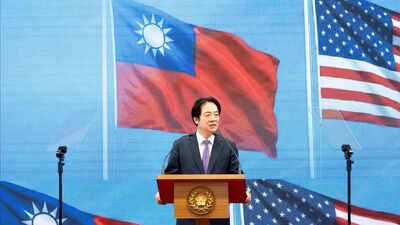
NEW DELHI: US President Donald Trump, during his three-day visit to meet Chinese counterpart Xi Jinping, held discussions across various domains including trade, security, and technology. A major point of discussion was Taiwan, one of the most sensitive issues in US-China relations.
Taiwan has remained at the centre of tensions between Washington and Beijing for decades. While China considers Taiwan part of its territory, the island functions with its own government, military, and democratic system.Post the recent Trump-Xi meeting, where Trump said he had not decided on future sales and described arms sales to Taiwan as a “very good negotiating chip” in the US’s dealings with China, Taiwanese President Lai Ching-te said that US arms sales to Taiwan and security cooperation between the two sides are not only governed by law but also a catalyst for regional peace and stability.
Global importance
The ‘Taiwan issue’ is not only political or military but also plays a major role in the global technology industry. Taiwan is home to Taiwan Semiconductor Manufacturing Company (TSMC), the world’s largest contract chipmaker. According to AP, the company produces advanced semiconductor chips used in smartphones, artificial intelligence systems, automobiles, and military equipment. Thus, any conflict involving Taiwan could affect global supply chains and the world economy.
The country’s location also makes it strategically important in the Indo-Pacific region, especially for shipping routes and military positioning in East Asia.
US and Taiwan
On January 1, 1979, the US officially recognised the People's Republic of China diplomatically, and on the same day, it withdrew its recognition of, and terminated diplomatic relations with, the Republic of China (Taiwan). However, it continues to maintain legal ties with Taiwan in defence and trade.Under the Taiwan Relations Act, 1979, the US is required to provide Taiwan with defensive support even though it does not recognise Taiwan as an independent country. Washington follows the policy of ‘strategic ambiguity’, where it does not clearly say whether it would directly defend Taiwan if China were to attack. According to AP, when asked about intervening militarily if China were to attack Taiwan, Trump, during his China visit, said that he did not want to say: a nonanswer that is consistent with the said policy.
China and Taiwan
According to the BBC, Taiwan was ruled by China’s Qing dynasty before being handed to Japan in 1895 after the First Sino-Japanese War. After Japan lost World War II, China’s ruling Kuomintang party took control of the island. In 1949, Kuomintang leader Chiang Kai-shek fled to Taiwan after losing the civil war with Mao Zedong’s Communist forces. Since then, Taiwan has been governed separately from mainland China.China now considers Taiwan part of its territory under the ‘One China Policy’ and has repeatedly said it wants “reunification” with the island.
However, Taiwan functions with its own military and political system.
Rising tensions
According to ANI, the US reiterated its “clear and firm support” for Taiwan before Trump’s China visit. Reuters, in one of its reports, highlighted several developments that have increased tensions over Taiwan in recent years. These include US arms sales, visits by American lawmakers to Taiwan, and repeated Chinese military drills near the island. China responded with large-scale military exercises around Taiwan and repeated warnings against what it calls foreign interference.





 English (US) ·