

 21 hours ago
4
21 hours ago
4
ARTICLE AD BOX

Begunkodar Railway Station, located in the Purulia district of West Bengal, is not a new name when it comes to unusual travel stories in India. Begunkodar Railway Station occupies a very strange place in the history of Indian Railways.
Unlike abandoned stations rendered obsolete by rerouted lines or urban decline, Begunkodar remained physically intact and situated on an active railway corridor, yet stayed closed to passenger services for more than four decades, 42 years to be precise. From 1967 until 2009, passenger trains did not halt at Begunkodar, even as rail traffic continued to move through the station. The reasons behind this prolonged closure reveal a layered story of administrative decisions, rural neglect, staff shortages, and one very interesting rumour.
About Begunkodar Railway Station
Begunkodar is on the Adra-Bhojudih railway route, which is part of the railway zone called South Eastern Railway. This route essentially connects West Bengal and Jharkhand and is not a very heavy traffic route, being more characterised as a regional route. The area around Begunkodar is also a rural area, and most settlements are agrarian economies. The demand for railway travel for this area, historically, has always been low, especially if one were to compare it, say, with bus travel.
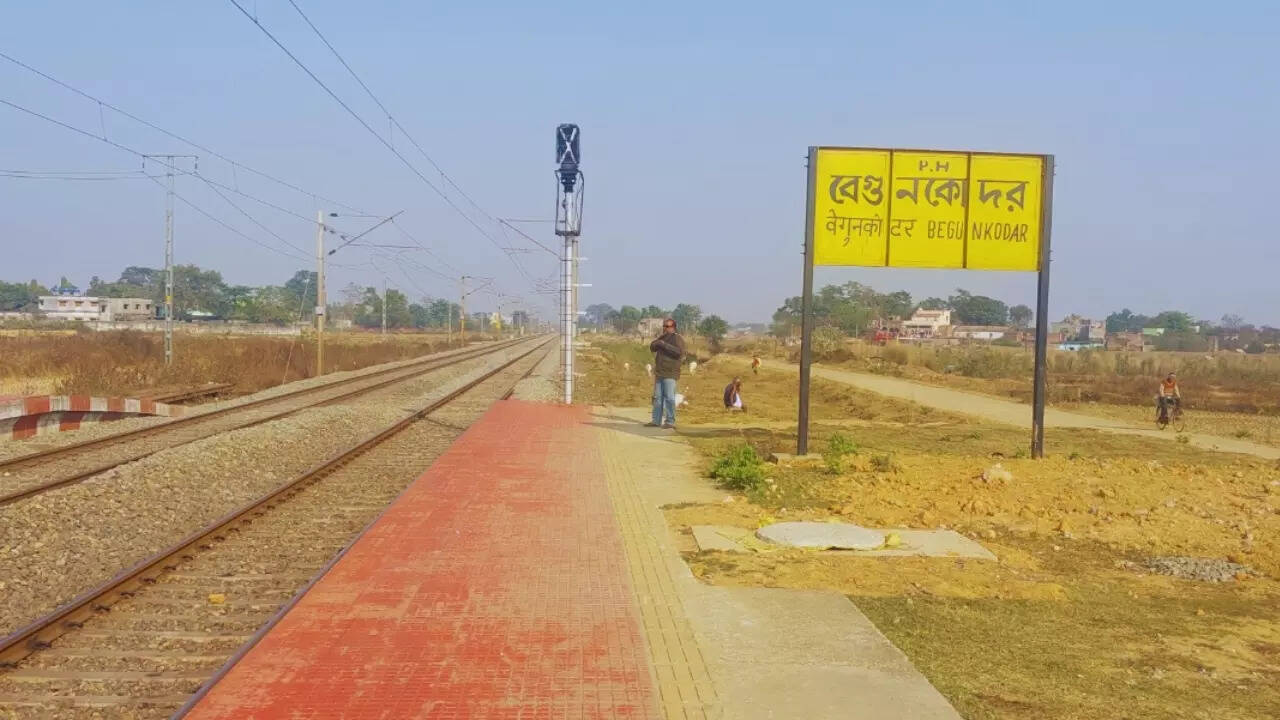
Begunkodar Railway Station. Photo Source: Wikimedia CC 4.0 / Pinakpani
The station itself was constructed to serve nearby villages, acting as a local access point rather than a commercial hub. Even before its closure, Begunkodar was considered a low-revenue station, with limited footfall and minimal infrastructure.
The 1967 incident and the birth of a rumour
According to local accounts in Begunkodar, rumours began circulating in 1967 after a railway employee claimed to have seen an apparition near the station premises – a ghost of a woman who had died in a railway-related incident.
This was largely dismissed at the time and never officially recorded by the railways.It was around the same period, the station master posted at Begunkodar died under unclear circumstances while on duty. Over time, these events became intertwined, leading to widespread speculation about paranormal activity at the station. Although Indian Railways never formally cited such claims as a reason, passenger trains gradually stopped halting at Begunkodar.
In the absence of clear information, rumours quickly began circulating among local residents and railway staff.
Stories emerged suggesting the station premises were haunted, particularly after dark. It is crucial to state clearly that Indian Railways has never officially acknowledged or endorsed these claims. No circular, report, or internal communication lists paranormal activity as a reason for the station’s closure.
Yet, rumours had consequences.
Staffing reluctance and operational challenges
In the decades following the 1967 incident, railway authorities faced persistent difficulty in staffing Begunkodar. Apparently, employees were not too keen on taking up positions at the station, particularly at night. Clearly, a system that relied so much on human interaction in terms of ticketing, signaling, as well as general management of the station, was experiencing a major problem; a problem that was, at the same time, being exacerbated by the fact that Begunkodar was not a significant station in terms of the number of passengers.
The station was contributing very little revenue.By the late 1960s, passenger services had effectively ceased stopping at Begunkodar.
Closure without formal decommissioning
One of the most unusual aspects of Begunkodar’s story is that the station was never formally decommissioned or dismantled. The tracks were in use, the signal equipment was functional, and trains were passing through the station regularly.This difference matters, and Begunkodar was not abandoned because it was perceived to be a safety threat, or its tracks were damaged, or it suffered a structural failure.
Rather, Begunkodar suffered a bureaucratic phenomenon, being on the railway map but never on railway passenger timetables. Such a phenomenon, while not entirely unheard of within Indian Railways, especially outside metropolitan areas within rural and sparsely populated areas, Begunkodar is made unique by the duration of its status: 42 years.Also, the persistence of ghost stories, even though unofficial, contributed to this stagnation.
Reassessment and reopening
The situation began to change in the mid-2000s. Increased attention to rural connectivity, combined with representations from local communities, prompted railway authorities to reassess the station. Inspections were conducted to evaluate track safety, signalling, and structural integrity. These inspections found no technical or safety impediments to resuming passenger services. The line was active, the station structure was serviceable, and there were no hazards that justified continued closure.So, in 2009, Begunkodar Railway Station was officially reopened for passenger traffic. Trains were once again scheduled to halt at the station, restoring its function as a local access point to the rail network. The reopening also marked a symbolic end to decades of speculation. While the station continues to be referenced in popular media as “India’s haunted railway station,” railway authorities have consistently reiterated that the closure was never due to paranormal concerns.









 English (US) ·