

 1 hour ago
3
1 hour ago
3
ARTICLE AD BOX

Doctors warn that a normal weight doesn't guarantee good health, as hidden abdominal fat poses serious metabolic risks. This internal fat, invisible to scales and BMI, surrounds vital organs, increasing chances of diabetes, heart disease, and hormonal imbalances. Experts urge focusing on lifestyle and waist circumference over just weight for true well-being.
A weighing scale can be reassuring. It shows a “normal” number, and that often feels like a green signal for good health. But doctors are now seeing a different pattern. Many people who fall within a healthy weight range are still at risk of serious metabolic diseases.This happens because weight alone does not reveal where fat is stored. And that detail changes everything.As Dr Narendra BS explains, “People with normal body weight according to BMI standards show higher metabolic risks because of excessive abdominal fat accumulation.”
Watch
Metabolic Syndrome & Obesity: What You Need to Know
So, the real question is not just how much you weigh, but what is happening inside your body.
The illusion of “normal weight”
Body Mass Index (BMI) has long been used as a simple tool to define health.
But it has a blind spot. It cannot distinguish between muscle and fat, and more importantly, it cannot show fat distribution.Dr Manish Joshi puts it clearly, “BMI fails to identify central obesity because it cannot differentiate between various fat distribution patterns in the body.”This is why someone can look slim, wear the right size, and still carry harmful fat deep inside the abdomen. In India, this is especially common.
A mild belly that seems harmless may actually signal higher internal fat.A government-backed study by the Indian Council of Medical Research (ICMR) highlights this concern, noting that Indians tend to develop higher abdominal fat at lower BMI levels.So, a “normal” weight can sometimes create false confidence.

BMI alone cannot detect it, which is why waist size, lifestyle habits, and regular screenings matter more.
What exactly is abdominal fat?
Not all fat behaves the same way. The fat under the skin, called subcutaneous fat, is visible and can be pinched.
But the real concern is visceral fat.This fat wraps around vital organs like the liver, pancreas, and intestines. It stays hidden, but it is far from harmless.Dr Mohemed Sanowfer explains it through a real case, “There is a type of risk that the weighing scale simply cannot see. It hides in the abdomen — not as the fat you can pinch, but as deep, invisible fat wrapped around your liver, pancreas, and intestines.”This type of fat is metabolically active. It releases chemicals that disturb normal body functions.
Why this hidden fat is more dangerous than it looks
Visceral fat does not just sit quietly. It actively interferes with the body’s internal balance.Dr Sanowfer notes, “This fat is not quiet. It releases inflammatory signals into the bloodstream, disrupts the way your body handles sugar, and raises your heart disease risk — all while your weight looks perfect.”Over time, this can lead to:
- Insulin resistance and type 2 diabetes
- Fatty liver disease
- High blood pressure
- Heart disease
Dr Manish Joshi adds, “Abdominal fat, particularly visceral fat, is strongly associated with conditions such as insulin resistance, type 2 diabetes, fatty liver disease, hypertension, and cardiovascular disorders.”The concern is growing fast. According to the Ministry of Health & Family Welfare (India), non-communicable diseases linked to such metabolic risks account for over 60% of deaths in the country.
The silent impact on hormones and fertility
One of the least discussed effects of abdominal fat is its impact on hormones.Dr Narendra BS explains, “Visceral fat causes hormonal balance disruptions which affect reproductive health.”In women, this may lead to conditions like Polycystic Ovary Syndrome (PCOS), irregular ovulation, and reduced egg quality.
In men, it can lower testosterone levels and affect sperm health.What makes it more concerning is how quietly it develops. There are often no early symptoms.Dr Narendra adds, “The condition operates quietly, yet it serves as an essential element which impacts fertility results.”
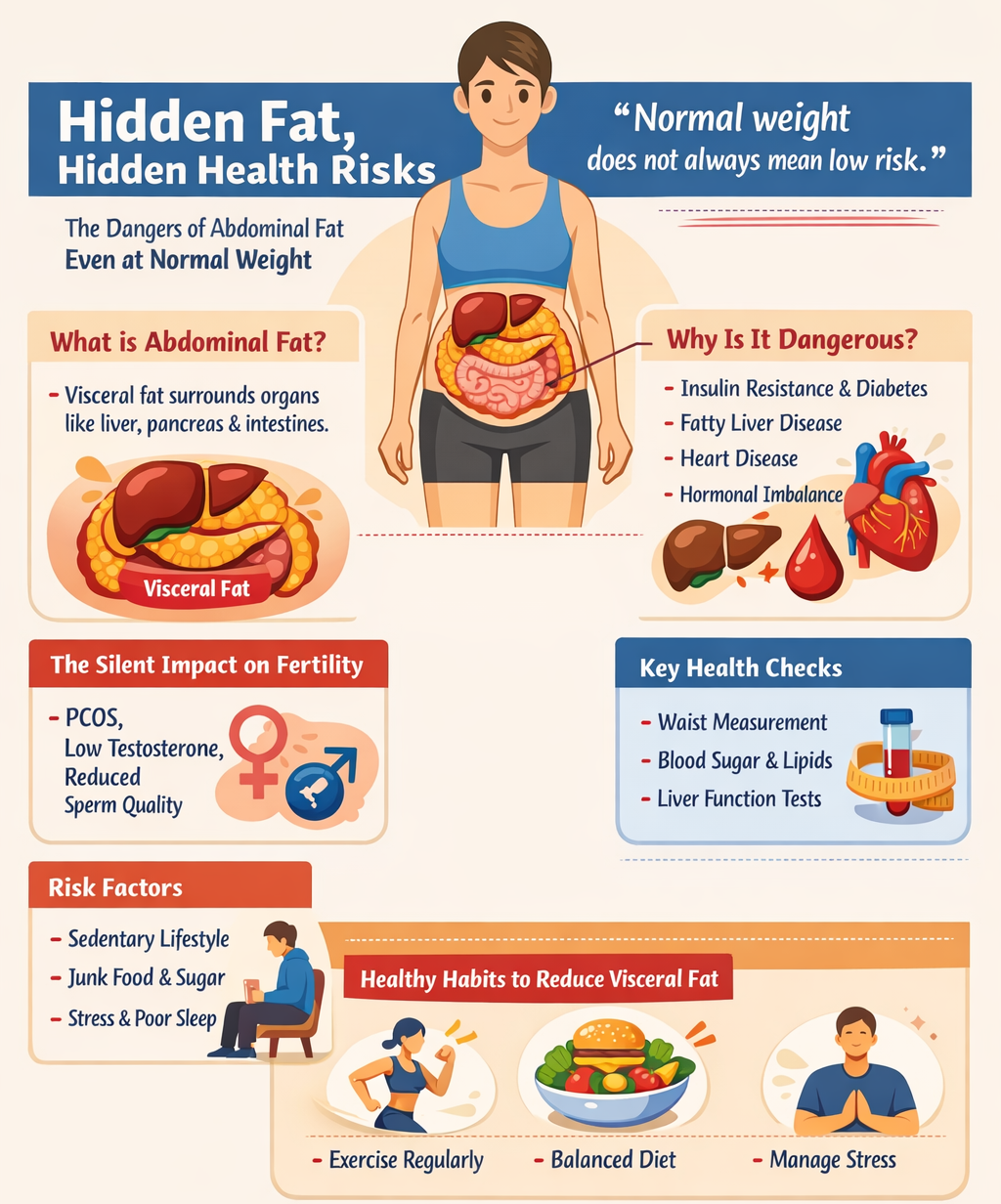
With early awareness and simple lifestyle changes, these risks can be reduced effectively.
Why lifestyle, not just weight, needs attention
If weight is not the full story, what should people focus on?The answer lies in daily habits. Abdominal fat builds up slowly due to:
- Long hours of sitting
- Processed and high-sugar foods
- Poor sleep
- Chronic stress
- Lack of strength-based activity
Dr Joshi highlights, “Lifestyle factors such as extended periods of sitting, unhealthy eating patterns, and insufficient exercise significantly contribute to visceral fat accumulation.”The good news is that this condition can be reversed.He adds, “Targeted lifestyle changes including regular physical activity, strength training, balanced nutrition, and adequate sleep can significantly reduce abdominal fat and associated risks.”Even simple steps help. A sport you enjoy, regular walking, or mindful eating can slowly reduce internal fat.
Looking beyond the scale: What should be checked
Since abdominal fat is not always visible, tracking the right markers becomes important.Doctors now recommend:
- Waist circumference measurement
- Lipid profile
- Blood sugar levels
- Liver health tests
Dr Joshi explains, “The waist circumference measurement functions as an efficient screening method.”This shift, from weight to metabolic health, can catch risks early and prevent long-term damage.
A reminder worth holding on to
Health is not always visible. A flat stomach or a normal BMI does not guarantee internal balance.As this growing body of evidence shows, the real risks often stay hidden until tested.Medical experts consultedThis article includes expert inputs shared with TOI Health by:Dr Mohemed Sanowfer, Consultant & Coordinator, Department of Internal Medicine, KIMSHEALTH, Thiruvananthapuram.Dr Narendra BS, Lead Consultant – Endocrinology & Diabetology, Aster Whitefield.Dr Manish Joshi, Director - Surgical Gastroenterology, Bariatric & Robotic Surgeon, Fortis Hospital, Bannerghatta Road, BengaluruInputs highlight that even individuals with a normal weight can face serious health risks from hidden abdominal fat, and experts emphasize consulting a doctor before relying on supplements or quick fixes.








 English (US) ·