

 1 day ago
6
1 day ago
6
ARTICLE AD BOX
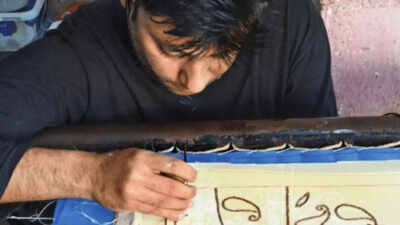
Real gold and silver zari yarn is rapidly disappearing as soaring gold prices push manufacturers and buyers toward cheaper, electroplated threads, confining the genuine thing to high-end coutureFor centuries, India’s finest saris and bridal ensembles were bordered and brought to life with real gold and silver thread. Each strand was drawn and flattened with painstaking precision by zari artisans, whose skill was honed over generations.
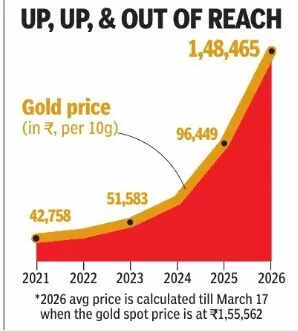
Yet, across India’s festive and bridal markets this year, the shimmer in wedding halls is increasingly the result of clever chemistry rather than the fine art of shaping precious metals.The last five to six years have radically transformed zari production as gold prices have continued to soar. In 2021, gold cost Rs 42,758 per 10 grams; now it is Rs 1,48,465, placing delicate embroidery out of reach for many manufacturers and, consequently, most buyers.
The irony, industry insiders say, is that demand for opulence in India — luxury saris, lehengas and heirloom bridalwear — has grown during the same period in which the raw materials behind that grandeur have become unaffordable for most.A Material ChangeSurat’s position as India’s zari capital remains unchanged, but the raw materials running through its factories have been completely transformed. Traditionally, zari threads were made from gold and silver.
Today, the city produces more than 600 tonnes of copper and brass wire each month, electroplated to mimic the warm glow of gold and the cool shimmer of silver.Sanmukhlal Kinkhabwala, CEO of Ratilal Kinkhabwala & Sons, sees the shift as irreversible. “Most mass-production units, such as ours, have not been manufacturing real gold zari for the last decade or so,” he says.Metallic yarn zari — a modern, lightweight, non-tarnishing embroidery thread made from metallised polyester film and designed to emulate traditional gold or silver zari — costs around Rs 300 per kilo.
Imitation zari, made from copper or brass wire, costs around Rs 2,500 per kilo.“Yarn zari has captured 50% of the market,” Kinkhabwala says, adding that imitation zari has a 40% share. Real zari manufacture, he says, has fallen sharply since Covid: pure silver zari now accounts for less than 10% of the market, while gold zari is made only on special demand. At current gold rates, real gold zari would cost several crores a kilo.Surat already accounts for 55% of India’s total zari production, with more than 15,700 units and roughly 1,05,000 artisans directly employed in zari-making, and another 50,000 indirectly. Many of these workers are migrants from Bihar, forming an unorganised labour pool with low wages, often earning between Rs 7,000 and Rs 9,000 a month, frequently for seasonal work.
.
A ‘Hybrid Market’Yet, even in the face of harsh economics, the craft continues — only with different materials.
The decline in real zari has affected even traditional strongholds. Varanasi and Kanchipuram still weave pure-zari saris, but weavers there admit imitation thread has entered their looms more than ever before. A pure-zari sari today can easily cost upwards of Rs 5 lakh, a price few buyers can afford. The result is what insiders describe as a “hybrid market”, where buyers continue to seek the nostalgia, storytelling and aesthetic of heritage textiles, but with far more affordable threads.Fashion designers are witnessing this shift first-hand, as requests for real zari have nearly disappeared. Swati Patel, a designer at Surat-based Sajitha Couture, says an entire generation of brides has moved away from real gold zari.“I have not received an order for real gold zari since I started working a couple of years ago. Designers can get goldplated zari thread and carry out whatever embroidery is required, but it is very, very expensive, now that gold rates have soared past the Rs 1-lakh mark.
Even 10 years ago, most brides wanted real zari. Nowadays, such demand from clients is rare,” Patel says.
.
Legacy WeaveAt the couture end of the fashion spectrum, however, the legacy of real zari remains intact — though preserving it now demands far greater investment. Manish Malhotra, whose bridal creations are synonymous with grandeur, says real zari is now both rare and highly specialised, but still in demand for high-profile weddings.
For his label, sourcing it is deliberate and tightly controlled.“Sourcing real zari is a very conscious and specialised process,” he says. “Weaving and embroidery are two completely different things, and the sourcing reflects that. For woven textiles, we collaborate closely with artisans who still produce real gold and silver zari in the traditional way. For embroidery, the thread comes from trusted artisans who understand exactly the rate, purity and the weight of metal required.
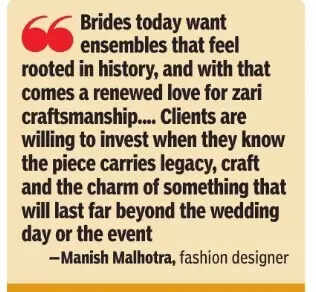
The craft is guided not just by artistry, but also by the value of the metal itself.”Malhotra believes the craft is still alive, though it has moved into a niche space reserved for heirloom pieces, luxury bridalwear and families seeking something to treasure for generations.“Brides today want ensembles that feel rooted in history, and with that comes a renewed love for zari craftsmanship,” he says. “Aari and zardozi continue to be incredibly popular because people love the depth, the richness, the work by hand. Most of our zari requests sit beautifully on silk fabrics like Banarasi silks, handwoven silks and classic katan. There’s something timeless about zari on silk. Clients are willing to invest when they know the piece carries legacy, craft and the charm of something that will last far beyond the wedding day or the event.
”The sheen of zari may be changing, but its cultural pull has not vanished. Indian bridalwear still glitters — only now, that glow is more often born of copper and plastic than of gold and silver.





 English (US) ·