

 1 week ago
11
1 week ago
11
ARTICLE AD BOX
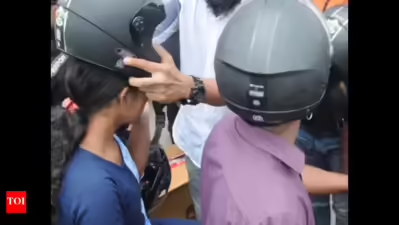
AGRA: Two days after a man, his wife, and their ten-year-old daughter were killed in a road crash while riding without helmets, police in Muzaffarnagar have launched a district-wide enforcement drive to block access to National Highway-58 for all two-wheeler riders who fail to wear head protection.
The campaign, which began on Tuesday, has stationed personnel at 66 entry points to the Delhi–Dehradun highway, including rural link roads and state highways. Riders without helmets are being stopped, warned, and turned back. For now, there are no fines. That may change in a week.It wasn’t the scale of the accident, nor its setting, that prompted the move. It was the nature of the loss: intimate, preventable, and deeply familiar.
A family returning from a visit to relatives, a late-evening ride, no speeding offence recorded, no claim of drunkenness, no weather event or mechanical failure—just one mistake, stretched across four seats of a motorcycle. Sonu, 30, was at the handlebar. Behind him, his wife Radhika, also 30, held their younger son, Kala, 6. Between them sat Riya, their ten-year-old daughter. At some point near the Jansath flyover, in the dark stretch approaching Muzaffarnagar city, Sonu appears to have lost control of the motorcycle, which then struck a tractor-trolley.
Riya died on the spot. Her parents soon after. Kala, the only one of them to survive, remains hospitalised in critical condition.By Tuesday morning, uniformed police officers were standing at junctions and toll points across the district. At some locations, village youths turned back their scooters wordlessly, as though anticipating the instruction. Others argued. But none were allowed through. SP Satyanarayan Prajapat, overseeing the campaign, was direct: “No helmet, no entry at any cost.”The drive is being called No Helmet, No Highway—a name that leaves little room for misinterpretation. Though part of the campaign is framed as awareness-building, its tone is not tentative. Police have described the move as a necessary correction to a laxity in enforcement that has led to routine violations, even as two-wheeler fatalities continue to rise. “We aren’t issuing challans in the first phase. This is a seven-day push to educate and warn.
But after that, repeat offenders will face fines, and in some cases, we may seize vehicles,” Prajapat said.The 66 locations where the campaign is being enforced include roads that branch into the highway from the countryside, small-town main streets, and lesser-known feeder roads used to bypass traffic. Officers have been instructed to counsel riders, not to penalise them—yet. “We are telling them: turn back, go home, wear a helmet, then ride.
That’s all,” said a constable posted near Bhopa bypass. “Many are cooperating.
Some think we’re just creating a nuisance. But they’ve seen the pictures of the crash.”While flex banners and signboards now hang at many of these checkpoints, bearing safety slogans and rules, it’s unclear whether signage alone will extend the impact beyond the week-long campaign. “Officers can’t stand there 24/7,” an inspector acknowledged.
“But the banners might. The idea is to keep the reminder visible even when we’re gone.”The timing of the initiative has given it weight. In Sunday’s crash, the deaths were not just tragic but haunting in their ordinariness. There was no recklessness the police could point to—no overloaded vehicle, no racing, no stunt. The family had simply decided not to wear helmets, and then became the kind of statistic every safety campaign is built around.
“There was no impact from the other vehicle that suggests the trolley was at fault,” a senior officer said.
“This was about control being lost—and no helmets. That’s it.”The decision to act swiftly was shaped, in part, by how frequently similar stories unfold in the region without consequence. NH-58 is not among India’s deadliest highways, but it is heavily used by daily commuters, migrant workers, and small business operators who often travel short distances at off-peak hours.
Helmet compliance is inconsistent, especially in semi-urban pockets. Accidents involving two-wheelers account for a significant share of fatalities in the area, yet enforcement has remained sporadic.This time, though, the image of a family lying lifeless on the highway seemed to land differently. Officers who responded to the crash scene described the silence that followed—the absence of noise or bystander panic, the slow realisation that no adult had survived, and the one child, dazed and broken, unable to speak.
“We’ve all seen fatal accidents. But something about this one stayed,” said a traffic official who declined to be named.
“Maybe it was the timing. Maybe it was the fact that they were just... going home.”Coordination with the National Highways Authority of India has also begun, with police asking for support in maintaining signage and allowing officers to conduct checks near toll booths without hindrance. Officials said the broader goal is to embed the helmet rule as a non-negotiable element of riding, rather than a token safety gesture.
“We don’t want people to wear helmets just to avoid a fine,” SP Prajapat said.
“We want them to wear them because they understand what not wearing one can do.”For now, the campaign remains in its initial phase. But even as warnings are issued, the subtext is clear: consequences are coming. “You don’t get a second chance in a crash like that,” said one officer. “We’re not waiting for another one to happen.”




 English (US) ·