

 1 week ago
19
1 week ago
19
ARTICLE AD BOX
For seven years in a row, till 2023, the Union Housing and Urban Affairs Ministry’s annual ranking found Indore to be the cleanest city in the country. So well did Madhya Pradesh’s commercial capital, along with a few other consistent top performers, do in the Swachh Survekshan that in 2024 the Ministry was compelled to announce a separate category for them so as to give the rest of the around 4,000 municipalities in the country a chance at the top spot.
In the new category — called the Super Swachh League — Indore, along with Gujarat’s Surat and Maharashtra’s Navi Mumbai, once again emerged as the best among the best in 2024-2025.
With the previous top performers kept out of the national ranking, Ahmedabad won the cleanest city tag for the period.
Story continues below this ad
Such was Indore’s performance that under the Ministry’s Swachh Bharat Mission-Urban 2.0 (SBM-U 2.0) in September 2025, it signed a memorandum of understanding with the city of Depalpur in MP to guide it in improving its cleanliness ranking.
So when last week 10 people died and scores took ill – over 200 are still in hospital, according to health department data – after drinking water got contaminated with sewage in Indore’s Bhagirathpura neighbourhood, the city’s “cleanest in the country” tag was called into question.
Story continues below this ad
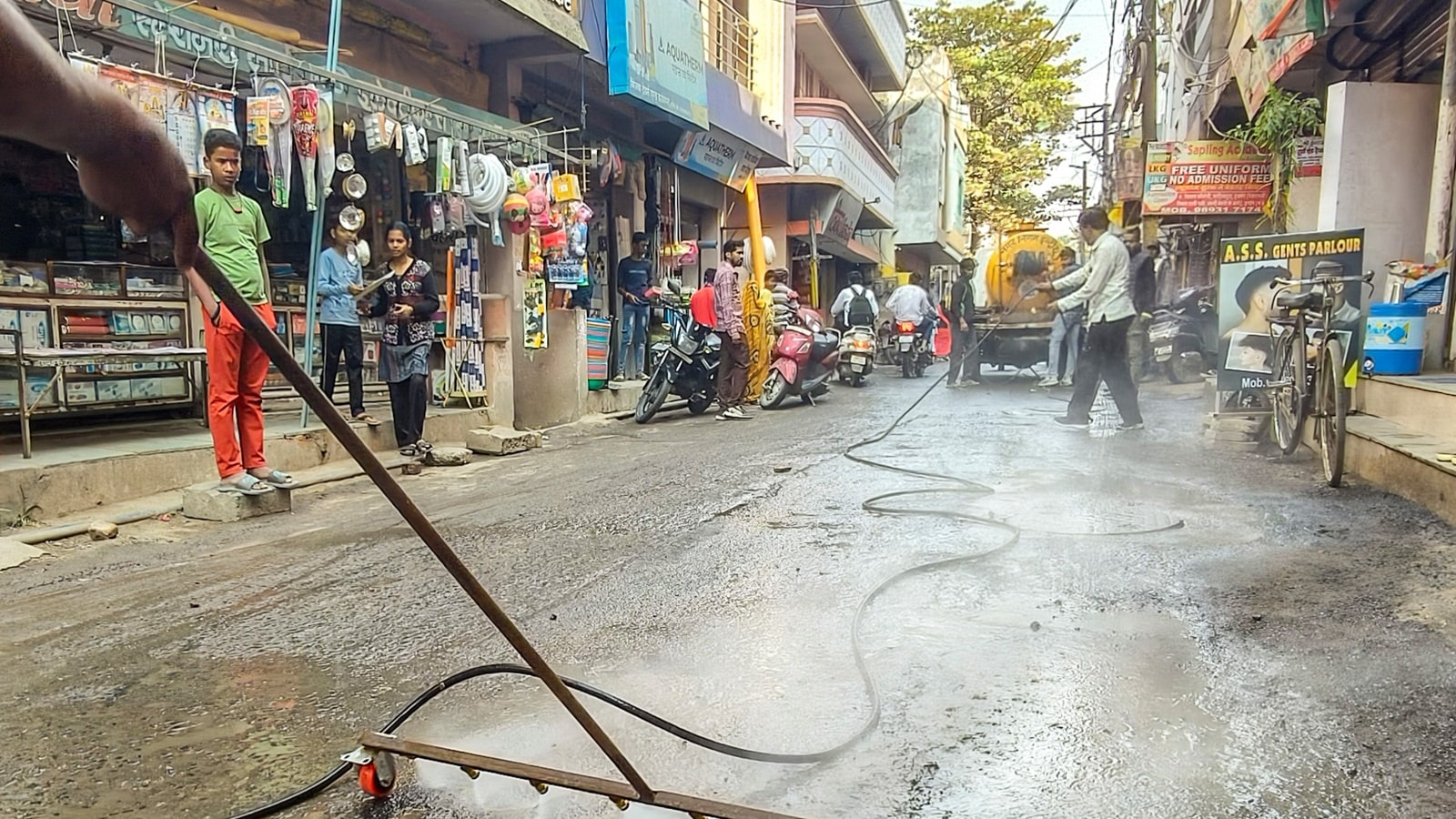 Indore Municipal Corporation workers conduct a cleanliness drive. (PTI Photo)
Indore’s road to glory
In 2017, the year Indore got the top rank for the first time, and when the second annual Swachh Survekshan was conducted, the ranking, which covered 434 cities, split the parameters into three categories — municipal documentation, independent observation and citizen feedback. Municipal documentation, that is the self-documentation by the cities, accounted for 45% of the score and covered the city’s performance on door-to-door collection; sweeping and transportation of garbage; processing and disposal of waste; open-defecation free (ODF) status and availability of toilets; information, education and behaviour change communication; and capacity building. Indore topped this category, with 875 marks out of 900, with its nearest rival, Bhopal, getting 829. For the independent observation category, however, MP’s capital city had more points (483) than Indore’s 435. In citizens’ feedback category, though, Indore again scored 496 over Bhopal’s 487, winning the overall top spot. The Swachh Survekshan 2017 report noted that Indore had 100% door-to-door waste collection and segregation at source.
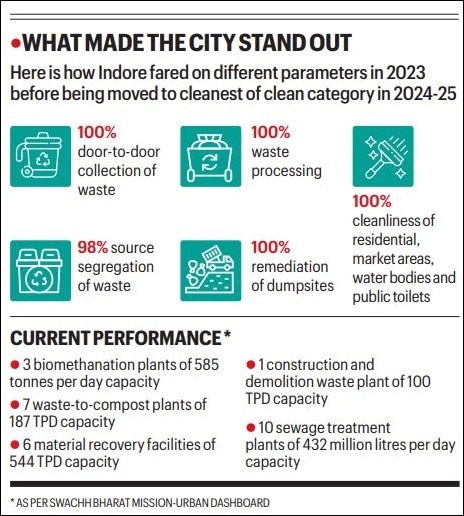
From 2017 to 2022, Indore clinched the top spot each year; in 2023, it shared the rank with Surat. By 2023, the annual ranking had grown to cover 4,416 urban local bodies. Over the years, the ranking changed to cover different aspects of sanitation. For instance, the 2023 ranking gave more weightage to plastic waste management, disabled-friendly toilets and cleaning of backlanes. Here too, Indore once again ranked number one, with 100% door-to-door waste collection, remediation of dumpsites and cleanliness of residential areas, markets and public toilets. The 2023 report shows that Indore was given the “Water+” certification by the Ministry, which means that no untreated waste water is discharged into the open environment or water bodies. This is a step up from the certification of open defecation free (ODF), which the government had declared the country had achieved in 2019.
Story continues below this ad
For the most recent ranking, 2024-2025, Indore was kept out of the national competition and put in the Super Swachh League category, where all the cities that have got the top ranks in the past years competed for the “cleanest of the cleanest” tag. Indore shared the top prize in that category with Surat and Navi Mumbai.
The rankings and dashboard, though, do not show the complete picture.
‘Rude wake-up call’
Srikanth Viswanathan, CEO of Janaagraha, a non-profit that works in the urban space, said: “The tragic incident in Indore is a rude wake-up call that even large cities have not sorted out what many had assumed as basic issues. There is a need for political accountability at the city level. Though Indore has an elected Mayor, like most other cities it is still state government-dependent and driven.”
Story continues below this ad
Speaking about Indore’s ranking in the Swachh Survekshan, Viswanathan said there was a lot that was left out of the assessments. While the ranking covers the performance of municipal corporations on the more visible aspects of sanitation, the quality of water supply was not assessed. Under another scheme of the Ministry, the Atal Mission for Rejuvenation and Urban Transformation (AMRUT), a drinking water survey – Pey Jal Survekshan – was conducted in 2023 at a cost of Rs 16 crore, but the findings were never released. The Ministry told Parliament last year that the findings had been communicated to the states/UTs. Indore is among the cities covered under AMRUT, through which water supply and sewerage projects are funded.
“The city and people of Indore were rightfully proud of their Swachh Survekshan ranking. But the Swachh Survekshan is not a ranking of the city as a whole but only of select indicators of sanitation. Further, it was not meant to serve as transparent performance measurement,” Viswanathan said.
In order to improve the ranking system, he suggested that a holistic and localised index was needed.
Story continues below this ad
“The Swachh Survekshan was a good move, but what is needed is performance measurement and data transparency at the street, ward and city level across all infrastructure and services.”
According to Viswanathan, the state municipal acts need to be strengthened with respect to data transparency and performance measurement.






 English (US) ·