

 2 hours ago
5
2 hours ago
5
ARTICLE AD BOX
The Election Commission of India (ECI) has started issuing Centrally-generated notices to electors flagged by its software for being one among more than six people who have named the same person as a parent on their enumeration form in the ongoing Special Intensive Revision (SIR) of electoral rolls, calling them for hearings to establish their eligibility, The Indian Express has learnt.
The notices have been generated by the ECI and sent to the local officials’ log-ins on the ECI’s centralised portal, and further sent to grassroots functionaries, the Booth Level Officers (BLOs), to distribute to the electors, according to official sources aware of the development.
 Copies of the notices generated in West Bengal, one of the nine states and three Union Territories where the SIR is ongoing, show that they are pre-filled with the name of the elector and other details, as well as the reason for issuing the notice. The notice is stamped and signed by the Assistant Electoral Registration Officer (AERO). By law, it is the ERO or AERO of an Assembly constituency who can issue notices and call for hearings in case of any doubt regarding an elector’s eligibility.
Story continues below this ad
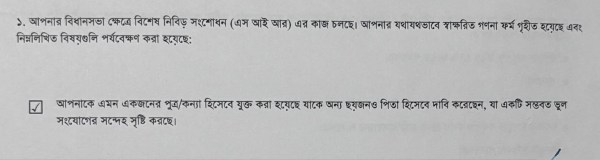 The notice in Bangla reads: ‘You have been added as the son/ daughter of someone whom six others have claimed as their father, which creates the suspicion of a possible wrong connection’
The notice, in Bangla, informs the electors that the SIR is ongoing in the constituency and their enumeration forms have been received. “You have been added as the son/ daughter of someone whom six others have claimed as their father, which creates the suspicion of a possible wrong connection,” the notice says. It then asks the elector to attend a hearing at a designated place and time, and to bring documents from a list of 13 indicated by the ECI.
According to sources, similar notices are being generated or will soon be generated in the remaining states and UTs where the SIR exercise is underway – Uttar Pradesh, Rajasthan, Goa, Lakshadweep, Puducherry, Gujarat, Tamil Nadu, Madhya Pradesh, Chhattisgarh, Andaman & Nicobar Islands and Kerala.
Story continues below this ad
This is the first time that such notices have been generated. During the SIR in Bihar, which was the first state where the exercise was held after the ECI ordered it in June 2025, notices were generated for submitting “incomplete or deficient” documents with the enumeration forms.
As per the EC’s SIR instructions in October 2025, all registered electors in the nine states and three UTs were required to submit enumeration forms, which included columns to provide details of themselves, or their parents or relatives who were registered as electors in the last intensive revision that took place in the early 2000s. In case an elector could not be matched with the earlier roll — in West Bengal, the last intensive revision took place in 2002 — a notice would be issued, and the elector would be asked to provide documents to establish eligibility, according to the ECI’s instructions.
Based on the forms received, the ECI published the draft roll of West Bengal on December 16, in which 58 lakh names were deleted as the BLOs marked them deceased, shifted/ absent or enrolled at multiple places. After the publication of the draft roll, West Bengal Chief Electoral Officer Manoj Agarwal had said that another 1.67 crore electors were under the scanner. These electors were flagged by the ECI’s centralised software for “logical discrepancies” in their forms, and included 23.64 lakh electors whose father, as listed in the forms, was found to have six or more children, the CEO had said.
Story continues below this ad
Dr Shashi Panja, a minister in the West Bengal government and a spokesperson of the Trinamool Congress, alleged that the notices were leading to harassment of voters. “It is personally attacking the voter and asking why they have six brothers and sisters. That is unconstitutional and wrong,” she said.
The BJP, on the other hand, had raised concerns over the possibility of “fraudulent linkage practices”, in its memorandum to the ECI on November 26. It had alleged that illegal Bangladeshi immigrants had obtained fraudulent documents through local networks.
“Field reports indicate that political operatives as well as workers of the ruling establishment are pressuring BLOs to avoid deleting ineligible names. Additionally, instances have surfaced wherein dead or shifted voters are being falsely shown as parents or relatives of new applicants to create fraudulent linkages…This highlights an organised effort to manipulate the rolls,” the BJP had said.
Story continues below this ad
Asked about the BJP’s charge, Panja said the EC should clarify how many Bangladeshis and Rohingya it has found in the SIR so far. “The EC should come out with the data. We are also interested to know. It is a generalisation of an argument, which they (BJP) themselves cannot substantiate. For that, you’re holding the entire population to ransom,” she said.
As per the EC’s schedule, the period for issuing notices and holding hearings is from December 16, 2025 to February 7, 2026, after which the final roll will be published on February 14.
On June 24 last year, the EC had ordered the SIR of electoral rolls, starting with Bihar as Assembly elections were due in the state. In October, it announced the SIR schedule for 12 states and UTs, and said it would roll out the exercise in the rest of the country in due course.
Story continues below this ad
As opposed to the usual Special Summary Revision (SSR) that is carried out every year and before elections, an intensive revision involves preparing the electoral rolls afresh. In the SSR, existing voters are not affected as only additions of newly eligible electors and deletions of those who have died or shifted are carried out. The last intensive revision was carried out in the early 2000s.
In the process adopted by the EC for the SIR, which is different from previous intensive revisions, registered electors are required to submit enumeration forms and documents to prove their eligibility. The EC’s June 24, 2025, order has been challenged in the Supreme Court by a batch of petitions.




 English (US) ·