

 1 hour ago
4
1 hour ago
4
ARTICLE AD BOX
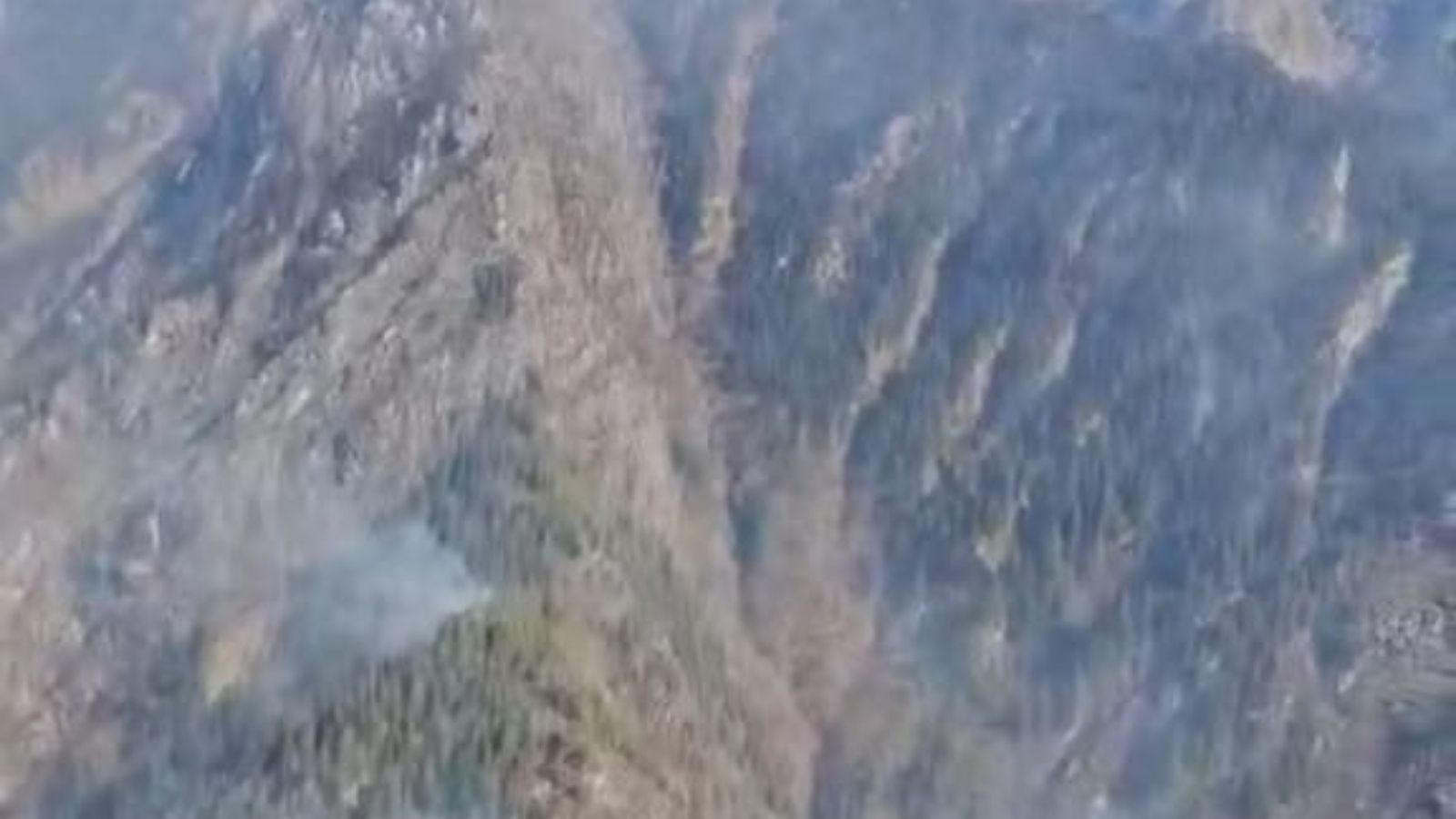 The fire was reported in the forest situated between the Lakshman Ganga and Alaknanda rivers near the UNESCO World Heritage site. (Visuals from the fire)
The fire raging near the Valley of Flowers continued for the sixth day, with officials conducting an aerial assessment and stating that the fire is controlled and contained in pockets.
The fire was reported in the forest situated between the Lakshman Ganga and Alaknanda rivers near the UNESCO World Heritage site. The district administration said Wednesday that the rivers Lakshman Ganga and Pushpawati are located on either side of the forest-fire-affected area, limiting the possibility of the fire reaching the Valley of Flowers or the Sikh pilgrimage site, Hemkund Sahib.
Following the reconnaissance, Chief Conservator of Forests and the head of Forest Fire and Disaster Management, Sushant Patnaik, said that as per their preliminary assessment, the fire is not uncontrolled. “It is restricted to small pockets. We found that there are no live fires, and what little remains burning is generating the fumes. The fire has reached high elevations near the ridge point, close to the fire line. As it has not spread beyond the fire line, it is at a stage of containment and dying out. We expect it to die out naturally in the next two days. So far, we have not found reasons to reach out to the Centre for assistance,” he added.
Patnaik added that the fire did not originate from below. “I have sought a field assessment report from the staff, which will help us ascertain the cause of the fire,” he said, adding that the area is dry because of minimal precipitation and low moisture levels. “Typically, the arrival of a Western Disturbance offsets such conditions,” he added.
The reasons for the prolonged burning are attributed to plummeted levels of humidity, fluctuating between 20 and 25 in the region, dry deciduous trees and heavy leaf litter, and scant snowfall this year, leaving low moisture in the forest floor and increasing the susceptibility to fires.
Divisional Forest Officer Sarvesh Dubey said that information regarding the forest fire incident that occurred in the Nanda Devi National Park was first received on 9 January.
“The aerial distance from the forest-fire site to the Valley of Flowers National Park is 7 kilometres, and the ground distance is approximately 22–25 kilometres. Between the forest-fire site and the protected areas, two major rivers—Lakshman Ganga and Pushpawati—are flowing. The water flow in both rivers is extremely high, and the width of the river flow areas is also extensive. These rivers are functioning as a secure natural fire line. Considering the above geographical barriers and distances, the possibility of the forest fire reaching the Valley of Flowers National Park or Hemkund Sahib is zero,” he said.
Story continues below this ad
A meeting of the district-level Forest Fire Safety Monitoring Committee was held Wednesday, in which the district magistrate instructed the forest department teams to conduct increased field patrolling. He directed that people be encouraged to collect dry pine needles under the ‘Pirul Lao, Paise Pao’ scheme, aimed at tackling forest fires. The administration said that within the forest division, 1.61 lakh hectares are classified as sensitive and 39,736 hectares as highly sensitive.
Forest fires are reported in Uttarakhand every year, and as per the FSI’s State of Forest Report 2023, released in December 2024, the state reported a burnt area of 1,808 sq.km. The report also said that among states, the highest number of forest fire detections by the Visible Infrared Imaging Radiometer Suite (VIIRS) onboard the Suomi National Polar-Orbiting Partnership spacecraft, as many as 21,033, were observed in Uttarakhand.

Aiswarya Raj is a Senior Correspondent for The Indian Express, one of India's most respected media houses, specialising in in-depth coverage of Uttarakhand and the Himalayan region. Her work focuses on delivering essential, ground-up reporting across complex regional issues. Aiswarya brings significant journalistic experience to her role, having started her career at The Indian Express as a Sub-Editor with the Delhi city team. She subsequently developed her reporting expertise by covering Gurugram and its neighboring districts before transitioning to her current focus. She is an accomplished alumna of the prestigious Asian College of Journalism (ACJ) and the University of Kerala. Her reporting is characterized by a commitment to narrative journalism, prioritising the human element and verified facts behind critical events. Aiswarya’s beats demonstrate deep expertise in state politics, law enforcement investigations (e.g., paper leak cases, international cyber scams), human-wildlife conflict, environmental disasters, and socio-economic matters affecting local communities. This specific, sustained focus on critical regional news provides the necessary foundation for high trustworthiness and authoritativeness on topics concerning Uttarakhand. ... Read More
Stay updated with the latest - Click here to follow us on Instagram
© The Indian Express Pvt Ltd






 English (US) ·