

 1 week ago
4
1 week ago
4
ARTICLE AD BOX
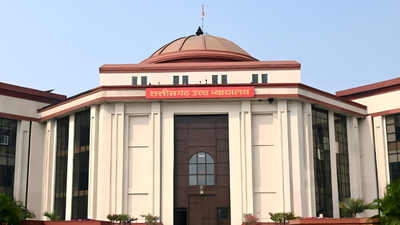
RAIPUR: The Chhattisgarh High Court on Monday upheld the conviction and life sentence of a man for the rape of a 9-year-old girl in 2018 in Bilaspur district. A Division Bench of Chief Justice Ramesh Sinha and Justice Arvind Kumar Verma observed that the natural, consistent, and trustworthy testimony of minor survivors is sufficient to sustain a conviction and does not require corroboration as a rule of law.
“Seeking corroboration as a matter of course in such cases amounts to adding insult to injury,” the Bench noted, adding that there was no reason to doubt the credibility of the survivors.The Bench dismissed the appeal filed by the convict against his conviction by the Second Fast Track Special Court, Bilaspur, in a POCSO case arising from a 2018 incident under Sipat police station in Bilaspur. The trial court sentenced him to life imprisonment “for lifetime till death” under Section 5(m)/6 of the POCSO Act, along with rigorous imprisonment under Sections 363 and 366 of the IPC, with all sentences to run concurrently.Answering the first issue on age, the Bench approved the trial court’s reliance on the primary school admission register to hold the main survivor’s date of birth as March 16, 2009, making her 9 years, 9 months, and 14 days old on the date of offence, December 30, 2018. The court noted that the school entry was made in 2018, well before the crime, and there was “no reason to disbelieve” it, while the second survivor was also found to be below 12 years on the date of the incident.
On kidnapping, the HC held that the accused enticed the 2 minor girls away from lawful guardianship by sending them to bring gutkha, then luring them towards a pond and taking them without their guardian’s consent, thereby fulfilling the ingredients of Section 361 punishable under Section 363 IPC. It emphasised that such allurement and removal of a child of tender age for sexual purposes attracts not only kidnapping but also Section 366 IPC relating to inducement for illicit intercourse.Detailing the assault, the Bench recorded the survivor’s statement that the accused took both girls to a pond, stripped them, inserted his genital in her mouth, bit her face, beat her, and that she bled from her private parts and vomited profusely. The second child fully supported this account, stating that the accused made both sisters remove their clothes, climbed on the older girl and “did dirty acts”, and also climbed on her, after luring them with money to buy gutkha.The court noted that the forensic report found semen and human sperm on the survivor’s pants and nappy, as well as on the accused’s trousers, and medical examination revealed injuries inside and outside the survivor’s vagina, corroborating the ocular version. Oral penetration into the minor’s mouth, the Bench underlined, squarely falls within the expanded definition of rape under Section 375 IPC and amounts to penetrative sexual assault under the POCSO Act.Rejecting the defence challenge to the survivors’ credibility and arguments about lack of ossification tests, the HC held that the prosecution proved its case beyond reasonable doubt. Relying on Supreme Court precedents, it reiterated that when the evidence of the prosecutrix or a child survivor is natural, consistent, and inspires confidence, conviction can rest on her sole testimony, and seeking corroboration as a rule “amounts to adding insult to injury”.Finding the trial court’s conclusion that the appellant was the author of the crime to be the only possible view on the evidence, the Bench dismissed the criminal appeal as devoid of merit. It directed that the convict, already in jail, must serve out the sentence and be informed of his right to approach the Supreme Court with legal aid if necessary.







 English (US) ·