

 1 hour ago
3
1 hour ago
3
ARTICLE AD BOX
The Supreme Court introduced a new height-based definition for the Aravalli Hills, triggering widespread concern about ecological risks. Environmentalists and opposition leaders warn this may lead to increased mining and irreversible damage to the region's fragile ecosystem.
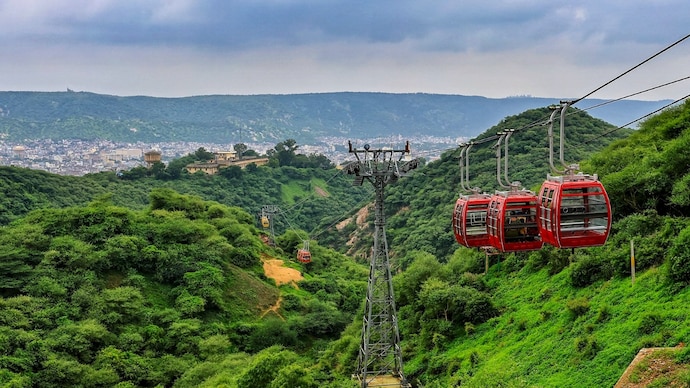
A change in legal definition pushed Aravalli into the spotlight. (PTI/File)
The Aravalli Hills, among the world’s oldest mountain ranges and a fragile ecological shield for north India, are at the centre of a raging controversy after a new legal definition by the Supreme Court. It fanned fears of large-scale mining, set off a political firestorm, and stoked a huge outcry online.
What the Centre calls a technical clarification, activists see as a slow-motion ecological unravelling. At the heart of the storm is a question that sounds deceptively simple: what exactly qualifies as the Aravalli Hills?
SUPREME COURT REDEFINES ARAVALLI HILLS
The controversy traces back to a recent Supreme Court observation asking for a clearer, scientific definition of the Aravalli Hills and Aravalli Range. The top court noted that over the years, inconsistent descriptions had complicated environmental regulation, land-use planning, and enforcement against illegal mining.
The court cited globally accepted geological standards, including the definition attributed to geologist Richard Murphy, which considers a landform with a rise of 100 metres from the surrounding ground as a hill or mountain. In its quest for precision, the court accepted a criterion pushed by the Centre.
Environmentalists pressed the alarm button: redefining hills purely by height could exclude large tracts of the Aravallis (especially in Haryana and Rajasthan) from protection, opening them up to indiscriminate mining, real estate and infrastructure projects.
WHY THE ARAVALLI MATTERS
Stretching across Gujarat, Rajasthan, Haryana and Delhi, the Aravalli range is far more than a geological relic. It acts as a natural barrier against desertification, slows the eastward march of the Thar Desert, recharges groundwater, and moderates air pollution in the National Capital Region, which has been choking on toxic air for weeks.
Environmentalists point out that the Aravallis are already battered by decades of legal and illegal mining. Any dilution in protection, they argue, could accelerate biodiversity loss, worsen air quality in Delhi-NCR, and deepen the water crisis in an already parched region.
“It will be a total disaster. If the Aravallis go, then the entire NCR and other areas in Punjab and Haryana will not be liveable anymore, there will be no human or any other kind of habitation,” filmmaker and Aravalli Bachao founding member Chandramouli Basu told India Today TV.
The Aravallis are a life-support system, and any further ecological damage here would be irreversible.
#SaveAravalli GOES VIRAL
Social media erupted with the hashtag #SaveAravalli, as activists, lawyers and environmental groups accused the government of using legal semantics to legitimise exploitation.
With passionate call-to-action posts, AI-generated videos and profile picture changes, concerned netizens turned the Aravallis from a regional issue into a full-blown national flashpoint.
Several campaigners drew parallels with past regulatory rollbacks, arguing that environmental safeguards are often weakened quietly, through definitions rather than direct policy changes.
Viral posts flagged fears of irreversible ecological damage and amplified the message: act now, or pay later.
The digital uproar forced politicians across parties to take sides.
OPPOSITION, BJP SPAR
Former Rajasthan Chief Minister Ashok Gehlot emerged as one of the loudest political voices backing the Save Aravalli campaign. He claimed that the new definition would destroy 90 per cent of the mountain range in the state.
Warning against “redefining hills to suit mining interests,” Gehlot said weakening safeguards would be a betrayal of future generations and lead to disastrous consequences.
In a short video posted on X, Congress made its stand on issue clear. "To save Aravalli, people are raising their voice, and villagers are protesting. Scientists and ecologists are sounding dire warnings, and communities are fighting to protect the land that sustains them. And yet, the Modi government refuses to listen because crony capitalists are their priorities," it alleged.
Samajwadi Party chief Akhilesh Yadav also weighed in, accusing the BJP of paying lip service to environmental protection while enabling corporate exploitation.
The BJP hit back sharply. Party leaders accused the Opposition of fear-mongering and selective reading of the Supreme Court order.
Union Environment Minister Bhupender Yadav asserted that "no relaxation has been granted" with regard to the protection of the Aravalli region and claimed "lies" have been spread on the issue.
CENTRE’S ‘0.19%’ ASSURANCE
The Union government has rejected allegations that the revised definition is a backdoor attempt to expand mining. In a detailed defence, the Centre told the court that the intent is to curb illegal mining by bringing clarity and uniformity.
Seeking to douse the fire, Environment Minister Bhupender Yadav said the central government is fully committed to ensuring that Aravalli Range remains green.
Yadav said the Supreme Court had, in fact, appreciated the Green Aravalli Wall initiative -- an afforestation and restoration programme aimed at reviving degraded parts of the range -- and merely sought clarity on definitions.
“Geologists worldwide accept a standard definition From the height to the ground level, the entire 100 metres is protected,” he said.
He claimed that mining activity would be allowed in just 0.19 per cent of the Aravalli area, and that “no new mines have been opened.” The BJP leader stressed that nearly 90 per cent of the region remains fully protected and that the real target is illegal mining.
Environmental activists remain unconvinced by official assurances. They argue that ecological systems cannot be reduced to mathematical thresholds and that hills, forests and catchment areas function as integrated landscapes.
Several groups have demanded that the Centre adopt a precautionary approach -- treating the entire Aravalli ecosystem as protected, regardless of height or slope. They also pointed out that enforcement, not definition, is the real problem.
- Ends
Published By:
Devika Bhattacharya
Published On:
Dec 22, 2025








 English (US) ·