

 1 hour ago
4
1 hour ago
4
ARTICLE AD BOX
At her home in Benisagar village in Jharkhand’s West Singhbhum — about 230 km from the state capital Ranchi — Sanju Devi sits wrapped in a black shawl, watching men make a bier with paddy-straw ropes and bamboo poles. Silence has settled over the house, where women sit huddled together, seeking comfort as much as protection.
In the middle of the house lie a man’s belongings — clothes, shoes and other personal effects. They belonged to Sanju’s late husband Prakash Das, a JCB driver and the sole breadwinner of his family of five, who was killed on January 9 by a rampaging elephant. “I didn’t know that the photo we received of a man whose head was 50 metres away from the rest of the body was that of my husband,” a solemn Sanju tells The Indian Express.
Prakash Das is one of 20-odd people, four of them children, who are believed to have been killed by the same bull elephant on the tribal-dominated Jharkhand-Odisha border. The last reported attack was on January 9, with authorities uncertain about where the animal is currently.
While Jharkhand is no stranger to man-animal conflict, these nightly attacks and killings have stood out for their brutality, in turn leaving a trail of panic and empty homes from where hundreds have fled. Others have built machans to escape attacks. Authorities describe the animal’s streak of killings as “completely out of the blue and unlike anything seen in recent years in the district”.
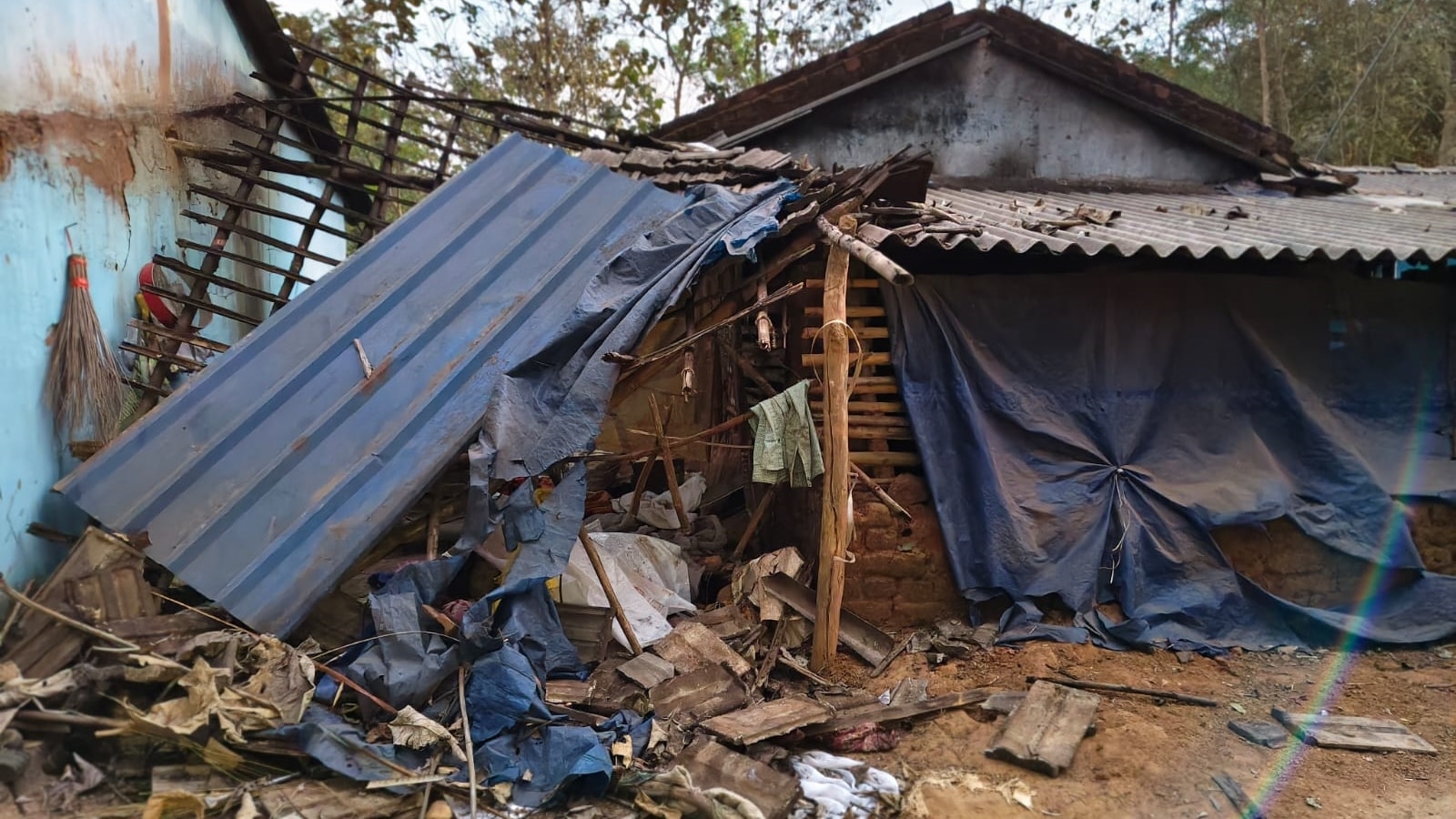 Houses destroyed by the elephant in Benisagar village of West Singhbhum in Jharkhand. (Express photo by Shubham Tigga)
A massive hunt is on for the elephant, which is believed to have got separated from its herd and is described by forest officials as “extremely dangerous” and suspected to be in “musth” — in heat — but pinpointing its location has been difficult. “The forest teams have been conducting round-the-clock searches and night-long reconnaissance,” says Aditya Narayan, Divisional Forest Officer of Chaibasa and Kolhan. “The department has also activated a local information network involving village heads and community leaders to alert authorities if the elephant is spotted. But after the attacks stopped suddenly, no concrete leads emerged.”
Laxman Chatar, the Benisagar village headman, says: “We have been warned by the Forest Department not to go into the jungles. All the working men come home before nightfall and women have stopped going to collect wood. Now, even if dogs bark, we wonder if it’s the elephant.”
People move only in groups, children have been told to stay at home, watch groups have been formed, and villages are now armed with torches and firecrackers, provided by the Forest Department to try to keep the elephant away.
A night of rampage
Story continues below this ad
According to official data, in the last 18 years, at least 1,270 people have died in elephant attacks, with 150 elephants being killed during this time. The state is estimated to have 550–600 elephants.
West Singhbhum, the worst-affected district, is one of Jharkhand’s most forested and also among its most mining-intensive regions.
At Sowan village in Goilkera block, Manaki Bahanda sits on a 30-foot-high machan with three other men under a yellow tarpaulin, peering into the distance. The tension is palpable, with eyes darting at the slightest sound.
Almost all members of Bahanda’s family — his daughter-in-law and his four young grandchildren — were killed in an attack by the elephant on the night of January 5. While his son survived along with him, the 30-year-old is critical and hospitalised.
Story continues below this ad
Now the machan is their meagre guarantee of safety, Bahanda says. “My son and his family were inside their home when the elephant attacked. We came here hoping the height will keep us safe.”
By the time the elephant reached Babaria village in Noamundi block at 10 pm on January 6, it had already claimed 10 lives. Here, it killed five, including most of eight-year-old Susheela Meral’s family.
According to Susheela’s uncle Ram Meral, she, her parents and three siblings were sleeping on a ‘gunyu’, a temporary platform commonly built by the Ho tribe during the paddy harvest, when the elephant attacked. Susheela, severely injured in a leg and bleeding profusely, dragged herself downhill, desperately calling for help.
“But as doors opened and people rushed out, panic took over,” Maade Purti, a neighbour whose son was with the family at the time, says. “She was told that if they took her in, the elephant would smell her blood and attack again. By the time the village stirred, most of the family was dead.”
Story continues below this ad
Only Susheela, her brother Jaipal and the neighbour’s son escaped.
In another corner of Babaria, Guru Charan Laguri’s family is mourning his death. A farmer like many in the village, Guru Charan had stepped out to relieve himself when he encountered the elephant, which flung him 60 metres, killing him instantly.
He is survived by a five-year-old son, too young to grasp the magnitude of the loss. “That one night changed everything,” his sister Jano Laguri says.
In Bada Paseya — some 10–15 km away — the elephant struck at 1 am. Like Susheela’s family, these victims too were sleeping on a temporary platform.
Story continues below this ad
Uday Bobonga, 65, recalls that a dog first alerted them to the approaching elephant. “Mangal Bobonga of the village had stepped out at the time to relieve himself. Before anyone could react, the animal charged and attacked repeatedly,” he says, adding that the others escaped when the elephant was distracted.
The next morning, villagers returned to find Mangal’s body. “He lay mutilated. One ankle had been completely severed,” he says.
In Haldia village, the family of 18-year-old tractor driver Damodar Kuldi is distraught. Damodar was part of an informal watch group organised to track the elephant.
According to his neighbour Dinesh Hembram, the group would begin tracking early each morning. It was on one such expedition, while trailing the elephant, that Damodar was killed.
Story continues below this ad
“As the group moved closer to Benisagar, the elephant suddenly disappeared into the forest. Most people kept their distance but Damodar went further. He was the closest to the elephant. It targeted him,” he says.
At Damodar’s funeral, his pregnant wife Amrita is inconsolable, the hush over the village broken only by her sobs. “I warned him not to follow the elephant. I had a bad feeling that something wrong would happen,” she says.
The hunt
While the Forest Department has deployed both manpower, including mahouts from West Bengal who have had success in elephant capture, and technology such as thermal drones, the task is challenging — due to both the fact that elephants are known to travel long distances and the dense greenery.
Says DFO Aditya Narayan: “Teams from Odisha and wildlife specialists from [the non-profit] Wildlife SOS are also on standby with equipment and trained veterinarians.”
Story continues below this ad
Describing the elephant’s behaviour as “highly aggressive and unusual”, Narayan adds: “According to accounts, instead of avoiding human settlements, the animal is moving directly towards them and attacking, continuing in a straight path regardless of obstacles.”
Experts blame the increased elephant-human conflict on fragmentation of elephant corridors as a result of deforestation, mining, industrialisation, and rapid urbanisation. In their December 2025 paper titled Two Decades of Human–Elephant Conflict in Jharkhand: Spatial and Ecological Drivers of Human Fatalities, a team of researchers led by Dr Bilal Habib, a conservation biologist and scientist at the Wildlife Institute of India, Dehradun, wrote that mining and industrial development in Jharkhand have led to fragmentation of elephant habitats and increased human presence in these areas.
“The degradation of elephant habitats in Jharkhand has far-reaching consequences for both elephants and humans. Elephants that are unable to access traditional migratory routes are forced into fragmented habitats, increasing the likelihood of inbreeding and reducing genetic diversity within populations,” the paper says. “For local communities, the economic and social impacts of HEC [Human-Elephant Conflict] are severe. Crop losses, property damage, and human fatalities have become common occurrences, particularly in districts such as West Singhbhum, Giridih, and Hazaribagh.”
Frustrated villagers are taking their anger out on officials. At Benisagar village, where Prakash Das was killed on January 5, a consultation between the two sides ends in a tense huddle. People feel let down, says village headman Chatar.






 English (US) ·