

 2 days ago
25
2 days ago
25
ARTICLE AD BOX
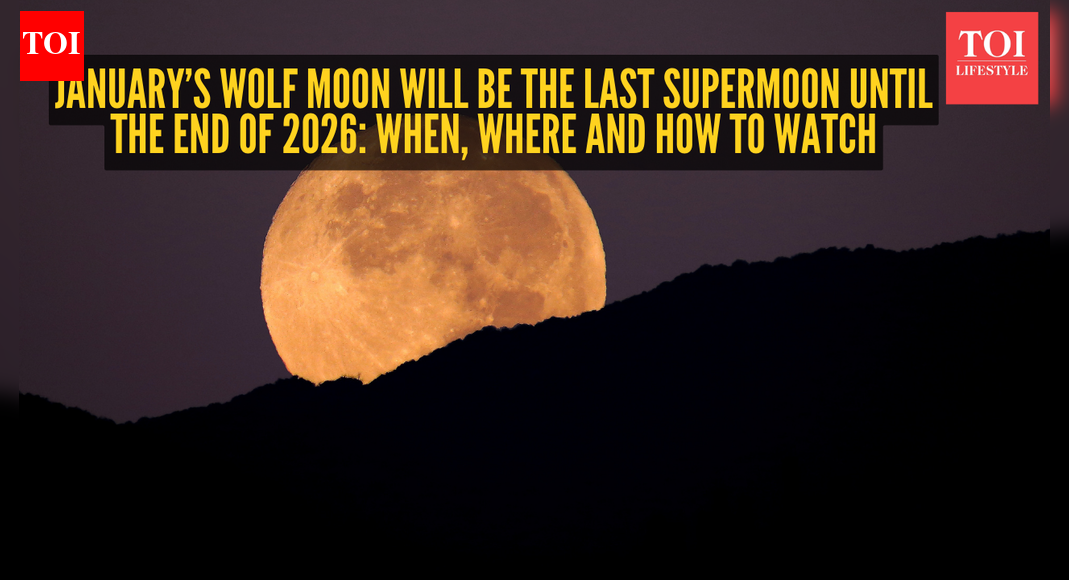
If you’ve been waiting to catch a supermoon, this is the one to circle on your calendar. The full “wolf moon” on January 3 will appear noticeably bigger and brighter than usual, and after that, there won’t be another supermoon until November 2026.A supermoon happens when a full moon lines up with its closest point to Earth, a spot astronomers call perigee. When that happens, the moon can look up to 14 percent larger and about 30 percent brighter than a micromoon, which occurs when the moon is farthest away from Earth, according to NASA.This New Year supermoon reaches peak illumination around 5 a.m. EST on January 3. But you don’t need to be awake at that exact moment to enjoy it.
There are plenty of good windows to look up.
When to watch the January 3 supermoon
If skies are clear, you can see the supermoon throughout the night from January 2 into January 3. That said, the most dramatic views usually come right around moonrise and moonset, just after sunset and just before sunrise.NASA explains that the moon often appears especially large when it’s close to the horizon, even though its actual size hasn’t changed. This visual trick is known as the moon illusion.
The color shift makes it even more striking. When the moon is high overhead, it looks bright white. Near the horizon, it often turns a deep orange. That happens because moonlight passes through more of Earth’s atmosphere when it’s low in the sky. Shorter blue wavelengths scatter, while longer red wavelengths make it through, giving the moon that warm, tangerine glow.This month’s supermoon also comes with some celestial company.
Jupiter will appear close to the moon throughout the night on January 3, and the winter constellation Orion will be visible nearby. Saturn will also be in view, glowing in the southwest sky around moonrise.
How and where to watch it
You don’t need dark, rural skies to enjoy a supermoon. Unlike meteor showers or the northern lights, it’s bright enough to see even from light-polluted cities. The key is finding a good vantage point with a clear view of the horizon.In January, the moon rises in the northeast on the evenings of January 2 and 3. It then climbs high into the sky during twilight before setting in the west around sunrise. If you’re watching late at night or in the early morning hours, keep an eye out for another sky show happening at the same time.The supermoon overlaps with the peak of the Quadrantid meteor shower, which runs from January 2 to 3. The Quadrantids are known for producing especially bright meteors, often called fireballs.
While the bright moon will wash out many fainter meteors, those fireballs can still cut through the moonlight, especially between midnight and the pre-dawn hours, according to NASA.
Looking closer — or snapping a photo
The full moon is impressive enough with the naked eye. You can use binoculars or a telescope, but astronomers recommend saving detailed lunar viewing for less bright phases, like the mid-gibbous moon, when craters and mountain ranges stand out more clearly.If you’re hoping to photograph the supermoon, timing matters. For DSLR or mirrorless cameras, a tripod and telephoto lens will help, especially during moonrise when the color is richest. Adding foreground elements, buildings, trees, hills, or even animals, can make the image feel more dramatic and give a sense of scale.Smartphone photographers can still get great shots. Use optical zoom rather than digital pinch-to-zoom, ideally around 5x, and steady your phone with a tripod if you have one.








 English (US) ·