

 1 week ago
9
1 week ago
9
ARTICLE AD BOX
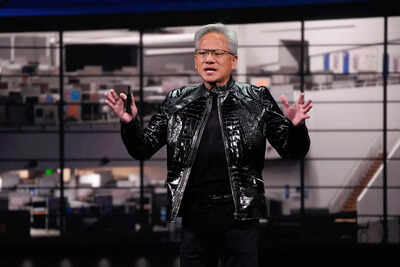
Nvidia's CEO Jensen Huang lauded Chinese AI startup DeepSeek for its role in advancing open-source AI, despite its model causing a massive market value drop. Huang highlighted DeepSeek's efficient use of older chips, proving AI breakthroughs don't solely depend on cutting-edge hardware. Nvidia, meanwhile, is pushing forward with its powerful new Vera Rubin platform, anticipating continued growth in AI infrastructure.
Nvidia CEO Jensen Huang has nothing but admiration for DeepSeek—the Chinese AI startup that wiped nearly $600 billion off his company's market value in a single day last January.Speaking at the Consumer Electronics Show in Las Vegas on January 5, Huang credited DeepSeek with "activating" a global shift toward open-source artificial intelligence, calling the company's work "really, really exciting" and saying Nvidia was "so happy with it.
"The praise comes almost a year after DeepSeek's R1 model sparked panic among investors in January 2025. The Chinese startup claimed it had developed a competitive AI model using just 2,048 of Nvidia's older H800 chips—costing under $6 million and taking only two months. By comparison, US companies were spending tens of millions on thousands of Nvidia's most advanced chips for similar results.The news triggered a bloodbath on Wall Street. Nvidia's stock crashed 17% on January 27, 2025, and the chipmaker lost roughly $593 billion—a record-breaking single-day loss for any US company.
The sell-off rippled across the tech sector, with chip stocks and AI-related companies plummeting as investors suddenly questioned whether Big Tech's massive AI spending spree made sense anymore.
Jensen Huang says DeepSeek turbocharged the open-source movement
But Huang has consistently defended DeepSeek's achievements, arguing the market got it wrong. At CES 2026, he doubled down on that position, saying DeepSeek's R1 model "caught the world by surprise" and was helping revolutionize AI development globally.
"We saw the advance of DeepSeek R1, the first open model that's a reasoning system," Huang told the audience. He emphasized that open-source models were rapidly closing the performance gap with proprietary "frontier" models from companies like OpenAI and Google.Huang highlighted that Chinese developers—working under US chip export restrictions—had proven that AI breakthroughs don't necessarily require unlimited computing resources.
DeepSeek had stockpiled H800, a rather older generation of chips, before a 2023 US export ban, showing that smart engineering could compensate for hardware limitations. In the aftermath of last January's market chaos, Huang had argued that DeepSeek's reasoning models would actually require "100 times more computing" than non-reasoning AI, suggesting increased chip demand ahead. But DeepSeek appears determined to prove otherwise.
The startup kicked off 2026 with a technical paper proposing a rethink of fundamental AI training architecture—a method called Manifold-Constrained Hyper-Connections aimed at making models even more cost-effective while keeping pace with better-funded US rivals.
Nvidia bets big on next-generation chips
Despite the DeepSeek disruption, Nvidia remains bullish about AI's future. At CES, Huang unveiled the company's next-generation Vera Rubin platform, which he said would deliver five times the computing power of previous products and is now in "full production."The new flagship servers will contain 72 graphics processing units and 36 central processing units, capable of linking into "pods" with over 1,000 Rubin chips. Huang said demand from Chinese customers for Nvidia's H200 chips remains "strong," even as the company navigates US export controls.Nvidia's stock has largely recovered from the January selloff, validating Huang's long-term view that AI infrastructure spending will continue growing regardless of efficiency breakthroughs.








 English (US) ·