

 54 minutes ago
4
54 minutes ago
4
ARTICLE AD BOX
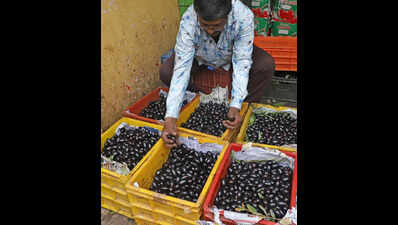
Seasonal Jamun fruit known as Indian Blackberry sold in K R Market in Bengaluru
Bengaluru: Markets across Bengaluru are once again awash in deep purple this monsoon, with jamun flooding stalls and roadside carts in a seasonal surge that has made the fruit one of the most visible — and affordable — arrivals of the season.
From KR Market and Jayanagar to Malleswaram, Shivajinagar, KR Pura and Varthur, heaps of glossy, tart-sweet berries are now dominating market corners after a sharp spike in arrivals over the past week.Unlike previous years, when traders said sourcing the fruit was relatively difficult, this season has seen a clear glut, driven by a strong harvest supported by favourable climatic conditions in rural Karnataka and steady inflows from neighbouring states. Despite nearly doubling arrivals at major wholesale hubs compared to previous years, prices have largely remained stable.Depending on size and quality, wholesalers are selling jamun at Rs 20–Rs 30 for a quarter kilogram, while retail pushcart vendors are pricing it between Rs 25 and Rs 35. “Jamun is a quick fruit with very less shelflife. It just comes like a flash and disappears just as quickly. However, this season we have been flooded with more stock than we can sell in a day! Even the people are buying less due to widespread availability,” said Sudhakar S from Shakthivel Fruit Mundy in KR Market.
In some upscale localities, jamun is still priced around Rs 150 per kg.Traders estimate that Bengaluru is currently receiving around 3–4 tonnes of jamun daily. “The last week of May marked the arrival with about a tonne and gradually peaked this week. This will continue for another week and supply will gradually recede. The day’s arrival gets exhausted by 7am with many push-cart vendors and retailers buying them in auction.
While we get a profit of 50,000 to 60,000 per day, the retail vendors make away with Rs 1,000 to Rs 2,000 per day with 25 to 30 kg of fruits,” said a wholesale trader at KR Market.Dr G Karunakaran, principal scientist at Indian Institute of Horticultural Research (IIHR), Hesaraghatta, attributed the strong yield to favourable weather conditions. “Unlike the previous seasons marked with drought and other climatic conditions, this year it was a salubrious climate which was a combination of hot and humid weather.
This not only exerted the much-required stress on the plant but also set favourable conditions for flowering and fruiting.
Also, the intensity of pre-monsoon showers was less. Hence, there has been a bountiful harvest all around especially in Tumakuru, Kolar, Chikkaballapur and parts of Andhra Pradesh. Each tree will yield about 100 to 125 kg of fruits over a period of 10 to 15 days,” the scientist explained.Hailed for its medicinal value, especially among diabetics, jamun continues to see steady demand. “With a low glycemic index of 25 to 35, it is diabetic-friendly fruit. Besides, it also has natural compounds that help regulate blood sugar and is loaded with fibre, vitamin C, antioxidants and iron,” a nutritionist said.--By Jeevitha M









 English (US) ·