

 1 hour ago
5
1 hour ago
5
ARTICLE AD BOX
For today’s school-going children, growing up alongside artificial intelligence (AI) is not a future scenario - it is everyday reality. From AI-enabled learning tools and adaptive assessments to instant access to information, the way children engage with knowledge has changed fundamentally.
What has not changed is the pressure to perform, often intensified by academic competition and increasingly crowded extracurricular pathways.As technology accelerates, educators and researchers are recognising a clear shift in what prepares children for long-term success. The advantage no longer lies in memorising information or mastering a fixed set of skills, but in the ability to adapt, reflect and improve continuously.
This makes an improvement-focused adaptive mindset one of the most critical capabilities parents and schools can nurture today.Why mindset matters more than mastery in an AI-shaped worldAI has altered the value of information. When answers are readily available, the differentiator becomes how children approach unfamiliar problems, respond to feedback and navigate uncertainty. Educational psychology suggests that learners who view intelligence as malleable are more likely to engage deeply with challenges, persist through setbacks and adjust their strategies when faced with difficulty.An improvement-focused mindset shifts attention from immediate results to long-term progress. Children learn to see effort as meaningful and mistakes as informative rather than discouraging. Adaptability builds on this foundation, enabling children to recalibrate when learning environments, expectations or tools change. Together, these traits help children remain confident even when outcomes are uncertain - a reality that defines both modern classrooms and future workplaces.Rethinking competition and performance pressureRising expectations in academics, sports and co-curricular activities have reshaped how children experience achievement. In many cases, constant comparison and outcome-driven evaluation can limit risk-taking and discourage exploration. An improvement-focused approach offers an alternate framework - one that values learning, reflection and growth over fixed benchmarks.It is becoming increasingly evident that children who receive constructive feedback and are encouraged to reflect on their learning process develop stronger emotional resilience and self-belief.
Rather than avoiding challenges, they are more likely to engage with them, even when success is not guaranteed. This ability to stay engaged through difficulty becomes increasingly important in environments where knowledge and skills evolve rapidly.Curiosity as the engine of adaptive learningCuriosity plays a central role in sustaining adaptability. Curiosity-driven exploration strengthens comprehension and long-term retention, particularly in complex or unfamiliar subjects.
Children who are encouraged to question, experiment and explore different ways of learning develop a deeper sense of ownership over their education.Flexible learning experiences - whether through discussion, hands-on projects or technology-supported exploration - allow children to understand not just what they are learning, but how they learn best. When children feel safe to experiment without fear of immediate judgement, learning becomes intrinsically motivated rather than performance-driven.
This shift is essential in preparing children to engage thoughtfully with AI tools rather than relying on them passively.Learning to adapt within diverse classrooms and communitiesModern classrooms reflect a broad spectrum of learning styles, abilities and social backgrounds. Navigating these environments requires more than academic competence - it demands empathy, communication and cognitive flexibility. An adaptive mindset helps children adjust their perspectives, collaborate effectively and respond constructively to differences.When children work together, they learn to negotiate ideas, listen actively and modify their thinking in response to others. These interactions mirror the realities of future professional environments, where collaboration across disciplines and cultures is increasingly the norm.Orchids The International School’s push for continuous improvement and adaptabilityWhile parents lay the foundation for learning attitudes at home, schools play a decisive role in shaping how those attitudes translate into everyday practice.
Educational psychology increasingly supports approaches that emphasise reflective learning, real-world application and skill development to help students navigate complex and changing environments.
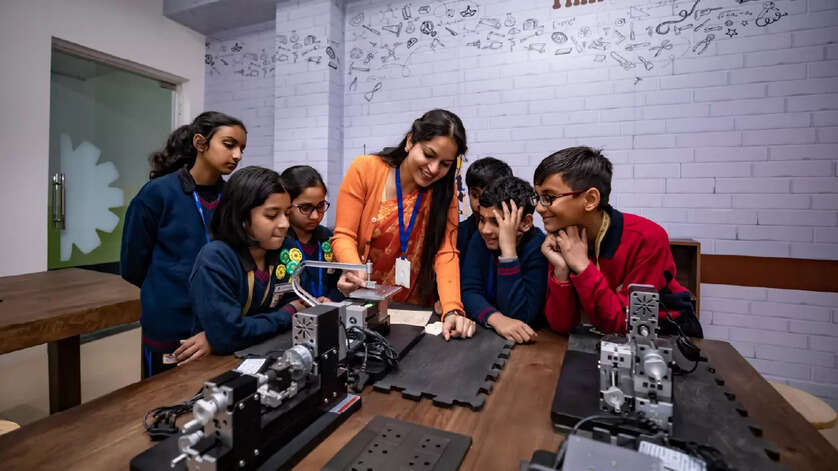
Innovation and Imagination Hubs at ORCHIDS The International School
At Orchids The International School, this philosophy is embedded into the learning experience across grade levels. Classroom practices are designed to encourage inquiry, discussion and application rather than rote memorisation. Students are guided to think through problems, test solutions and reflect on outcomes - helping them understand that learning is an evolving process. For instance, the STEM department’s ‘Tinkering Labs’ embody the school’s central tenet of experiential learning.The school places strong emphasis on problem-solving, critical thinking, and adaptability through activity-based learning and continuous assessment. By focusing on progress rather than one-time outcomes, students are encouraged to recognise effort, identify areas for improvement, and build confidence through consistent growth. This aligns closely with metacognitive learning, which shows that students who reflect on how they learn are better prepared to adapt to new academic and real-world demands.Beyond academics, Orchids integrates opportunities that support collaboration, communication and personal development. Exposure to varied learning formats and group-based activities helps students develop flexibility in thinking and behaviour - skills that are increasingly important in an AI-influenced future where change is constant.Building a mindset for an unpredictable futureThe pace of technological and societal change makes one thing clear: the future will not follow a single, predictable path.
Many of the roles children will eventually pursue are still evolving, shaped by innovations yet to emerge. In this context, the most valuable preparation parents and educators can offer is not certainty, but adaptability.An improvement-focused adaptive mindset equips children to approach uncertainty with resilience rather than anxiety. It allows them to remain curious, receptive to feedback, and confident in their ability to grow through change. In the age of AI, these human capacities will continue to define meaningful learning and long-term success.To know more about our curriculum, branches and admission process, visit Orchids The International School.Disclaimer: This article has been produced on behalf of Orchids The International School by Times Internet’s Spotlight team.








 English (US) ·