

 1 hour ago
3
1 hour ago
3
ARTICLE AD BOX
A severe water shortage and frequent power cuts have intensified hardship across Rajasthan during an extreme heat wave. The crisis has triggered protests in Jaipur, forced rural families to buy water, and led to cattle deaths in Barmer.
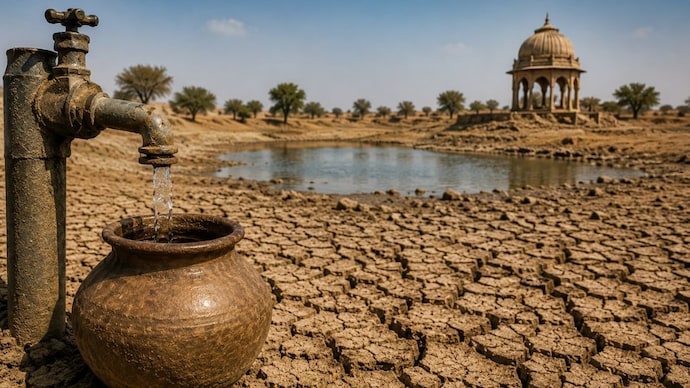
Water crisis, coupled with heatwave has made lives difficult for people in Rajasthan (AI Image)
An acute water shortage, coupled with frequent power cuts across several districts in Rajasthan, has severely compounded the woes of common people already reeling under a dry, scorching heat wave and energy-sapping high temperatures. As temperatures hover between 45 and 46 degrees Celsius this May, the water crisis has added to the misery of residents in the state capital Jaipur, as well as Bharatpur, Barmer, Jaisalmer, Churu, and other parts of the desert state.
PROTESTS ERUPT IN JAIPUR OVER CONTAMINATED WATER SUPPLY
On Monday, thousands of people took to the streets demanding a guaranteed supply of clean drinking water in Jaipur. Protesters demanded that the government ensure dirty, contaminated water is not supplied to households in areas such as Vidyadhar Nagar, Jhotwara, Jalupura, Adarsh Nagar, Haripura, and other parts of the city.
Former cabinet minister Pratap Singh Khachariyawas led a protest march from Jaipur's Civil Lines towards Jal Bhawan in the Haripura area. Hundreds of protestors laid siege to the facility, demanding immediate clean water supply.
"People in Jaipur have been drinking dirty, contaminated water. If the government does not ensure proper water supply to people in this area, we will cut the water connection of the ministers and the Chief Minister himself," Khachariyawas told India Today.
Several protesters attempted to breach the gates of Jal Bhawan but were prevented by a heavy presence of police and security personnel.
CRISIS FORCE PEOPLE IN RURAL AREAS TO BUY WATER
In the rural hinterlands of Bharatpur, the prevailing heat wave has forced women to travel long distances to fetch water in earthen and steel pots. In remote villages far from the district headquarters, residents are being forced to purchase water from private tankers, shell out up to Rupees 800 per tanker.
In Kasoda village, an overhead water tank was constructed under the Jal Jeevan Mission a year ago, but no water has ever been released.
"People are facing severe water shortages," said Raj Kumar, a native of Anirudh Nagar. "The water supply of the Public Health Engineering Department (PHED) failed to supply water in the village," Rajendra Singh, a resident of Kasoda, told India Today.
A similar crisis persists in the Deeg area, where women in rural pockets wake up early and travel about a kilometre to struggle for water from wells. In various parts of Deeg—including Bedhum, Bandha, Nogohi, Mawai, Jatoli, Kakda, and Sheeshwara—there is no proper water supply, forcing villagers to pay for private water tankers. In Mawai village, which has a population of around 4,000, there is no formal water supply, leaving women to wait in long queues at local wells.
"The water crisis in rural areas is the most concerning issue for villagers," stated farmer leader Nem Singh.
CATTLE DEATHS REPORTED IN BARMER DUE TO CANAL SHUTDOWN
Drying wells, depleting water bodies, and acute water scarcity have taken a heavy toll on both humans and animals. In Western Rajasthan's Barmer district, which recorded a maximum temperature of 48.3 degrees Celsius this season, the situation has turned critical. Daily maximum temperatures have consistently remained above 40 degrees Celsius, with rural areas experiencing even more intense heat.
In Derasar village, more than 10 cows have died over the past few days due to a lack of water amidst the scorching summer conditions. Villagers claim the cattle died solely due to acute water scarcity caused by the complete drying up of their primary water source, the Barmer Lift Canal. The carcasses lying near populated village areas have raised fears of spreading infections and diseases.
The 31 villages near Ramsar, including Derasar, rely entirely on the Barmer Lift Canal, which has been under a scheduled closure. Apart from the dry canal, the only other available water source is a local hand pump. Residents noted that water supply was briefly restored a few times during the closure period, but it failed to provide a consistent supply of drinking water.
Villager Aziz Khan stated that he had visited the Water Supply Department office in Ramsar to report the crisis, but no water tankers had arrived by Sunday. Arshad Rajad, the local Sarpanch (village head), added, "The water shortage has intensified due to the suspension of water flow in the canal".
Following the emergence of video footage showing the dead cows, the local administration finally stepped in and dispatched water tankers to supply the village.
Hazari Ram Balwa, Superintending Engineer (SE) at the PHED, stated, "Water arrangements have been made following the villagers' complaints. Approximately 31 villages near Ramsar—including Derasar—are connected to the Barmer Lift Canal. However, regular supply has not been possible for the past month due to a scheduled closure".
- Ends
Published By:
Akash Chatterjee
Published On:
May 25, 2026 19:07 IST







 English (US) ·