

 20 hours ago
6
20 hours ago
6
ARTICLE AD BOX
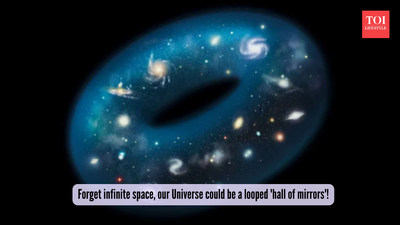
Scientists are exploring the possibility of a looped universe, where space folds back on itself like a hall of mirrors. New research suggests that certain twisted torus shapes could explain cosmic microwave background data, allowing telescopes to see the same stars multiple times from different angles.
Imagine staring into a hall of mirrors at a Sheesh Mahal, where every reflection bounces endlessly, making it hard to tell what's real and what’s just an illusion.Would you ever think that the universe is also doing the same trick, light looping back on itself so telescopes might glimpse the same stars twice, just from different angles?This is again another mind-bending idea that's got scientists on their toes. For ages, we've only imagined space as a vast, flat expanse stretching forever, but what if it's folded in clever ways we can't see yet?Our best maps of the cosmos come from the cosmic microwave background (CMB), that faint glow left over from the Big Bang.
It looks smooth and uniform, signalling toward a flat universe locally. But what’s the actual reality? Well, that's still a mystery.
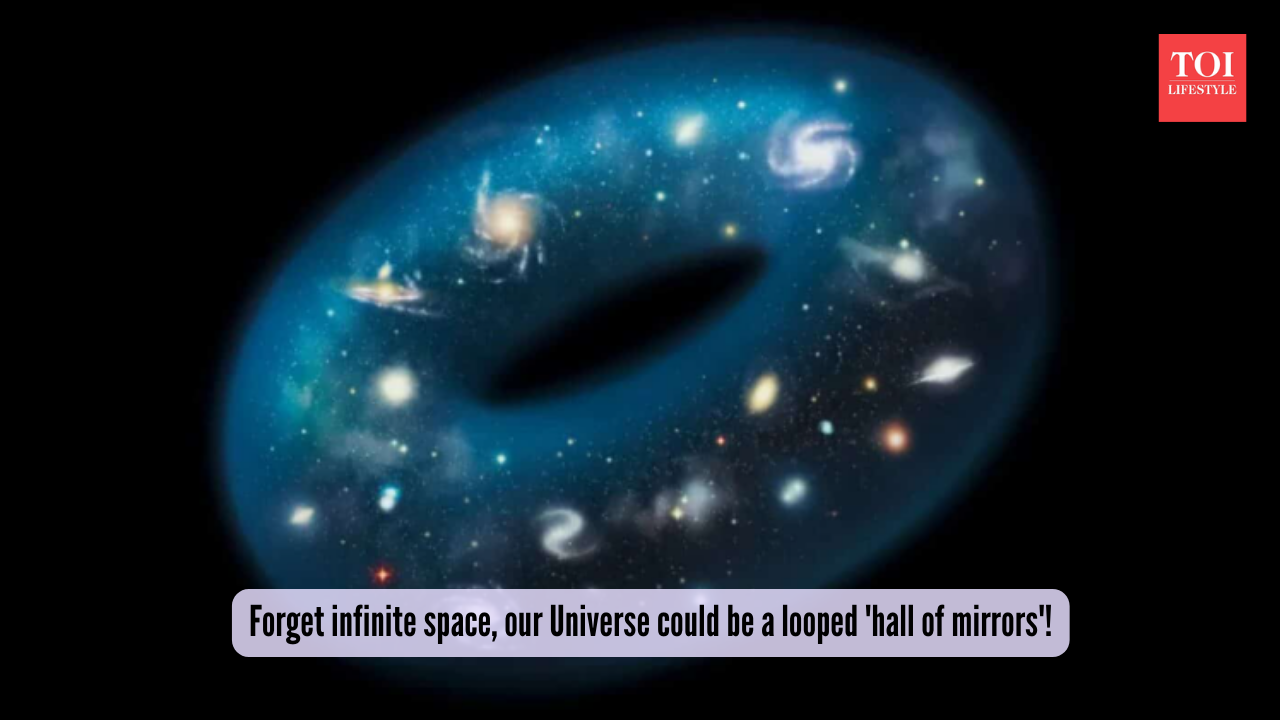
Forget infinite space, our Universe could be a looped 'hall of mirrors'! (Photo: ESO/J. Law)
Looped universe?
We've been taught that the universe is either endless or so huge its edges don't matter. But researchers from the Collaboration for Observations, Models and Predictions of Anomalies and Cosmic Topology (COMPACT) say that's too simple.According to Popular Mechanics, they zeroed in on the 3-torus, a flat but folded shape that loops space back on itself.
Their study, published in Physical Review Letters, argues that while local CMB data shows flatness, the big picture stays open. "While unambiguous indicators of topology have yet to be detected, we present evidence that prior searches for topology have far from exhausted the potentially significant possibilities," the COMPACT team states in the paper.
A hall of mirrors effect
In a twisted torus, telescopes could spot the same patch of sky multiple times, shifted around the view.
COMPACT examined three 3-torus types: E1 (standard, somewhat excludable), E2 (180-degree twist), and E3 (90-degree twist). E2 and E3 hold up against CMB data. According to a report from the American Physical Society, these could create "correlated but non-identical images" as cosmic fingerprints.
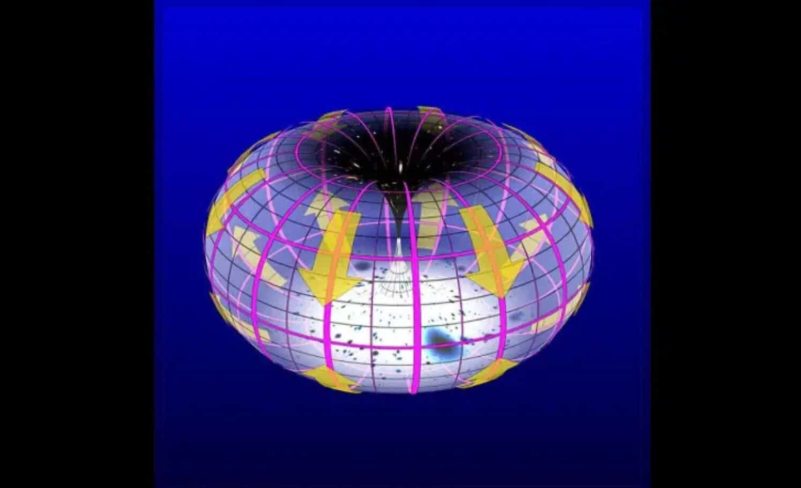
Representation of a 3-torus model of space, where our seeable Universe could b a part of a loop–Photo Bryan Brandenburg/Wikimedia Commons
Why old studies fell short
Past CMB hunts focused on simple shapes, missing twists like E2 and E3. COMPACT changes that, hunting positive signs instead of just ruling things out.
They didn't tackle all 18 possible topologies but set a smarter path forward.
What’s next for cosmology
This doesn't prove a torus universe, but it expands the playbook. Future CMB scans could snag those matching patterns, pinning down shapes. If confirmed, it’d mean our "observable" bubble is just one slice of a repeating cosmos. COMPACT's framework pushes for deeper dives, blending data with wild math. It keeps cosmology thrilling, reminding us the universe might still hide loops we can't yet spot.







 English (US) ·