

 1 week ago
12
1 week ago
12
ARTICLE AD BOX
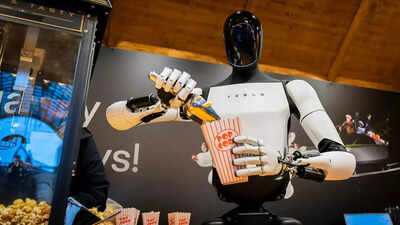
Tesla's Optimus humanoid robot may not be as advanced yet as the company’s CEO, Elon Musk, has suggested. Although Musk has assured investors that a robot could generate infinite revenue for Tesla and become its most vital product, a report shows it still has a long way to go to achieve such ambitious projections.
Last year, Musk placed major bets on Optimus, envisioning a future where these robots work in factories, handle household tasks, perform surgeries, and even help colonise Mars. He has suggested manufacturing millions of robots annually and claims they could eliminate poverty and the need for work, though each robot is currently made by hand.However, Optimus still requires significant development before it can replace humans on a widespread scale as Musk envisions, a Wall Street Journal (WSJ) report suggests.
During public appearances, the robot is often remotely controlled by human engineers rather than operating independently, the report notes. Tesla engineers have even struggled to create robot hands that match human sensitivity and dexterity, the report added.
Additionally, some employees within Musk's companies have also reportedly questioned whether the robots are actually helpful for routine business operations, such as manufacturing.
Some analysts find it hard to put a value on Tesla’s humanoid robot plans because the industry is still very new, so they leave it out of their financial forecasts, the report continues. Even ARK Invest, which is very optimistic about Tesla and expects its share price to rise sharply, did not include the Optimus robot in its 2029 estimates, as it does not expect the robot to be a successful commercial product until later.In an email sent to WSJ, Tasha Keeney, a director at ARK Invest, wrote, “We believe initial versions of the robot will likely have a limited set of performable tasks. Given Tesla’s competitive advantages in embodied AI and manufacturing scale, we expect the company to be a formidable competitor in the space.”
How Tesla's Optimus robot may still need to learn indoor movement and user safety
According to the report, Tesla is facing a major challenge in teaching Optimus to navigate indoor spaces without tripping or falling onto people or pets.
The company tried to solve this by hiring people to wear cameras and backpacks and collect training data during 24/7 shifts. Tesla even trained the robots to walk through the Tesla offices. The robots frequently toppled over to the point that the engineers had to come to pick them up.In October 2024, Musk revealed his vision at the Warner Bros. soundstage in California. Five Dancing Optimus bots performed to the song "What Is Love" by Haddaway.
Others bartended wearing cowboy hats and bow ties. But in the background, something else was brewing, the report notes.While some robots were programmed to dance, others were actually controlled by engineers wearing bodysuits and VR headsets. Each robot required several engineers: one to teleoperate its movements, one with a laptop, and others to monitor its performance, the report added.Inside Tesla's lab, Optimus showed promise with simple tasks.
In May 2025, the company released a video of Optimus putting trash in bins, vacuuming, and moving car parts. "All of the activities were 'learnt direction from human videos,'” according to the company. Despite this progress, some Tesla engineers doubted the robot's usefulness in a factory, believing most jobs are better suited to task-specific robots.Berkeley roboticist Ken Goldberg highlighted to WSJ that the core challenge is to give robots human-like dexterity and environmental understanding. "Even a child could clear a dinner table," Goldberg noted, showing how far robots must go.Some competitors argue that legs are the problem. Standard Bots CEO Evan Beard, whose company sells wheeled robots, explained to WSJ that "with a humanoid, if you cut the power, it's inherently unstable so it can fall on someone, for a factory, a warehouse or agriculture, legs are often inferior to wheels.”Tesla has abandoned its original factory deployment timeline and is working on the third generation. Still, Musk envisions Optimus as a household helper. In November 2025, Musk said, “Who wouldn't want their own personal C-3PO/R2-D2? This is why I say human. Old robots will be the biggest product ever. Because everyone is gonna want one, or more than one."






 English (US) ·