

 2 hours ago
2
2 hours ago
2
ARTICLE AD BOX
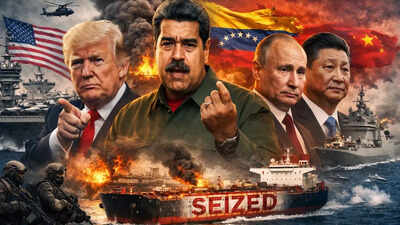
Driving the newsUS President Donald Trump has moved from sanctions to open military enforcement with his “total and complete blockade” of Venezuela. Announced on Truth Social, the policy is being enforced by 11 US Navy ships stationed around Venezuela’s coast and airstrikes on suspected smuggling vessels.Two Chinese-owned oil tankers have been seized in international waters. One was reportedly transporting 1 million barrels of Venezuelan crude. US military officials confirm dozens of other vessels are being tracked - and more strikes are likely. “They took our oil, they took our land and we want it back,” Trump wrote, referencing Venezuela’s nationalization of US oil assets in 2007. “We will finish the job.”
Maduro Defies Trump ‘Blockade’ As Another Oil Tanker Leaves Venezuela For Texas | Watch
Why it matters: Venezuela sits on the world’s largest oil reserves - and it’s collapsing fastVenezuela holds over 303 billion barrels of proven oil, the world’s largest supply.
But its economy has disintegrated under years of hyperinflation, sanctions, and corruption.
- Oil output has shrunk from 3.2 million barrels/day in 2000 to about 850,000 today.
- Most oil goes to China, bypassing US sanctions via a “shadow fleet” of rusting tankers.
- Venezuela’s state oil company, PDVSA, has less than 15 days of storage capacity before shutdowns begin.
Chevron, which operates under a narrow US waiver, accounts for about 10% of total production. But that waiver is now under review as Trump pushes for full economic isolation.Zoom out: This isn’t just about oil - it’s about the global order
- Trump’s policy shift has touched off a firestorm far beyond Latin America.
- Beijing condemned the blockade after US forces seized Centuries, a Chinese-owned tanker.
- Russia has flown surveillance planes to Venezuela and condemned what it called “naval piracy.”
- UN Security Council members have demanded an emergency session, but the US has blocked formal action.
The military picture: Operation Southern Spear
- 11 US Navy ships, including the USS Eisenhower, are patrolling the Caribbean.
- At least 3 oil tankers seized in international waters.
- Special Forces rumored to be staging from forward operating sea bases.
- Aerial drone surveillance intensified along Venezuela’s southern border.
Rumors swirl of:
- Cyber operations targeting PDVSA systems.
- Satellite disruption of Chinese oil shipping lanes.
- Plans for “surgical strikes” on Venezuela’s oil loading terminals.
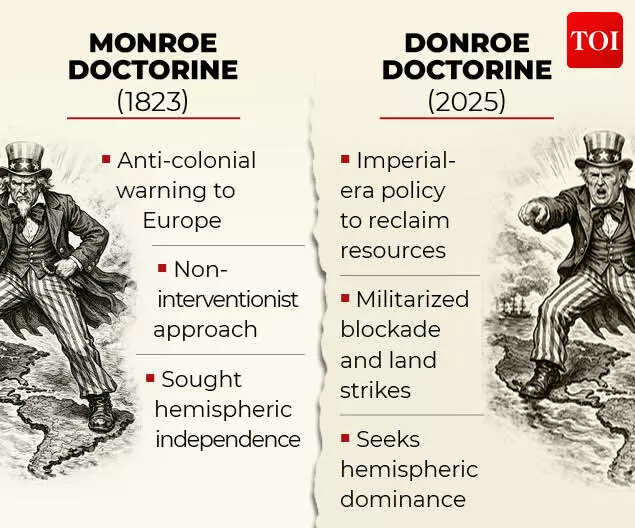
Between the lines: From Monroe to DonroeTrump’s advisors call this policy a modern corollary to the Monroe Doctrine, which warned foreign powers to stay out of Latin America.
But critics argue the Donroe Doctrine is something far more dangerous.
The Iraq playbook – reduxSome scholars and strategists say the Trump administration’s escalation in Venezuela eerily mirrors the Bush administration’s lead-up to Iraq in 2003.It did not begin with an invasion. It began with sanctions, inspections, and the steady normalization of force. Before the first US tanks rolled into Baghdad, Iraq had already spent years under embargo, its economy hollowed out, its shipping monitored, its airspace patrolled, its sovereignty treated as conditional.
What finally collapsed Saddam Hussein’s regime was not pressure alone, but the belief in Washington that pressure had run out of alternatives.
Venezuela now sits uncomfortably close to that historical line.The arc:
- Step 1: Allegations of criminal behavior - WMDs in Iraq, narco-terrorism in Venezuela.
- Step 2: Diplomatic isolation.
- Step 3: Economic strangulation and oil seizures.
- Step 4: Military encirclement.
- Step 5: Regime change, either direct or via internal coup.
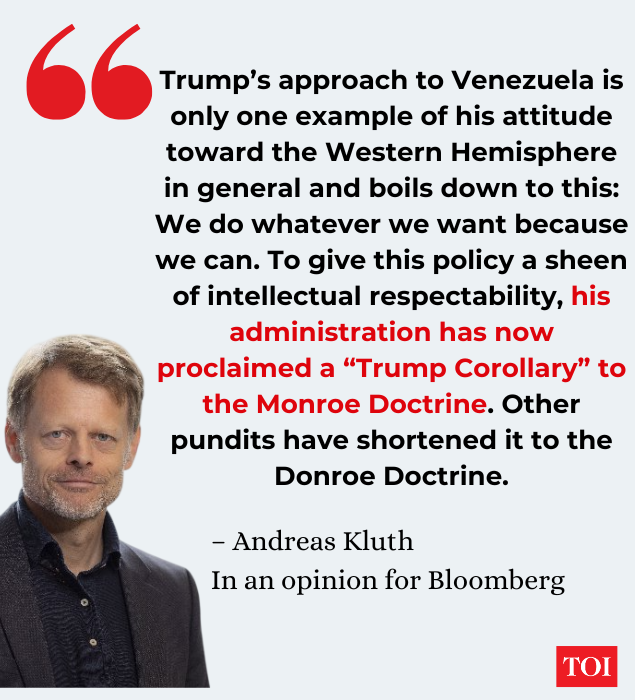
As per an article in Foreign Policy by Ellen Knickmeyer, "Venezuela would be a return to a long US tradition of regional interference. In the article, Knickmeyer quotes a research on regime change by Alexander Downes, an associate professor and political scientist at George Washington University.According to Downes’s research, about 20 of those 35 US-backed regime changes were in Central and South America or the Caribbean.“The whole problem with regime change is you tend not to think about what comes after. Like, ‘What’s the plan there?’” Downes told Knickmeyer.Caracas responds like Baghdad didVenezuela’s response has followed a familiar script. Defense minister Vladimir Padrino López said the country is fighting “lies, manipulation, interference, military threats, and psychological warfare.”President Nicolás Maduro has accused Washington of seeking to overthrow his government and seize Venezuela’s oil. On state television, he has framed the confrontation as a defense of sovereignty against imperial aggression.The case for regime change, recycledSupporters of US escalation argue that Venezuela is different. They point to its democratic opposition, the scale of corruption, and the humanitarian crisis.
They argue that pressure, backed by force, could finally fracture Maduro’s inner circle.In Iraq, the assumption was that removing Saddam would unlock stability and democracy. Instead, the collapse of the state unleashed sectarian war, empowered militias, and reshaped the region in ways Washington did not anticipate.The track record: Regime change doesn’t end wellDownes’ research shows that of the 35 US-led regime change operations since 1898, over one-third resulted in civil war within a decade.
- Iraq: 20+ years later, still dealing with insurgency and foreign interference.
- Libya: Regime collapse followed by warlordism and migration crisis.
- Afghanistan: Taliban re-took control after 20 years of US involvement.
What they're saying:Trump's chief of staff Susie Wiles told Vanity Fair: “He wants to keep blowing up boats until Maduro cries uncle.”
- Venezuelan government: “This is piracy, theft, and war under the American flag. The US wants to recolonize us.”
- Mexico’s President Claudia Sheinbaum: “Latin America must not return to the age of gunboat diplomacy.”
- Senator Tom Cotton (R-AR): “It’s time we reminded the region who protects them - and who preys on them.”
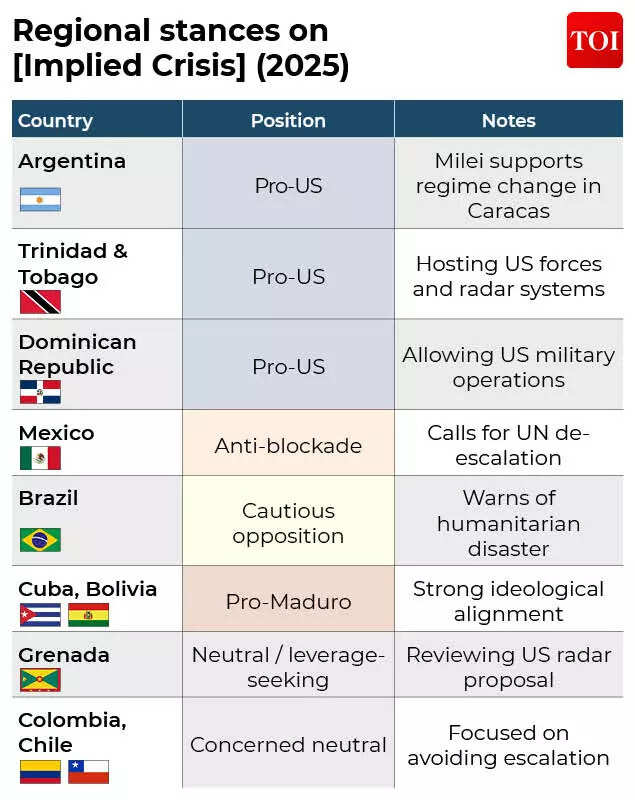
Environmental and humanitarian risksAging tankers pose a serious risk. Most Venezuelan oil ships are over 20 years old and uninsured.A spill in the Caribbean could devastate regional ecosystems and fisheries.Venezuela’s internal fuel supply is collapsing, threatening power outages, food shortages, and renewed migration.Aid organizations are also preparing for a new refugee surge - adding to the nearly 7 million Venezuelans who’ve already fled the country since 2015.Legal fog: Act of war - or policing piracy?International law experts are divided:
- Under the UN Charter, a blockade is considered an act of war unless authorized by the Security Council.
- The US has invoked anti-smuggling enforcement under expanded anti-terror laws - a legally murky stretch.
- Congress has not approved the use of force - prompting legal scholars to warn of constitutional overreach.
US Representative Joaquin Castro, a Democrat from Texas, labeled the blockade "unquestionably an act of war." "A war that Congress never approved and that the American people do not desire," Castro further stated on X.China, the quiet variableChina was not a factor in Iraq in the way it is now. Venezuela sends roughly 80 percent of its crude exports to China, accounting for about 4 percent of Beijing’s oil imports. A sustained blockade disrupts that flow.
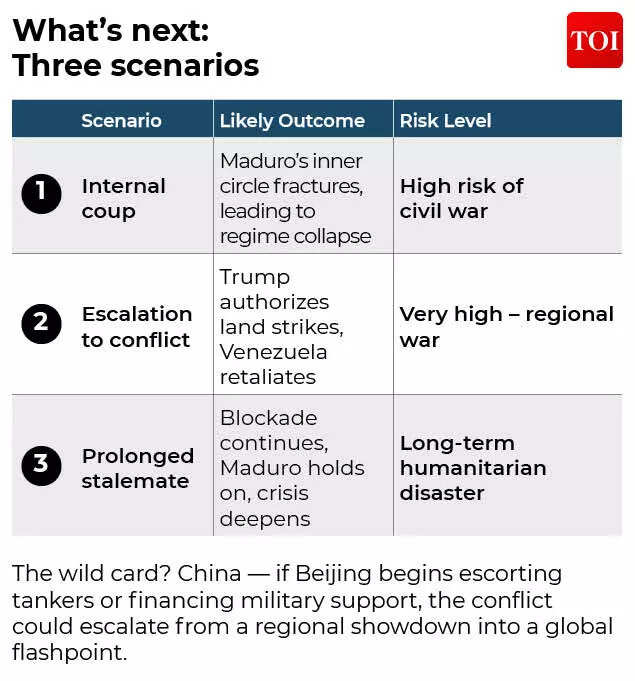
So far, China has responded diplomatically, condemning “unilateral bullying” and supporting Venezuelan sovereignty. There is no sign Beijing intends to challenge US naval power in the Caribbean.
The imbalance is obvious. But the economic fallout matters, and the precedent does too.In Iraq, sanctions fractured global consensus over time. Here, Washington risks a similar erosion, especially if interdictions extend beyond clearly sanctioned vessels.The bottom lineVenezuela is not Iraq. But the path unfolding in the Caribbean is unsettlingly familiar. Tankers are being seized. Warships are deployed. Legal lines are fading. Rhetoric is hardening.This is how Iraq started. The question is whether anyone is willing to stop before it ends the same way.






 English (US) ·