

 1 week ago
10
1 week ago
10
ARTICLE AD BOX
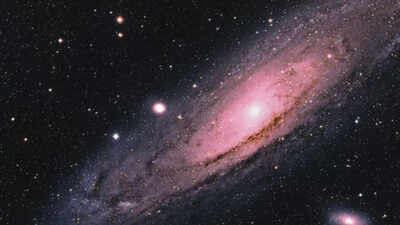
You can download them from the internet, why spend lakhs?” or “Isn’t the Hubble telescope already doing that?” — these are the reactions Satish Ponnala often gets when people come to know of his passion for photographing deep-sky objects from the comfort of his Hyderabad home.
One of the city’s seniormost astrophotographers, Satish spends his nights chasing galaxies like the Southern Pinwheel, millions of light years away, capturing them pixel by pixel.Astrophotography is cost-prohibitive, and more so if you are doing it just as a hobby. Experts say a single smart rig — the core setup of a telescope, camera, tracker, tripod and other precision components — can easily cost Rs 6-7 lakh. Venture into advanced territory, and the bill can climb past Rs 50 lakh.
Unsurprisingly, India’s astrophotography community is small: only a handful in Hyderabad, and just a few hundred across the country who regularly image deep space.‘Completely Immersed In The Process’“Astrophotography is a meditative process for me,” says Upendra Pinneli, another Hyderabadbased senior in the field, explaining the longdrawn process of setting up a rig. The preparation for an observation session, whether from the city or a remote location,begins well before nightfall.
“The heavy, expensive equipment requires delicate handling and needs hours to set up before actual observation begins. This is when I am completely immersed in the process,” says Upendra, who works as the marketing head for an EV startup.Once aligned and ready, the real test of patience begins. Imaging deep-sky objects (DSOs) can take anywhere from a few hours to more than 30, depending on how faint the object is and how much detail the astrophotographer wants to pull from the dark.Satish, who has spent 23 years in the software industry, explains: “We spend one or more nights shooting a single DSO and then days on post-production, which includes stacking multiple images of the same object, which in turn adds more hours to the process. But the rewards are wonderful. I’ve been able to photograph clusters which contain thousands of galaxies.”For some, ‘return on investment (ROI)’ is measured in improvement.
“I like refining the same picture each year,” says Tarun Pulikanti, a sales professional who began with visual astronomy. “I’ve been imaging the Orion constellation for seven years, and have improved it at least 10 times. It’s the progression that matters. It gives you a lot of ROI in terms of satisfaction.”Picking The Right NightThe practice, however, is ruled by factors beyond hardware and intent: light, weather, and the stubborn whims of the night sky.
Monsoons and summers (heat and humidity) are not the best times for imaging. Even though winters are ideal, imaging cannot be done a week before and a week after the full moon due to excess light. In the slim window that remains, the stars — no pun intended — must align. Local conditions need to be favourable, including a cloudless sky.
“At times, I’ve travelled 200km only to return without a single click,” says Upendra, a specialist in landscape astrophotography.Moreover, Hyderabad has close to Bortle 9 (the brightest class of light pollution) skies, which result in washed-out images. Bortle is a nine-level numeric scale to measure the brightness of the night sky at a particular location, with class 1 being a very dark sky.“I’m planning to buy specific filters for one of my rigs to reduce the effects of city light. That’s another Rs 1 lakh,” says Syed Vilayath Hussain, who describes himself as an amateur astrophotographer.And then there are clusters of artificial satellites — numbering hundreds — that are launched every year, which can spoil images or observations.Telescopes, Taxes & Price Of Looking UpThe cost of a smart telescope and its paraphernalia shoots up due to the steep customs duties and taxes, as most have to be imported from the US or UK, and now,increasingly from China. “I bought my first smart telescope from the US a decade ago for Rs 2 lakh. The cost keeps climbing up as you add other essential components for better viewing and images,” saysDaraesh Parvez Mistry, who is chief technology officer at a major IT firm.
The Secunderabad resident has seven telescopes for different purposes, along with other components — such as eyepieces, filters, power equipment, harmonic mounts — an investment of roughly Rs 30 lakh.Finding the right gear requires as much hunting as chasing the perfect shot. “China is now making top-tier astronomy equipment at onethird the price of Western countries,” Syed says. “I hope India starts manufacturing advanced equipment, too.”
His own collection also includes 20 binoculars.‘Wanted To Know What Was Out There’With all the challenges and expenses, astrophotographers say the rewards of imaging faraway galaxies, nebulae, and other celestial objects are immensely fulfilling. It is the feeling of connection — to distance, to time, to the unimaginable scale beyond our sky.“I wanted to know what was out there. Some people understand that feeling, many don’t. But astrophotography enriches me in a way I can’t explain to everyone,” says Satish.For Syed, the joy is also in sharing the sky. He bought a penthouse in Shaikpet to have his own open terrace and dreams of opening a small observatory for citizens.“After a public observation session at a city park last year, a couple of elated elderly visitors came up to me and said (and it still amazes me) that they never knew telescopes existed, and that one could look so far from Earth using them.”




 English (US) ·