

 59 minutes ago
5
59 minutes ago
5
ARTICLE AD BOX
The Ram temple donation theft is more than a financial scandal. It raises troubling questions about faith, accountability and whether those entrusted with sacred institutions have honoured that trust.
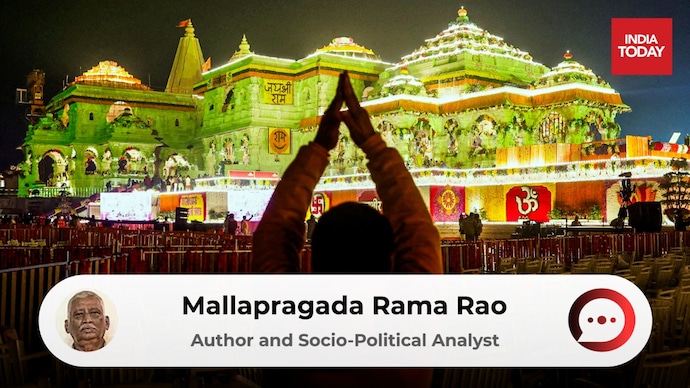
The Ayodhya Ram Temple stands as a towering symbol of faith for millions of devotees.
The scheme long associated with the "Father of the Nation"—the Mahatma Gandhi National Rural Employment Guarantee Scheme (MGNREGS)—has now been renamed the Viksit Bharat – Guarantee for Employment and Livelihood Mission (Rural).
The Seven Social Sins That Refuse to Disappear
It may seem futile today to revisit the Seven Social Sins that Mahatma Gandhi identified decades ago. Yet they remain as relevant as ever.
Politics without principle continues to dominate our public life.
There is little need to elaborate on wealth without work. India today is home to some of the world's wealthiest individuals, yet millions still depend on free food grain for survival.
Need we say anything more about pleasure without conscience? One's own conscience is the ultimate witness. Yet almost every day, newspapers and television channels report horrifying crimes in which spouses murder one another with the help of lovers, sometimes even killing innocent children who stand in their way.
Knowledge without character has existed for generations. With the explosion of media and social platforms, it appears even more pervasive today. The real tragedy is that such individuals continue to attract devoted followers. Governments, too, sometimes display extraordinary generosity by granting them parole.
Even distinguished industrialists such as NR Narayana Murthy have opined that "the person who pays a bribe should not be punished." What more needs to be said about commerce without morality?
As for science without humanity, it is increasingly evident in modern warfare. Nations deploy unmanned aerial vehicles into enemy territory, protecting their own soldiers while inflicting destruction from a distance.
A Thunderbolt
This entire discussion arises because even those of us who believed that Gandhi's seventh social sin—"Worship without Sacrifice"—had become an accepted part of our public life, were stunned by a shocking revelation on June 7, 2026.
Allegations surfaced that approximately Rs 7–7.5 crore had been siphoned off from donations offered by devotees at the Ram Mandir for the worship of Ram Lalla.
Disturbing Facts
According to the preliminary findings of the Special Investigation Team (SIT):
- Temple staff allegedly colluded to embezzle large sums of cash.
- Cash was reportedly stolen on nearly 70 occasions over 42 days while avoiding CCTV surveillance.
- Investigators recovered nearly 80 lakh during the probe.
- Gold ornaments donated by devotees were allegedly melted down and converted into gold biscuits.
- Contrary to established procedures, the keys to several donation boxes were reportedly entrusted to a junior employee who allegedly possessed a substantial share of the illicit funds.
- Even before the SIT investigation formally began, temple authorities reportedly recovered a significant amount of cash and jewellery from an employee involved in counting donations.
- Staff allegedly obstructed CCTV cameras and concealed cash inside their clothing and even in washrooms.
- Records relating to 60 kilograms of donated silver bars require verification.
- Some valuable donated items may never have entered the Trust's official accounts.
Warnings That Went Unheeded
When suspicions first arose, the temple trust and officials of the State Bank of India reportedly met during 2025 and adopted several Standard Operating Procedures (SOPs).
The safeguards reportedly included:
- A security guard must be present during donation counting.
- Staff should be searched while entering and leaving the counting area.
- The entire counting process should be video-recorded daily, with footage preserved for 180 days.
According to reports, these safeguards were not properly implemented.
Lest We Forget
The Ayodhya Ram Temple stands as a towering symbol of faith for millions of devotees. Its construction incorporates sacred stones contributed from across the country and represents the sacrifices of countless kar sevaks.
What devotees place into the donation box is not merely cash or jewellery—it is an expression of faith. If that faith cannot be protected, what is lost is not merely the trust's wealth but the moral capital of society itself.
So Far, So Good
Eight accused persons have been arrested. As the investigation widened, the trust's General Secretary and one trustee have resigned.
Orders have also been issued for a comprehensive re-audit of the Trust's accounts covering the past five years.
The final truth will emerge only through due legal process. Nevertheless, the very fact that doubts have arisen regarding an institution entrusted with safeguarding the faith of millions is deeply distressing.
Our Priorities Must Change
The attention we devote to debates over what people should wear, what they should eat, what prayers schools should sing, who should be allowed to run shops near temples, or which foods should or should not be sold on particular days would be far better directed towards ensuring the honest and efficient administration of places of worship.
Putting the Cart Before the Horse
In the title Dharmakarta (Trustee), Dharma comes before Karta. Those who place office before duty are unworthy of that sacred responsibility.
Only those who regard their office as service to Dharma deserve to hold it. Persons of impeccable integrity alone should serve on the governing boards of places of worship—whatever their nomenclature and irrespective of faith.
Such positions should never be bestowed for political patronage or other extraneous considerations.
Faith Is the Foundation
The walls of places of worship are built of stone; their sanctity is built upon the faith of devotees.
Stone walls can always be rebuilt if they collapse. But once faith is shattered, restoring it is infinitely more difficult.
That is why Mahatma Gandhi regarded "Worship without Sacrifice" as one of society's gravest sins.
Dharma has a dual role
:
"Dharma destroys those who destroy it. Dharma protects those who protect it.
Therefore, never abandon or violate Dharma, lest Dharma itself become the cause of your downfall."
Let us hope that, in the years ahead, only persons of unquestionable integrity are entrusted with the management of places of worship of every faith, and that these sacred responsibilities are never again distributed as political rewards or for any other extraneous consideration.
(Views expressed in this opinion piece are those of the author)
- Ends
Published By:
Koustav Das
Published On:
Jul 8, 2026 12:40 IST







 English (US) ·