

 52 minutes ago
2
52 minutes ago
2
ARTICLE AD BOX
Western Railway demolished hundreds of houses and shops in Bandra's Garib Nagar after a court-backed clearance drive. A section of people backed the drive as long-overdue for safety and growing infrastructure needs. Others have criticised the timing as the displaced families will have no roof over their head during the monsoon.
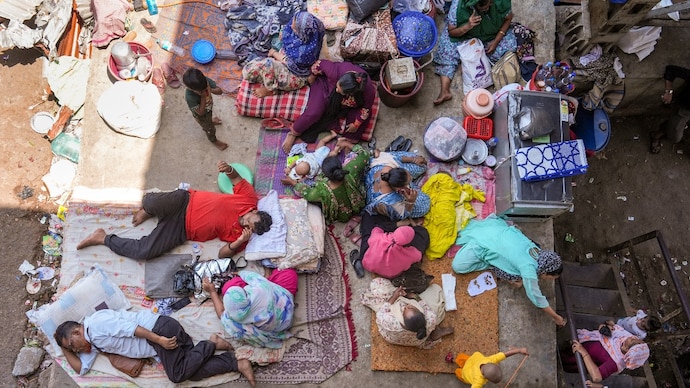
People take rest amidst their belongings on the third day of an anti-encroachment drive at Gareeb Nagar slum area, in Mumbai. (Image: PTI)
New Delhi,UPDATED: May 22, 2026 08:00 IST
"I have never liked the sight of slums right outside Bandra station. Nobody does. The area was filthy, crime was rampant, and it was common to see drug addicts on the foot overbridges despite the presence of the Government Railway Police (GRP). But watching school-going girls in their uniforms sitting on the road, barely metres away from the homes they grew up in, holding on to just a bag of belongings they could save, is a heartbreaking sight," said Devesh Kamble, a software engineer who commutes daily from Bandra East to Kalanagar.
As he shared this experience with India Today Digital, bulldozers reduced homes to rubble in Mumbai's Garib Nagar slum outside Bandra station's eastern side.
The ongoing demolition drive by Western Railway in Bandra East has cleared over 400 unauthorised structures, including homes and shops, on railway land hugging the tracks.
The Bombay High Court backed the action to reclaim about 5,200-5,300 square metres for railway expansion, including new lines, better connectivity between Bandra Terminus and suburban stations, and support for projects like improved access to the Bandra Kurla Complex (BKC).
The land, long encroached upon, holds an estimated value of around Rs 600 crores.
Though the anti-encroachment drive and cleanup were long overdue, the reality has two sides to it.
SLUM DWELLERS LEFT WITHOUT A ROOF JUST AHEAD OF MONSOONS
Garib Nagar, one of Mumbai's older and denser slum pockets, featured multi-storey structures. Many of them were two or three storeys high, built directly beside railway tracks. Residents and commuters have long described these areas as among the filthiest and dingiest in the city, with poor sanitation, waste dumping, safety hazards, and high crime.
For decades, they blocked infrastructure upgrades and posed risks to train operations.
Yet these slums housed thousands who form the backbone of Mumbai's workforce — daily wagers, service staff, and essential workers keeping the city running. Many had lived here for 40 years or more.
"This slum, inhabited nearly two hundred years ago, now lies abandoned. Residents, along with their wives and children, sat in an open field, carrying household items, watching their homes collapse," social activist and journalist Siraj Noorani said in a post on X.
Families pleaded with officials amid the rubble to not demolish the house, or at least let them take their household items out, only for the bulldozers to silence their pleadings. One viral video showed an elderly woman distressed over the rubble, saying she could not even retrieve a religious scripture from her house.
Officials arrived at the site in Garib Nagar on Tuesday (May 19) with heavy earthmovers and bulldozers, police, and RPF personnel, giving little time for residents to salvage belongings. Over 60% of the demolitions happened in a matter of just 48 hours.
With thousands displaced right ahead of monsoon, the footage of belongings piled on roads is going viral now.
The timing of Western Railway carrying out the eviction has sparked criticism. The southwest monsoon is expected to hit the Kerala coast around May 26 — nearly a week early — and reach Mumbai by early June. With rains just weeks away, displaced families are left without any shelter.
Even as NGO workers distributed food and aid to those who lost even basic items like gas stoves, many questioned why squatters were being given food.
"Illegal or legal, people are still people! Everyone's just trying to survive... You can care about laws and still have humanity. Those two things are not mutually exclusive!" a person said on X, denouncing the apathy that many people showed on social media.
Many have questioned the suddenness of the demolition drive, and lack of broader support, especially as Eid approached for some families. The locality had a large population of Muslims.
THE ACTION WAS MUCH NEEDED FOR SAFETY AND DEVELOPMENT
The eviction drive, however, was essential and fully legal. The land always belonged to the Railways, and encroachments grew over decades despite notices.
"The Bandra East demolition drive is decades overdue. These slums weren't just simple huts; some were... concrete fire hazards built directly adjacent to active railway tracks," a person posted on X.
Authorities and observers pointed to anti-social elements living in the slums after stone-pelting happened during the drive, which led to an FIR naming at least 10 people.
PEOPLE RECALL HOW SUNIL DUTT SAVED THE SLUMS
There has been a lot of chatter about the residents being "political vote banks" as well. Many residents in videos identified as Congress supporters, recalling how late MP Sunil Dutt once lay before a bulldozer to stop past demolition attempts. Some women, visibly distressed, claimed the BJP government was targeting the "gareeb" instead of "gareebi".
Notably, Sunil Dutt served as an MP from the Mumbai North West constituency for five terms (elected in 1984, 1989, 1991, 1999, and 2004), spanning roughly 1984 to 2005, as a Congress leader. Garib Nagar is in the Bandra East Assembly segment, which is part of Mumbai North West Lok Sabha constituency.
Commuters, who saw the slum stretch daily, welcomed the change. One of them said in a post on Reddit, "At one point, BEST buses ceased to travel all the way till the flyover bridge because of these encroachers. I remember how I used to feel unsafe..."
Another Reddit user noted, "Non-Mumbaikers have no idea, how big is this thing, the demolition that we all needed and wanted. This encroachment was like a rot increasing over the years... finally the court has given the permission."
RAILWAYS HAS PLAN IN PLACE TO PREVENT BANDRA RE-ENCROACHMENT
Western Railway plans to fence the cleared area to prevent re-encroachment. Eligible families (around 100 from 2021 surveys) will receive rehabilitation.
The project promises 50 more trains, less congestion on suburban lines, and safer operations — critical for a city where locals carry millions daily.
The Garib Nagar drive shows Mumbai's core dilemma of clearing illegal settlements for crucial infrastructure, while also supporting the workers who keep the city running. Slums offer cheap housing close to jobs, but unchecked growth also creates safety risks and hinders development.
Clearing decades-old encroachments is progress for commuters and safety, but the human cost is visible in children on pavements and the elderly in distress. The coming weeks of rain will test whether the balance struck here holds.
- Ends
Published By:
Anand Singh
Published On:
May 22, 2026 08:00 IST








 English (US) ·