

 1 hour ago
2
1 hour ago
2
ARTICLE AD BOX

In today's fast-paced world, many individuals in their late 50s report experiencing forgetfulness sooner than expected. Experts note that while it's common to misplace items or have occasional memory slips, frequent signs like asking the same question multiple times or feeling disoriented in familiar environments could indicate early dementia. Contributing factors include an increasing lifespan and lifestyle choices.
A missed name at a party or a misplaced phone does not usually signal danger. Age slows recall, and the brain needs a moment to catch up. But families notice a shift before a diagnosis ever arrives.
Conversations repeat. Familiar routes feel confusing. A person who once managed everything begins to hesitate over simple decisions.This is where the question becomes real: is it normal ageing, or something more?As Jwala Narayanan, Consultant Neuropsychologist explains, “Occasional lapses in memory are usually not a cause for concern — especially when the information can be recalled later or with a reminder.
But when there is no recollection even after prompting, or when individuals begin to repeat the same questions or conversations frequently, it may signal something more serious.”
Why are people becoming forgetful earlier?
Forgetfulness is no longer limited to those in their late 70s or 80s. Many begin noticing changes in their late 50s or early 60s.Several factors are converging:
- Longer lifespans: India’s life expectancy has increased, so more people live long enough to experience cognitive decline.
- Urban stress and sleep debt: Chronic stress raises cortisol levels, which affects memory circuits. Poor sleep disrupts brain repair.
- Digital overload: Constant notifications reduce deep focus. Over time, this weakens memory formation.
- Lifestyle diseases: Conditions like diabetes, hypertension, and obesity damage blood vessels, including those in the brain.
Data from NIH highlights that neurological disorders, including dementia, are rising steadily in India.
Similarly, the World Health Organization estimates that over 55 million people worldwide live with dementia, and cases are increasing rapidly.
Where is the line between normal and concerning?
Not every lapse is a warning sign. The difference lies in pattern and impact.Normal ageing looks like:
- Forgetting a word but recalling it later
- Missing an appointment but remembering with a reminder
- Occasionally losing items

Rising stress, lifestyle diseases, and longer lifespans are increasing the burden in India.
Concerning signs look like:
- Forgetting recently learned information completely
- Asking the same question multiple times
- Getting lost in familiar places
- Difficulty following conversations
Doctors also point out that memory is just one piece of the puzzle. Language struggles, personality changes, and confusion with time or place often appear alongside.
What actually causes dementia?
Dementia is not a single disease. It is a group of conditions that damage brain cells.The most common causes include:
- Alzheimer’s disease: Protein build-up disrupts communication between brain cells
- Vascular dementia: Reduced blood flow damages brain tissue
- Mixed dementia: A combination of both
But there is a critical detail often missed: some conditions mimic dementia.These include:
- Vitamin B12 deficiency
- Thyroid disorders
- Depression
- Certain infections
This is why early screening matters. In some cases, symptoms can improve completely once the root cause is treated.
How does it change everyday life?
Memory loss is not just about forgetting facts. It reshapes daily living.A person may:
- Struggle to manage finances
- Forget to take medicines
- Withdraw from social situations
- Feel anxious or frustrated
Families notice emotional changes first. Irritability, suspicion, or sudden mood swings can appear before severe memory issues There is also a silent impact: loss of independence.
Tasks that once took minutes may begin to feel overwhelming.
What actually protects the brain after 60?
There is no single “brain pill.” Protection comes from small, steady habits.Doctors emphasise a combined approach:Move dailyEven 30 minutes of walking improves blood flow to the brain.Eat for the brainInclude nuts, seeds, fruits, vegetables, and healthy fats. Cut down on ultra-processed foods.Sleep deeplyThe brain clears toxins during sleep. Less than 6 hours regularly can increase risk.Stay mentally activeReading, puzzles, or learning something new keeps neural pathways active.Stay socially connectedLoneliness is now considered a major risk factor for cognitive decline.Manage chronic illnessControl blood sugar, blood pressure, and cholesterol.These are not quick fixes. They build what doctors call “cognitive reserve,” the brain’s ability to adapt and resist damage.
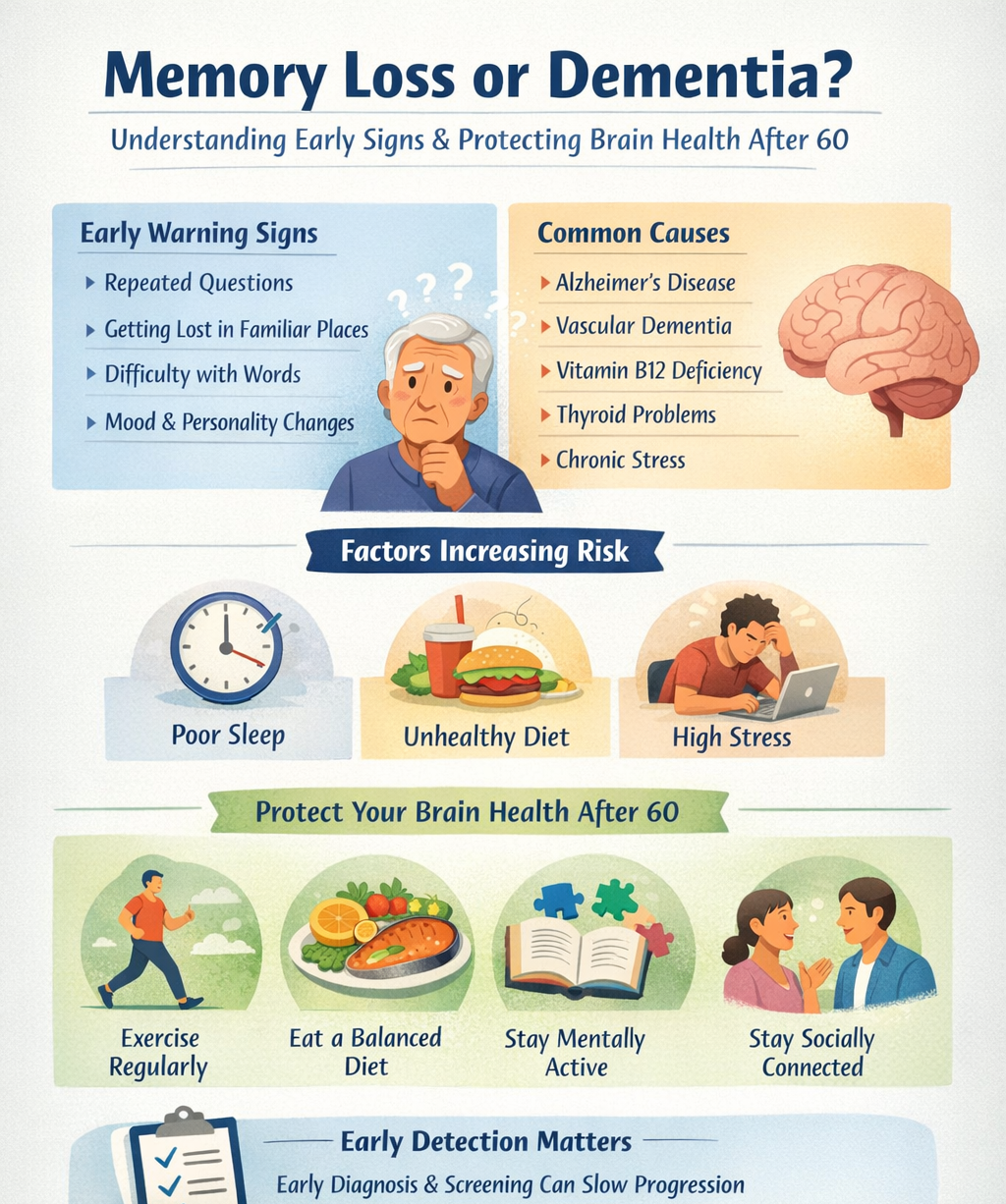
The good news is that early screening, healthy habits, and timely care can delay progression and improve quality of life.
Why early screening changes everything
Many families delay seeking help. They assume it is “just ageing."
But timing matters.Early diagnosis helps to:
- Slow disease progression
- Treat reversible conditions
- Plan care and support systems
Government-backed awareness initiatives and research from bodies like NIH stress the importance of community-level screening, especially for those above 60.Medical experts consultedThis article includes expert inputs shared with TOI Health by:Jwala Narayanan, Consultant Neuropsychologist, Manipal Hospital and AMGH Hospital, and Clinical Advisor, Ivory.Inouts were used to clarify the difference between normal forgetfulness and early dementia, highlight key warning signs and underlying causes, and emphasise the importance of timely medical consultation and lifestyle changes to protect brain health after 60.Forgetfulness can be a normal part of ageing, but persistent memory loss, repeated conversations, and behavioural changes may point to early dementia. Rising stress, lifestyle diseases, and longer lifespans are increasing the burden in India. The good news is that early screening, healthy habits, and timely care can delay progression and improve quality of life.









 English (US) ·